U.S. Politics · California · Criminal Justice
Newsom Moves to Commute All 548 California Death Sentences
The governor’s proposed universal clemency would replace every California death sentence with life imprisonment without parole. No one would be released, and the state Supreme Court must first authorize Newsom to act in 382 cases.
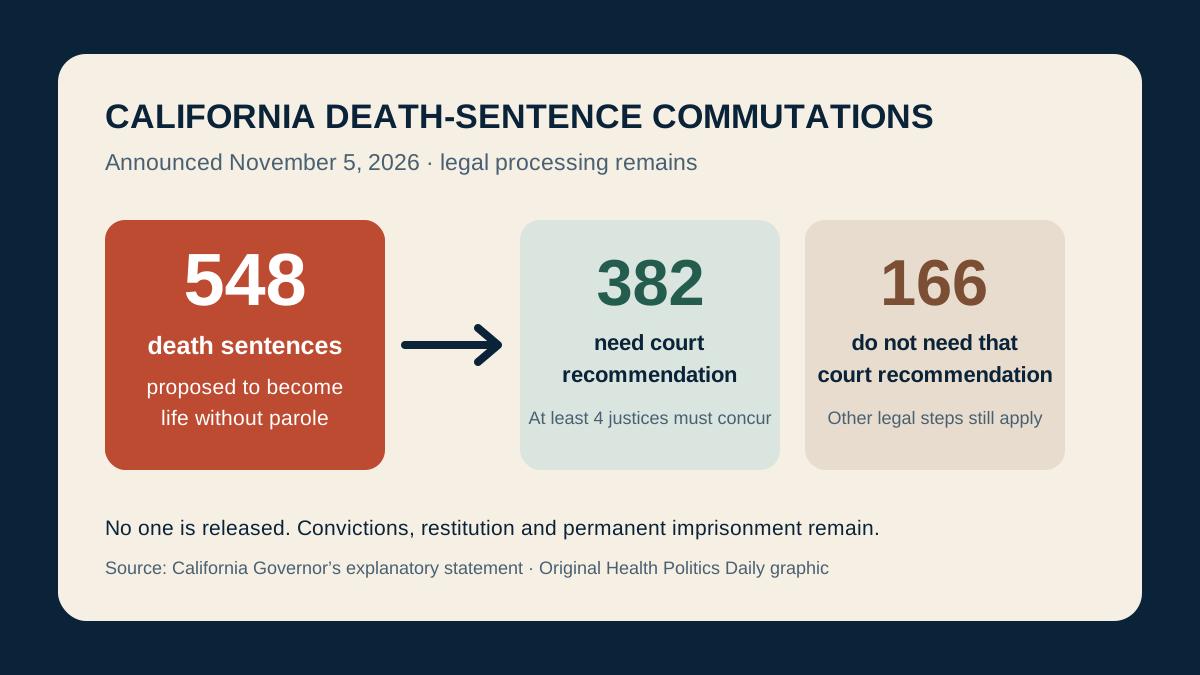
Verified baseline: a decision announced, with legal steps remaining
California Gov. Gavin Newsom announced November 5 that he had decided to commute all 548 death sentences in the state to life imprisonment without the possibility of parole. The governor’s official clemency page says the commutations will not take effect until the necessary legal steps are complete.
The clemency would change only the death sentence. According to the governor’s explanatory statement, every affected person would remain incarcerated and permanently ineligible for parole. Underlying convictions, other sentence terms and restitution orders would remain in place.
Why 382 cases need the California Supreme Court
Article V, section 8 of California’s Constitution requires a recommendation from the state Supreme Court before a governor may pardon or commute the sentence of someone convicted of more than one felony. At least four of the court’s seven justices must concur. The governor identified 382 people—about 70% of the total—as needing that recommendation.
Newsom has asked the court to review those cases before his term ends in January. The court describes its role as checking whether clemency would be an abuse of the governor’s power, not deciding whether it agrees with the policy. The remaining 166 cases do not require that constitutional recommendation, but the official page says their commutations also await completion of necessary processing.
This is why it is more accurate to say Newsom has moved to commute the sentences than to say every sentence has already changed.
What changes—and what does not
- Execution eligibility: once effective, a commuted sentence could not be carried out as an execution by a future governor.
- Custody: recipients remain in prison for life without parole; this action creates no release date or parole hearing.
- Convictions: guilty verdicts are not vacated, pardoned or relitigated by the commutation.
- Victims and restitution: restitution orders remain. California’s Office of Victim and Survivor Rights and Services is notifying registered victims and families and offers case updates and support.
- California law: the death penalty remains on the books. Newsom’s action changes existing sentences; it does not repeal the statute or prevent future death sentences.
Why the decision is nationally consequential
California has the largest death-row population in the Western Hemisphere but has not carried out an execution since 2006. Newsom imposed a moratorium in 2019, withdrew the state’s lethal-injection protocol and closed San Quentin’s execution chamber. Those actions paused executions; the new commutations would permanently replace the covered death sentences.
The Death Penalty Information Center told the Associated Press that, if completed, the action would be the largest mass clemency in U.S. history and would reduce the national death-row population by nearly 30%. Other governors have commuted all death sentences in their states, but on a much smaller scale.
California voters rejected death-penalty repeal in 2012 and again in 2016. The clemency therefore puts constitutional executive authority in direct tension with relatively recent voter decisions, even though clemency and repeal are legally different acts.
People at the center
Newsom said he understood that the announcement could reopen painful memories for victims’ families. Some survivors and prosecutors condemned the decision as overriding juries and denying accountability; others, including the sister of a murder victim quoted by the Associated Press, said executions do not provide the healing survivors are promised.
People-first reporting can hold both facts at once: the crimes and losses remain grave, and the state still has a duty to describe precisely what punishment, process and legal authority are changing. This article does not evaluate any person’s guilt or provide legal advice.
Fact, analysis, forecast and opinion
Verified fact: Newsom decided to commute 548 death sentences to life without parole; 382 require a court recommendation, and no recipient would be released. Analysis: the action converts a temporary moratorium into permanent protection from execution for each completed commutation while leaving capital punishment legally available in California. Forecast: the Supreme Court’s timing and response in the 382 cases are unknown. Opinion: Health Politics Daily takes no position on capital punishment or on the governor’s use of clemency.
What remains uncertain
The state Supreme Court has not announced how it will organize or time review of the 382 requests. The governor seeks a recommendation before leaving office, but the Constitution does not guarantee that schedule. It also remains unclear exactly when the 166 commutations not requiring court recommendations will be finalized.
Future litigation could test aspects of the process. Nothing in the announcement itself resolves broader challenges to California’s death-penalty statute or predicts whether prosecutors will seek new death sentences.
Bias Lens: historic clemency or disregard for victims and voters?
Verified baseline: the proposal changes death sentences to life without parole, releases no one and preserves convictions and restitution. Court recommendations are required in 382 cases before Newsom may complete those commutations.
Left-leaning — The Guardian: emphasizes protection from future executions, prolonged delays in death-row representation and the failed Tennessee execution. Center — Associated Press: foregrounds the unprecedented scale, court-approval requirement and sharply divided reactions from survivors and prosecutors. Right-leaning — Fox News: describes Newsom as “wiping out” death row and centers criticism that the action betrays victims and voter decisions.
Those frames direct attention toward state violence and due process, institutional mechanics, or accountability and democratic consent. The controlling baseline is narrower: the governor is using clemency to substitute life without parole, not erasing convictions or releasing prisoners.
Principal sources
- California Governor — clemency decision, process and victim resources
- Governor’s explanatory statement — scope, legal authority and court request
- Governor’s open letter — stated rationale
- Associated Press — national scale and responses
- CalMatters — California legal and corrections context
No suitable directly relevant official or publisher-authorized video with clear persistent embedding permission was available, so none was embedded.
No comments yet.