International Politics · Paraguay · Banking
Paraguay’s Peña Remains President as Impeachment Advances
Santiago Peña offered to resign after Ueno Bank’s collapse froze millions of customers’ access to money. Congress did not accept the resignation, leaving him in office while a Senate impeachment process moves forward.
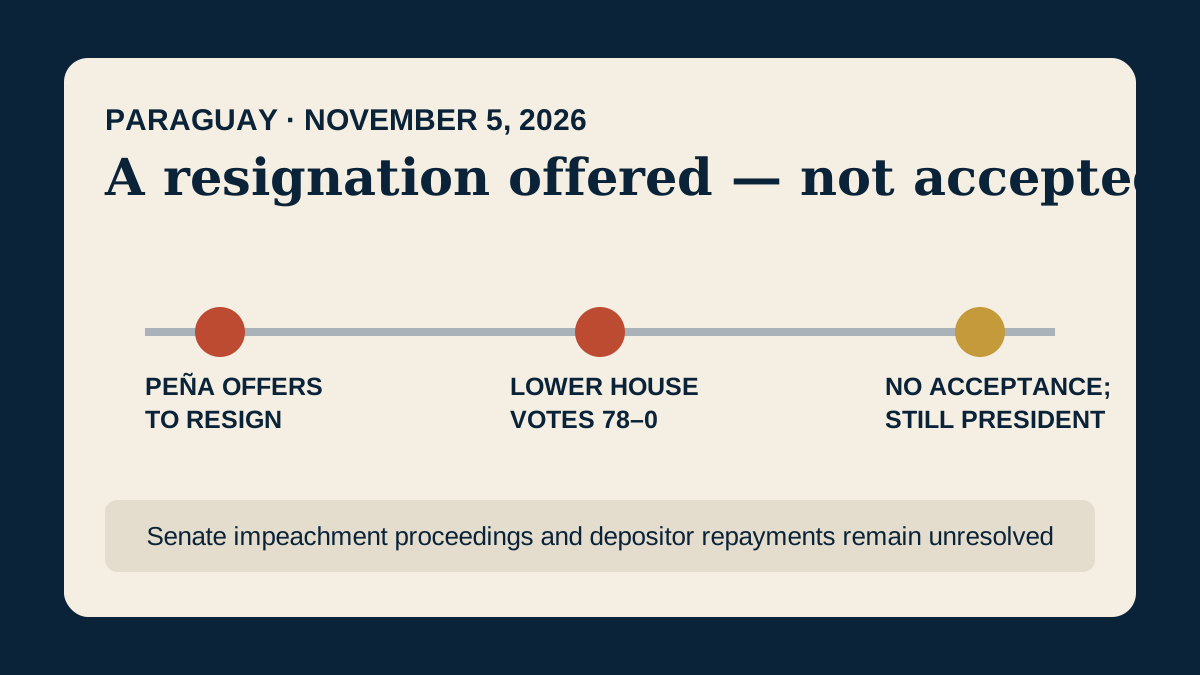
Verified baseline: Peña has not left office
Paraguayan President Santiago Peña announced Thursday that he was submitting his resignation, saying he wanted to protect institutional stability during a banking crisis. The resignation did not take effect on announcement. Article 202 of Paraguay’s Constitution gives Congress the power to accept or reject a president’s resignation.
A joint congressional session convened to consider the letter but ended without approving it after lawmakers lost a quorum. The Chamber of Deputies separately voted 78–0 to approve articles of impeachment against Peña. The Senate must conduct the next stage. Until Congress accepts the resignation or the Senate removes him, Peña remains president.
The lower house rejected a separate impeachment request against Vice President Pedro Alliana by 48–30. Alliana therefore remains next in the constitutional line of succession, but he has not become president.
How a bank failure became a leadership crisis
The Central Bank of Paraguay placed Ueno Bank into resolution after adjustments to its financial statements left its solvency ratio below half the required minimum. The bank had about three million customers—roughly 60% of Paraguay’s adult population—and held an estimated $800 million to $850 million in public money, according to Associated Press and Reuters reporting.
Peña was a shareholder in Grupo Vázquez, the conglomerate associated with Ueno, until March 2025. Critics allege conflicts of interest and inadequate oversight. Peña and the bank have denied wrongdoing. A past business relationship and political responsibility questions do not by themselves establish criminal liability.
The central bank says Ueno’s failure is an isolated case rather than evidence of a system-wide banking collapse. Prosecutors and regulators are investigating conduct at the bank, and court proceedings—not political allegations—will determine individual criminal responsibility.
What depositors need to know
The central bank has begun paying a first group of depositors with total deposits of up to 10 million guaraníes who have no debt to Ueno and hold an account at another Paraguayan institution. Its November 5 notice says eligible people in that group will receive their full deposit balance.
The statutory guarantee covers up to 75 monthly minimum wages per depositor per institution—currently 228.3 million guaraníes, about $38,000. The regulator estimates the guarantee fully covers most individual depositors, but repayment timing and recoveries above the insured limit remain uncertain. Customers should use only the central bank’s official payment portal and communications; a crisis involving account access creates opportunities for phishing and impersonation.
Public deposits and pension-related funds raise a separate question. Officials say current pension payments can continue, but the final recovery of public money held at Ueno depends on the resolution process, asset values and litigation.
Why resignation and impeachment are not interchangeable
Resignation would normally produce a constitutional succession once Congress accepts it. Impeachment is an adjudicative political process: the lower house accuses, and the Senate considers whether to remove the officeholder. The distinction may also affect Peña’s future legal and political status, which is one reason lawmakers disagreed over whether to accept his resignation.
Verified fact: Peña offered to resign, Congress did not accept the offer, the lower house approved impeachment articles and he remains president. Analysis: lawmakers’ choice between resignation and impeachment affects both succession timing and accountability. Forecast: the Senate’s schedule, vote and final outcome are unknown. Opinion: Health Politics Daily takes no position on whether Peña should resign or be removed.
What remains uncertain
It is not yet clear when the Senate will hold a trial, whether Peña will again seek an accepted resignation, or whether the votes exist to remove him. The full financial shortfall at Ueno, recoverable asset value, criminal responsibility and ultimate recovery of uninsured and public funds also remain unresolved.
The situation has moved quickly enough that headlines describing Peña simply as having “resigned” can mislead. He submitted a resignation letter, but the constitutional act needed to end his presidency did not occur.
Bias Lens: resignation headline or unresolved constitutional process?
Verified baseline: Peña announced and submitted a resignation, but Congress did not accept it; the lower house approved impeachment articles and he remains president pending further action.
The left-leaning Guardian foregrounded frozen household savings, public deposits and the political collapse behind Peña’s announcement, while noting that Congress still had to act. Centrist Associated Press updated around the constitutional status, emphasizing that Peña remained in office and faced a Senate trial. Right-leaning German newspaper Die Welt highlighted Congress’s refusal to accept the resignation and the possible consequences for Peña’s future legal protections.
These frames emphasize household harm, procedural status or legal consequences. The most reliable wording separates Peña’s political announcement from the uncompleted constitutional act: he offered to resign but had not left office at publication.
Principal sources
- Paraguay Chamber of Deputies — impeachment vote and vice-presidential vote
- Central Bank of Paraguay — Ueno resolution and deposit guarantee
- Central Bank of Paraguay — first depositor-payment group
- Associated Press — current constitutional status and banking investigation
- Reuters — Ueno’s growth, ownership ties and public-funds context
No suitable directly relevant official or publisher-authorized video with clear persistent embedding permission was available, so none was embedded.
No comments yet.