International Politics · South Africa · Elections
ANC Holds Narrow Lead in Early South Africa Municipal Count
The governing party is narrowly ahead of the Democratic Alliance in provisional results, but incomplete urban returns mean neither national shares nor local governing coalitions are settled.
By Health Politics Daily News Desk · November 5, 2026 at 3:57 a.m. ET

Watch in this article
Pumpjack operating at the Kern River Oil Field
A short CC0 field video provides visual context for reporting on oil production and fuel supply.
Thomas Farley / Wikimedia Commons · CC0 1.0 · License and source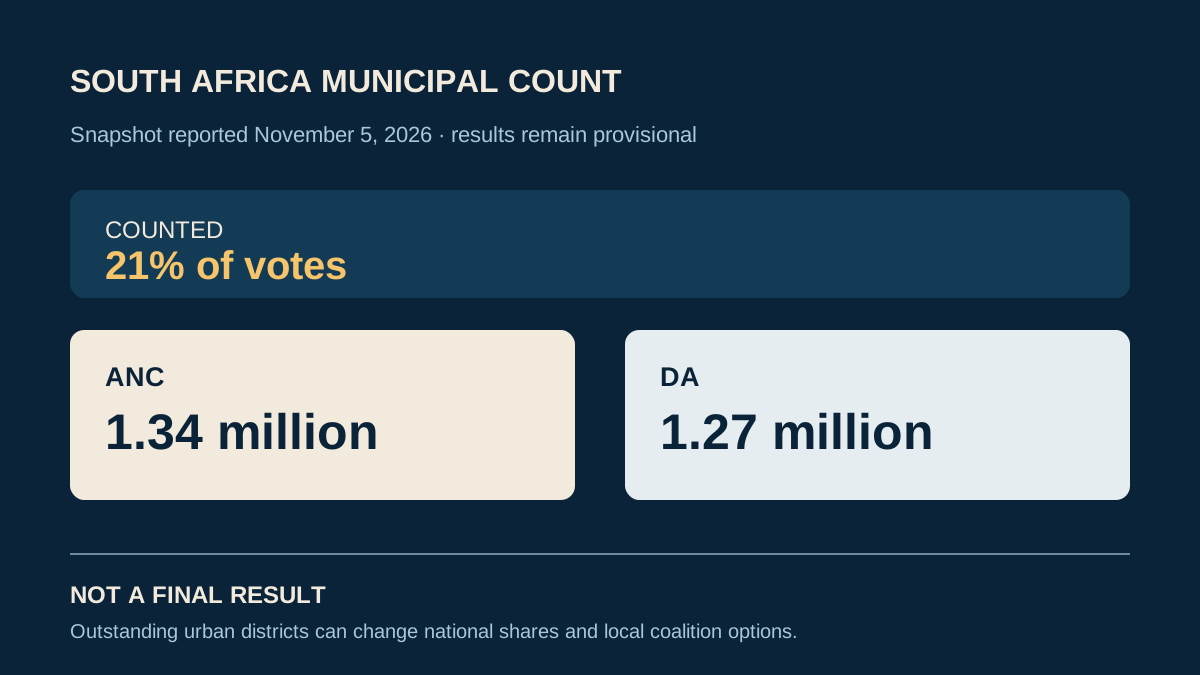
Verified baseline
South Africa's African National Congress held a narrow early lead in the November 4 municipal elections as counting continued Thursday. At 9:14 a.m. South Africa time, Business Day reported 21% of votes counted, with about 1.34 million votes for the ANC and 1.27 million for the Democratic Alliance.
The Electoral Commission's live dashboard is the authoritative source for the changing totals. Earlier, Reuters reported that with about 12% counted the ANC had roughly 32% and the DA 31%. These snapshots are not contradictory: they capture a rolling count at different times.
Why the early national percentages can mislead
Municipal results arrive unevenly. Smaller districts may finish before populous parts of Gauteng and KwaZulu-Natal, so the national shares at any moment do not represent a scientific sample of all voters. In Gauteng, Business Day reported only 10% captured around 9 a.m., while KwaZulu-Natal had about 11% captured shortly before then.
A Council for Scientific and Industrial Research projection cited by Reuters estimated a possible final national result of about 32% for the ANC and 26% for the DA. That is a model, not a certified result. The final party shares, municipal seats and ward winners will come from the Electoral Commission after outstanding results are captured and audited.
Why the result matters beyond a national score
These are local elections. Voters are choosing councils responsible for services that directly shape daily life, including water, electricity distribution, waste collection, roads and local planning. A national vote total is a useful political signal, but it does not decide who governs Johannesburg, Tshwane, eThekwini or every other municipality.
Where no party wins a council majority, parties must negotiate coalitions. Reuters reported that parties will have two weeks after the results are declared to form governments. Those negotiations may determine mayors, budgets and service-delivery priorities even where the party with the most votes falls well short of 50%.
What the early count says about the ANC and DA
The ANC's national municipal vote has declined from 62% in 2011 to 46% in 2021, according to Reuters. An early share near 32% would extend that fall, but it is too soon to call the final margin or infer a single cause from the count alone.
The DA's strong early performance is politically significant, particularly in major urban centres, but its national percentage may shift as later-reporting districts are added. Smaller parties—including uMkhonto weSizwe, the Economic Freedom Fighters, the Inkatha Freedom Party, ActionSA and the Patriotic Alliance—may hold decisive council seats.
Fact, analysis, forecast and opinion
Verified fact: the ANC led the DA narrowly in provisional national totals while most votes remained uncounted. Analysis: incomplete urban returns and the municipal structure make a single early national percentage an unreliable guide to every council. Forecast: coalition talks are likely in major municipalities, but their composition cannot be known until seats are allocated. Opinion: Health Politics Daily does not endorse any party or coalition.
Bias Lens: horse race, service delivery or coalition arithmetic?
Verified baseline: Electoral Commission data show a live, incomplete count; no final national result or municipal coalition had been certified at publication.
Center/international — Reuters: leads with the close ANC–DA national race and connects it to the 2029 election and ANC leadership succession. Public broadcaster — SABC News: emphasizes operational progress, early ward wins and provincial breakdowns. Business-focused — Business Day: provides a rapid market-style live tally and urban updates.
The framing differs by audience and format, not by evidence about the count. A meaningful left-versus-right split was not established in reliable early coverage, so attaching ideological labels would force false symmetry.
What remains uncertain
The final national shares, turnout, ward winners and municipal seat allocations remain unsettled. Counting order can move party percentages sharply. Coalition agreements, if needed, will follow certification and may change during negotiations; early market or political reactions are not proof of a final governing arrangement.
Principal sources
- Electoral Commission of South Africa — live official results
- Electoral Commission — election readiness and registered-voter facts
- Reuters — early tally and coalition context
- SABC News — early ward and provincial count
- Business Day — rolling count updates
No suitable directly relevant authorized video with clear persistent embedding permission was available at publication.
No comments yet.