Finance · New Zealand · Interest Rates
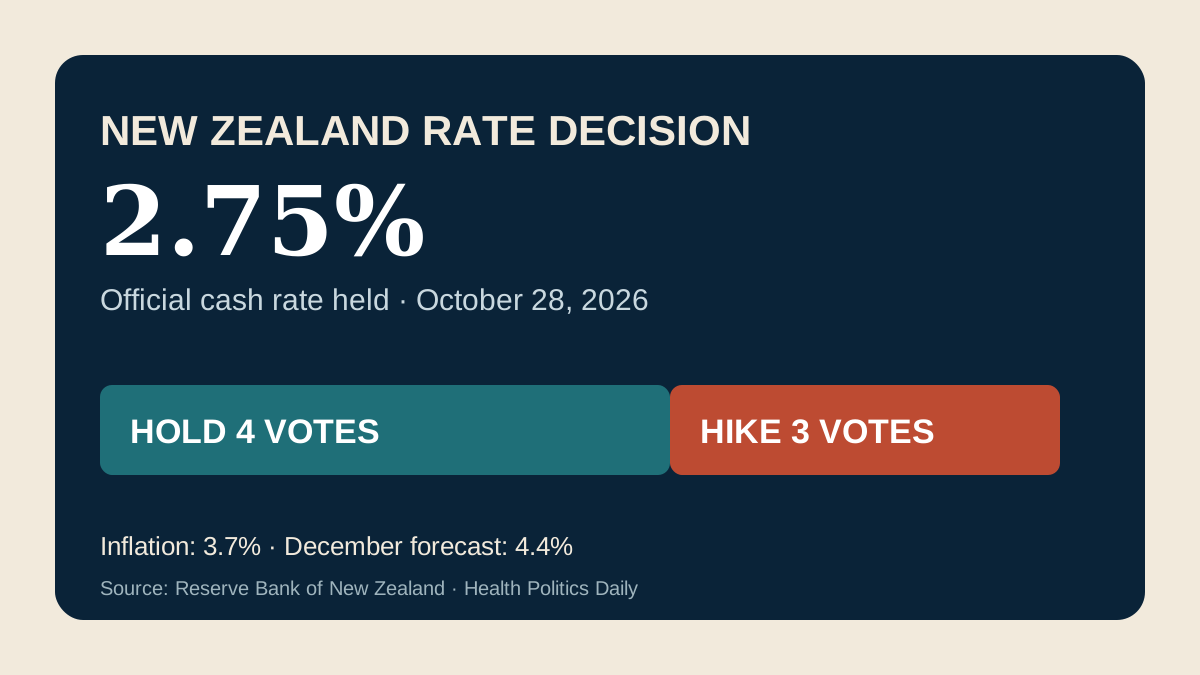
New Zealand Holds Rate at 2.75% in Surprise 4–3 Decision
The Reserve Bank paused after two increases, citing weaker-than-expected inflation effects and an uneven recovery. Three policymakers wanted an immediate quarter-point increase.
By Health Politics Daily News Desk · October 28, 2026 at 10:00 a.m. ET

Verified baseline
New Zealand’s Monetary Policy Committee voted 4–3 on Wednesday to hold the official cash rate at 2.75%. Anna Breman, Carl Hansen, Rebecca Williams and Prasanna Gai voted to pause; Hayley Gourley, Paul Conway and Karen Silk favored raising it to 3%.
The decision was unexpected: a Reuters poll found 22 of 27 economists had forecast a quarter-point increase. The New Zealand dollar fell as much as 1.7% after the announcement, according to Reuters.
Why the committee paused
Annual inflation eased to 3.7% in September from 4.1% in June and was below the bank’s forecast. Wage growth is subdued and medium-term inflation expectations remain stable. The four members supporting a pause said two recent increases needed more time to affect demand and prices, while household spending and investment remain weak.
That was not an all-clear. Core inflation is near the top of the 1%–3% target band, price increases have broadened, and the bank expects annual inflation to reach 4.4% in the December quarter, largely because of fuel prices. The committee said tighter policy is likely to be required, conditional on incoming data.
What the split vote means
The three members favoring an increase put more weight on the risk that persistent core inflation, freight costs and fuel shocks become embedded in prices and wages. The majority emphasized uncertainty and the danger of tightening into a fragile recovery. Both sides agreed on the basic data; they differed on timing and risk management.
The next scheduled OCR decision is December 9. A future increase is plausible, but neither the vote nor officials’ comments guarantee one. Oil prices, the exchange rate, household demand, wage setting and inflation expectations can change the outcome.
Practical implications
- Borrowers: the policy rate did not rise today, but mortgage and loan pricing can still move with funding costs and expectations.
- Savers: deposit rates are set by individual institutions and need not mirror the OCR one-for-one.
- Businesses: a weaker dollar can raise import costs while exporters may benefit from stronger foreign-currency returns.
- Households: national inflation averages will not match every family’s housing, transport and food costs.
This is general economic reporting, not personal financial advice.
Fact, analysis, forecast and opinion
Verified fact: the OCR remains 2.75%, the vote was 4–3 and annual inflation is 3.7%. Analysis: the narrow vote shows the pause was about timing rather than confidence that inflation is defeated. Forecast: officials say further tightening is likely, but December remains conditional. Opinion: Health Politics Daily takes no position on the appropriate rate.
For regional context, see our reports on Australia’s inflation increase, the global inflation outlook and China’s unchanged loan prime rates.
Bias Lens: pause, surprise or delayed tightening?
Verified baseline: the OCR is 2.75%, four members voted to hold and three voted to raise it to 3%. The bank says tighter policy is likely but conditional.
Early coverage is primarily technical rather than ideological, so a forced left-center-right comparison would create false symmetry. The Reserve Bank emphasizes the full risk balance; centrist Reuters foregrounds the market surprise and currency fall; business-focused Business Times stresses election timing and possible later increases. No comparably substantive, clearly left- or right-leaning original report was available at publication, so this lens does not assign unsupported labels.
What remains uncertain
Fuel prices and the exchange rate could lift inflation, while a sharper global downturn could weaken demand. The decision came ten days before New Zealand’s election, but the official record does not say electoral politics determined the vote.
Principal sources
- Reserve Bank decision and meeting record
- Reserve Bank official cash rate page
- Reuters market coverage
- Business Times
The official RBNZ media-conference page provides the authorized livestream; it was linked rather than embedded because persistent third-party embedding permission was not clear.
No comments yet.