Mexico · Public safety · Extreme weather
Hurricane Trudy Nears Mexico as Coastal Warnings Expand
A hurricane warning covers Manzanillo to Cabo Corrientes. Rain, landslides and dangerous surf remain threats beyond the storm’s center.
By Health Politics Daily News Desk · October 17, 2026 at 1:59 p.m. ET
What is verified
Mexico extended a tropical-storm warning northward to San Blas on October 17 as Hurricane Trudy approached its Pacific coast. The U.S. National Hurricane Center reported sustained winds of 90 mph at 15:00 UTC. That timestamp does not describe conditions at every coastal community.
The NHC’s advisory 17 lists a hurricane warning from Manzanillo northward to Cabo Corrientes and a hurricane watch south of Manzanillo to Punta San Telmo. Tropical-storm warnings extend south to Zihuatanejo and north from Cabo Corrientes to San Blas. A warning means conditions are expected somewhere in that area; a watch means they are possible.
The forecast: water hazards extend beyond the center
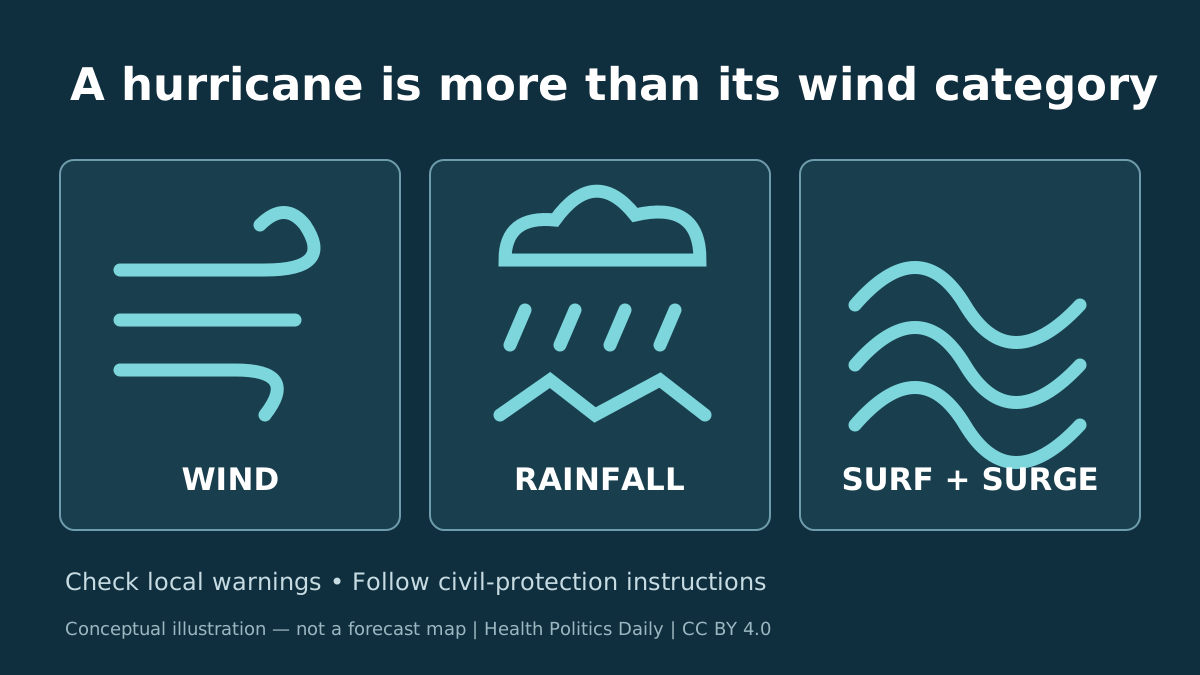
The advisory forecasts 4–8 inches of weekend rainfall in coastal Michoacán, Colima and Jalisco, with isolated totals near 12 inches and potentially life-threatening flooding and mudslides. It also warns of coastal inundation where winds push water onshore, destructive waves and dangerous rip currents.
Mexico’s Servicio Meteorológico Nacional separately highlights intense rain in Colima and Michoacán and very heavy rain in Jalisco and Nayarit in its October 17 notices. The Associated Press reports that Mexican naval authorities urged caution and Colima officials warned that earlier storms had left the ground saturated.
What remains uncertain
The NHC’s 15:00 UTC forecast discussion allows some strengthening but says wind shear, dry air and interaction with land could limit it. Its forecast peaks at 105 mph before weakening—not the major-hurricane intensity in some earlier forecasts. The forecast brings Trudy close to the coast before turning it away; it does not establish a specific landfall.
Exact local rainfall, the closest approach and eventual damage remain uncertain. A forecast change is not evidence that an earlier predicted outcome actually occurred. This report uses advisory 17 as its weather-data cutoff; subsequent advisories can change the warning boundaries and expected impacts.
Practical implications and context
Analysis: For households and travelers, the useful question is not just whether the center crosses land. Coastal access, river crossings and hillside roads can become unsafe while the eye remains offshore. The storm’s category alone cannot answer those questions.
Use Mexico’s meteorological service and local civil-protection notices for current instructions, shelter information and restrictions; confirm transport arrangements directly with operators. Do not infer that a route or airport is open from the storm track. Our earlier Hurricane Simon report explains another recent coastal threat, while our Pacific season analysis provides broader context. Neither substitutes for today’s local warning.
Bias Lens: timestamps and emphasis, not a partisan weather dispute
Verified baseline: Advisory 17 records a 90-mph hurricane and active coastal warnings. Forecasts describe possible future impacts, not confirmed damage.
La Jornada, a left-leaning Mexican newspaper, foregrounds official precautions and the weakening to Category 1 in its October 16 report. Reuters, the center wire-service comparison, leads its October 17 coverage with rainfall and coastal-flood risks.
FOX Weather, the specialist outlet within the right-associated Fox media group, gives more prominence to storm intensity and the wider Pacific storm picture. That ownership context does not make its meteorology partisan. Its page contains an older video headline and forecasts alongside updated text; readers should check each element’s date.
These examples differ in geography, timing and editorial emphasis. They do not establish a left-versus-right disagreement about the warnings, and this comparison does not treat older intensity forecasts as equally current evidence.
Sources and video
Primary sources are the NHC public advisory and forecast discussion linked above and SMN’s October 17 notices. AP and Reuters provide corroborating reporting. No suitable current, directly relevant video with clearly verified embedding permission was identified; no video is embedded.