CLIMATE — HURRICANES — PUBLIC SAFETY
Pacific Hurricane Season Sets Record for Accumulated Cyclone Energy
Long-lived, powerful storms pushed 2026 past the previous eastern-and-central Pacific activity record. The metric measures wind energy over time—not landfall damage or the number of storms.
By Health Politics Daily News Desk · Published Monday, October 12, 2026 at 8:00 p.m. America/New_York · Approximately 8 minutes
Verified Baseline
Storm energy east of the international date line passed the 2018 record
The 2026 hurricane season in the eastern and central Pacific has produced more accumulated cyclone energy, or ACE, than any previously recorded season in that combined region, according to Colorado State University hurricane researcher Phil Klotzbach. Associated Press reported that the total passed the prior 2018 mark Sunday while Hurricane Simon remained active.
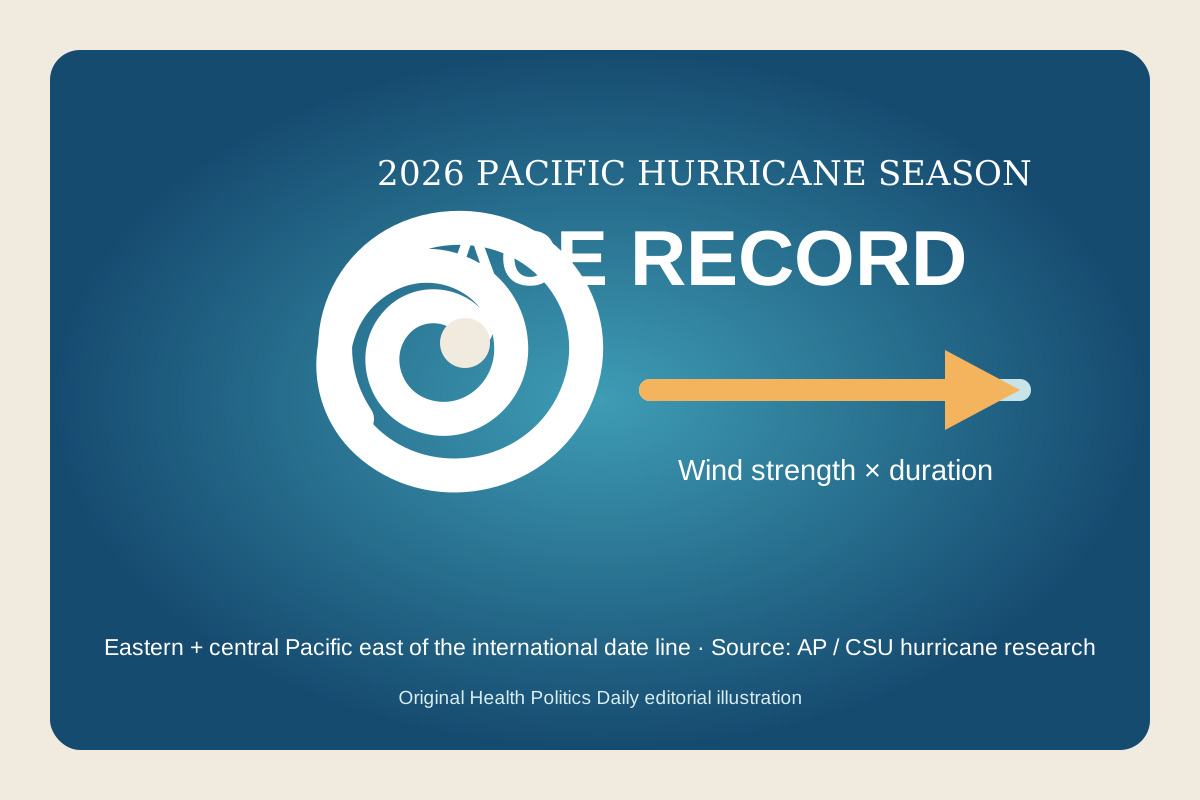
ACE combines how strong a tropical storm or hurricane is with how long it maintains those winds. Powerful storms add energy much faster than weak ones, and long-lived storms keep adding to the total. It is therefore a broader measure of seasonal activity than counting named storms or hurricanes alone.
The record applies to the eastern and central Pacific east of the international date line. It is not a global hurricane record, and it does not mean every location in the basin experienced record damage.
Why 2026 Became Exceptional
Several storms stayed strong for unusually long periods
A concentrated run beginning with Odalys on September 20 produced five major hurricanes—Nolo, Odalys, Polo, Rachel and Simon. Polo remained at Category 5 strength for more than two days, according to AP. Simon became the season’s 21st named Pacific storm and its 11th hurricane.
A strong El Niño has favored Pacific hurricanes by reducing disruptive wind shear in parts of the basin. Exceptionally warm ocean water supplies additional energy once storms organize. The same El Niño pattern increased upper-level winds over much of the Atlantic, helping suppress development there for most of the season; Isaias was the Atlantic’s first hurricane and formed unusually late.
Analysis: El Niño is a central driver of this season’s basin contrast, but it does not explain every storm’s track or intensity by itself. Shorter-term atmospheric patterns, local ocean temperatures and internal storm structure also matter. Scientists can describe how warmer background conditions influence rainfall and potential intensity without attributing every individual storm or impact to one cause.
Why the Record Matters
Offshore storms can still produce flooding, surf and costly disruption
ACE is not a damage scale. A high-energy storm can remain over open water, while a weaker storm can be deadly if it moves slowly over a populated or mountainous area. The practical risk comes from each storm’s track, size, rainfall, waves and local vulnerability.
The 2026 season has already sent dangerous surf and moisture toward Hawaii, Mexico, California and the desert Southwest. Remnants of Rachel contributed to flash flooding and record rainfall in Las Vegas. Reuters reported Monday that Simon was bringing flooding and evacuation concerns to western Mexico even after weakening from Category 4.
The record also matters for emergency planners because repeated systems can exhaust crews, shelters, infrastructure and household finances. Communities may experience several rounds of rain or surf without the storm center ever making a direct landfall.
Practical Implications
Use current local forecasts, not the seasonal record, for decisions
- Residents and travelers: follow the National Hurricane Center, local weather offices and civil-protection authorities for warnings tied to a specific storm. ACE does not identify which neighborhood will flood.
- Coastal communities: monitor surf, rip-current and coastal-flood alerts even when a hurricane is far offshore.
- Inland communities: Pacific moisture can amplify flash-flood and severe-weather risk far from the coast, including deserts and the central United States.
- Emergency managers: plan for overlapping recovery demands and verify that shelters, communications and backup power remain ready late in the season.
The Pacific hurricane season continues through November 30. Seasonal records do not replace evacuation orders or site-specific guidance.
What Remains Uncertain
The final seasonal total and future storm impacts are not known
The record can continue rising while named systems remain active. The National Hurricane Center was also monitoring another disturbance west of Mexico with a high chance of development, but formation probabilities are not promises about a storm’s eventual strength or track.
Verified fact: the combined eastern-and-central Pacific ACE total has surpassed the previous record. Forecast: favorable conditions could add more activity before the season ends, but individual tracks and impacts remain uncertain. Opinion: Health Politics Daily takes no position in political disputes over climate policy; public communication should distinguish measured seasonal activity, physical explanations and policy judgments.
Bias Lens: record activity, climate context and immediate hazards
The eastern and central Pacific’s 2026 accumulated cyclone energy passed the previous record. ACE combines sustained wind strength and duration; it does not measure deaths or property damage.
Left-leaning coverage: The Guardian has emphasized El Niño, warm Pacific waters and the wider climate context while covering the season’s major storms. Center coverage: AP explains the ACE record and scientists’ attribution of the season’s unusual pattern; Reuters foregrounds Simon’s current flooding and evacuation risks. No timely mainstream right-leaning report focused on this newly crossed ACE threshold was identified, so one is not forced into the comparison.
The difference is primarily emphasis: long-term climate conditions, the record-setting metric, or immediate public-safety impacts. None changes the geographic scope of the record or makes ACE a direct damage measure.
Principal Sources
Scientific explanation and current hazard reporting
- Associated Press — ACE record, storm sequence and expert explanation
- The Washington Post — seasonal record and downstream flood context
- Reuters — Simon conditions and western Mexico impacts
- National Hurricane Center — official current advisories and outlooks
No directly relevant official or publisher-authorized video with clearly established third-party embedding permission was available, so no video is embedded.
Related Coverage