U.S. COURTS — BROADBAND — RURAL HEALTH
Fifth Circuit Rejects FCC’s Creation of Telecom Subsidy Administrator
The ruling vacates a 2025 contribution factor and raises uncertainty for universal-service funding. It does not mean that rural broadband, school connections or household phone discounts have already stopped.
By Health Politics Daily News Desk · October 17, 2026 at 10:04 a.m. ET
What the court actually decided
Verified fact: an October 15 Fifth Circuit panel held that the Federal Communications Commission lacked specific congressional authorization to establish the Universal Service Administrative Company, or USAC. The court’s opinion in Consumers’ Research v. FCC, No. 25-60535, finds a violation of the Government Corporation Control Act.
The panel vacated the fourth-quarter 2025 universal-service contribution factor and sent the matter back for further proceedings. It addressed that statutory-authority issue rather than deciding all the constitutional and statutory arguments presented.
Reuters’ October 16 report describes the roughly $9 billion annual funding system and quotes an FCC spokesperson saying the order would not take effect for at least two months. The FCC said it was considering its options. That attributed timing statement is not a guarantee about the eventual outcome.
Why schools, rural patients and households care
USAC’s program overview identifies four branches: Lifeline, High Cost, E-Rate and Rural Health Care. Together they support affordable communications for low-income households, high-cost areas, schools, libraries and rural health facilities.
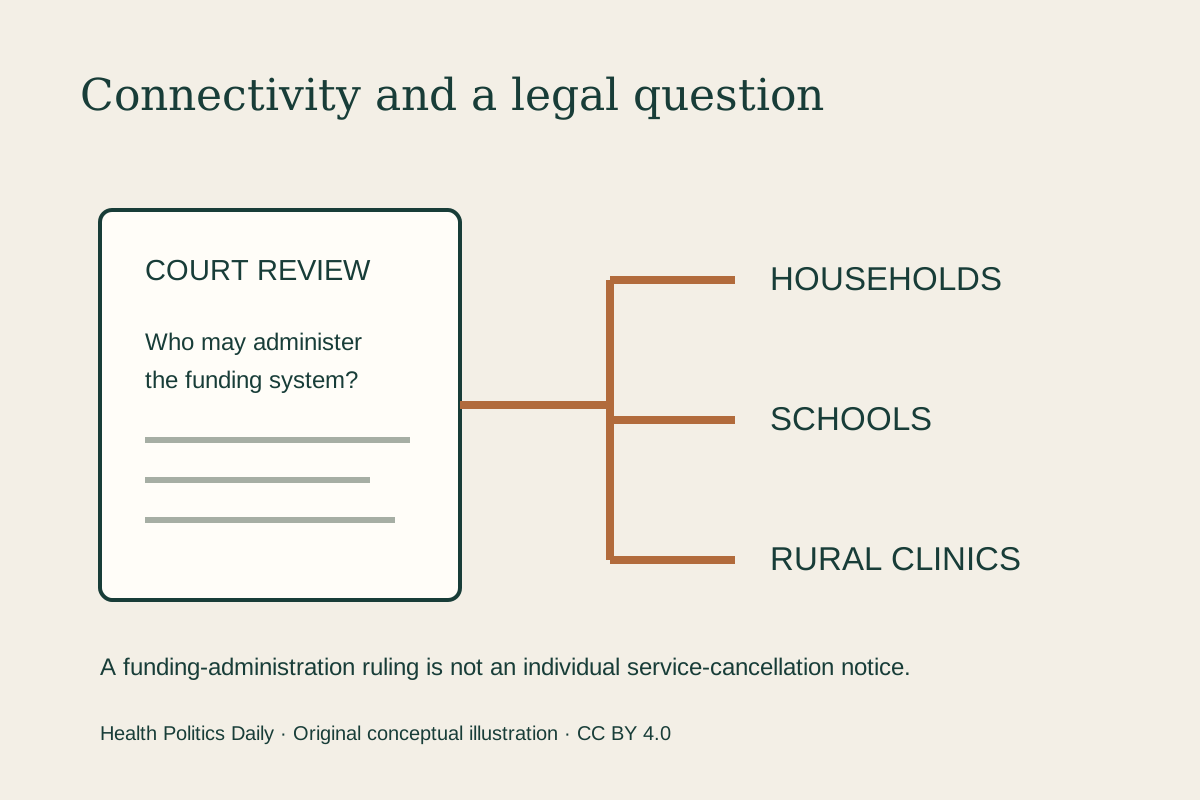
Analysis: this is not merely a dispute over a corporate name. Administrative uncertainty can complicate planning for organizations that depend on predictable support. A rural clinic’s communications connection can be part of delivering remote care; a school’s connection can be essential infrastructure rather than an optional convenience. But those stakes do not establish that any particular connection will be cut.
Nothing in the reviewed decision is a notice to an individual household that its account has been canceled. Beneficiaries should distinguish a court ruling about funding administration from a program-specific notice about their own service.
Why the Supreme Court’s 2025 decision is different
The Supreme Court’s June 27, 2025 opinion rejected a nondelegation challenge to the contribution mechanism. It concluded that Congress sufficiently constrained the FCC’s discretion and that the agency retained decision-making authority while using USAC’s nonbinding advice.
The new panel ruling concerns a different question: whether a federal statute specifically authorized creation of the corporation. The two decisions therefore should not be reduced to a claim that a lower court simply reversed the Supreme Court.
Analysis: a program can survive one legal theory and face another. Understanding the remedy, the governing law and the procedural stage is more useful than treating every adverse ruling as immediate abolition.
What the charge on a phone bill means
USAC explains that carriers fund universal service through assessments on certain interstate and international revenues. The quarterly contribution factor is not a percentage applied to every dollar of every consumer’s phone bill. Carriers may recover their contributions through a customer charge, but the FCC does not require that pass-through.
Analysis: comparisons between a contribution factor and an income-tax rate are not like-for-like: they apply to different bases and obligations. Nor does vacating a past factor automatically establish a refund for an individual subscriber. The reviewed ruling does not calculate such a payment.
What to watch next
Relevant developments include the mandate and any stay, further judicial review, FCC implementation and potential congressional action. The school-sector Association of Educational Service Agencies’ October 16 update flags uncertainty for E-Rate and distinguishes the vacated factor from the broader funding questions.
Forecast: administrative or legislative changes could become necessary, but the evidence reviewed here does not establish which route will prevail or a date for service disruption. This report is general information, not individualized legal advice.
For related context, see our reporting on public-finance resilience and household protection and digital-finance safeguards. Those are separate policy developments, not parts of this litigation.
Bias Lens: access, lawful authority and consumer costs
Verified baseline: the panel vacated a contribution factor because it found USAC’s creation lacked statutory authorization. Immediate service termination is not established.
Center reporting: the linked Reuters report emphasizes the system’s scale, beneficiaries and FCC response. Right-leaning advocacy: Citizens Against Government Waste’s October 16 commentary emphasizes legal authority and charges passed to consumers.
Left-leaning contextual advocacy: Public Knowledge’s June 27, 2025 statement celebrates the earlier Supreme Court result as protecting access and argues for reform. It is not a response to the new ruling.
These perspectives ask different questions: who pays, who benefits and how administrators are authorized. Advocacy is identified as such, not treated as neutral reporting. Earlier commentary cannot resolve the new case, and no ideological label substitutes for reading the opinion.
Sources and video
Principal sources: the Fifth Circuit and Supreme Court opinions, USAC’s program explanation, the FCC response reported by Reuters and AESA’s update. No directly relevant authorized video with clear embedding permission was verified; no video is embedded or rehosted.