YEMEN — MISSILE TECHNOLOGY — SUPPLY CHAINS
Report Traces Chinese Components Sought for Houthi Missile Program
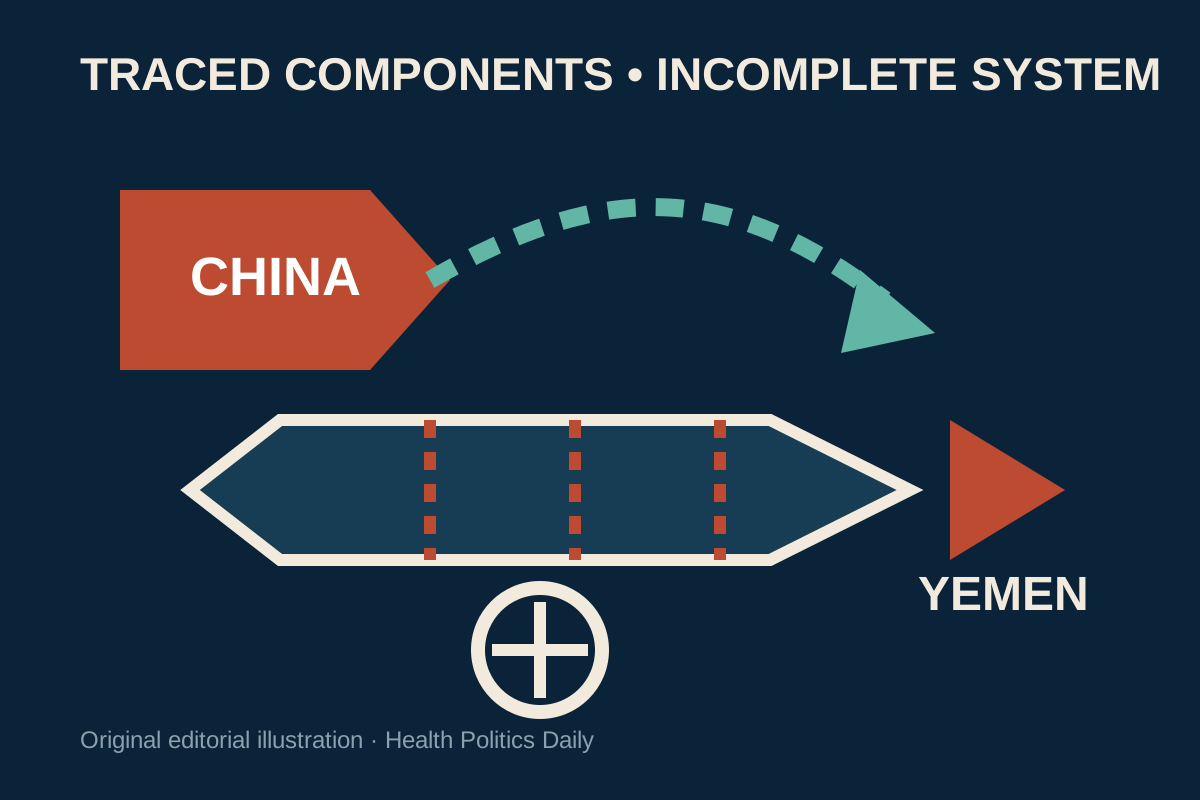
Specialized parts in two intercepted shipments point to an effort to assemble a medium-range missile in Yemen. The findings do not establish that a deployable weapon has been completed or that China’s government directed the transfers.
By Health Politics Daily News Desk · Published Thursday, October 15, 2026 at 8:00 a.m. America/New_York · Approximately 8 minutes
Verified Baseline
Investigators linked intercepted parts to a specific missile design
Conflict Armament Research, a weapons-tracing organization, analyzed information released by Yemen’s internationally recognized government about two shipments intercepted in July. The cargo originated in China and was headed for Hodeidah, a port controlled by Yemen’s Houthi movement, according to the Associated Press.
The documented items included stabilizing-fin cores, rocket-motor aft closures with nozzle attachments, motor igniters and phenolic resin used in heat shielding. CAR assessed the combination as consistent with an effort to build a version of Iran’s Kheibar Shekan medium-range ballistic missile.
What the Evidence Shows
The components suggest intent and technical planning, not a finished missile
The parts are more probative together than separately: nozzle assemblies and igniters relate to propulsion, fins support stability, and ablative material protects a missile during high-speed atmospheric flight. CAR analyst Fabian Hinz told AP that the items were unusually specific and would have required design information associated with the missile.
That supports the assessment that the shipments were intended for a missile program. It does not independently prove that the Houthis assembled, tested or deployed a working Kheibar Shekan variant.
Why It Matters
Local assembly could make interdiction harder and expand the threat
The Iranian Kheibar Shekan design is generally described as having a range of roughly 2,000 kilometers, sufficient to reach all of Saudi Arabia and parts of Israel from Yemen. A locally assembled variant could reduce reliance on smuggling complete missiles, which are larger and easier to detect.
Analysis: the reported supply pattern points toward modular procurement—importing components and materials while completing more assembly inside Houthi-controlled territory. That may complicate embargo enforcement because customs authorities must identify specialized parts rather than complete weapons.
China’s Response
Beijing says it controls military and dual-use exports
A Chinese Embassy spokesperson told AP that China follows its international obligations and maintains strict controls over military and dual-use exports, but did not address the report’s specific findings. Publicly available evidence does not establish that the Chinese government authorized or knew the intended end use of the shipments.
The distinction matters: components originating with Chinese manufacturers, actions by exporters or intermediaries, and direction by the Chinese state are separate claims requiring separate evidence.
Practical Implications
What governments, shipping firms and civilians should watch
- Export-control agencies: the findings may prompt closer screening of precision-machined rocket parts, heat-shield materials and shipment documentation.
- Shipping and insurers: tighter inspections could add delays around Yemeni routes even when cargo has legitimate civilian uses.
- Saudi Arabia and Israel: a successful program could add to existing drone and missile-defense pressure, but the report does not confirm an operational new system.
- Yemeni civilians: further interdiction and retaliation could deepen shortages in a country already facing severe humanitarian stress.
What Remains Uncertain
Production status, supply-chain responsibility and performance remain unknown
The public record does not establish how many similar shipments arrived, whether critical guidance systems were obtained, or whether a prototype has been successfully tested. The report also does not identify evidence of Chinese state direction.
Forecast: Saudi Arabia and partners are likely to press Beijing and exporters for stronger end-use controls while expanding maritime inspections. Opinion: any policy response should identify the companies, intermediaries and evidence involved rather than treating every China-origin component as proof of government sponsorship.
Bias Lens: procurement evidence, strategic threat or geopolitical blame?
Two intercepted China-origin shipments contained specialized missile components bound for Houthi-controlled Hodeidah. Investigators assessed the combination as supporting a medium-range missile project; no completed new missile was documented.
Center coverage: AP emphasizes the component evidence, the Houthis’ growing assembly capability and China’s denial of wrongdoing. Center-right/business coverage: The Wall Street Journal foregrounds the potential range and strategic threat of a missile based on the Iranian design. Left-leaning coverage: no major left-leaning outlet had published a directly comparable report on the component findings at publication time, so this lens does not force an unrelated Yemen story into the comparison.
The framing difference is between forensic supply-chain evidence and strategic consequence. Neither framing, by itself, proves state sponsorship or operational deployment.
Principal Sources
Weapons tracing, reporting and regional context
- Conflict Armament Research — Houthi missile-component research
- Associated Press — shipment details and responses
- The Wall Street Journal — strategic assessment
No directly relevant official or publisher-authorized video with clear embedding permission was available.
Related Coverage