TECHNOLOGY POLICY — U.S. ELECTIONS — CONSUMER PROTECTION
FCC Weighs Waiver for Unsolicited AI Political Robocalls Before Midterms
A conservative advocacy group wants political artificial-voice calls exempted from the cellphone consent rule; the FCC has requested comments but has not approved the change.
By Health Politics Daily News Desk · Published Wednesday, October 7, 2026 at 9:58 p.m. America/New_York · Approximately 8 minutes

Watch in this article
Pumpjack operating at the Kern River Oil Field
A short CC0 field video provides visual context for reporting on oil production and fuel supply.
Thomas Farley / Wikimedia Commons · CC0 1.0 · License and source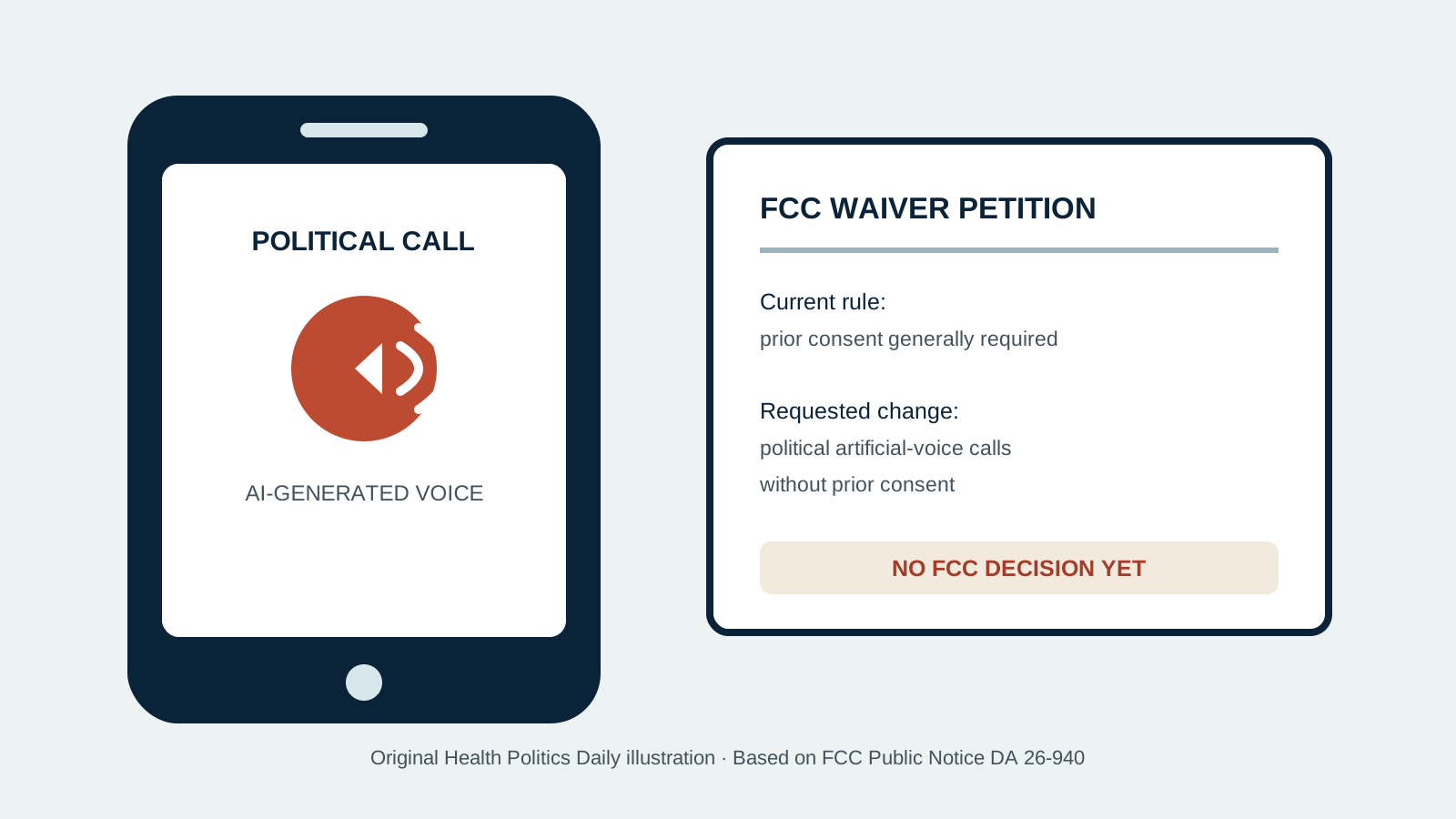
Verified Baseline
The FCC is considering a petition, not announcing a rule change
Club for Growth asked the Federal Communications Commission for a limited waiver and statutory exemption that would permit noncommercial political calls to wireless numbers using artificial or prerecorded voices—including AI-generated voices—without the recipient’s prior express consent. The agency’s public notice opened the request for comment.
The FCC has not granted the petition. Current federal consent restrictions therefore remain in effect. The initial comment deadline was October 5; reply comments are due October 19, according to the docket notice.
What the Request Would Change
Political groups could reach cellphones without first obtaining consent
Federal rules generally restrict artificial or prerecorded voice calls to cellphones without prior express consent. Club for Growth argues that political speech should receive treatment similar to certain permitted informational calls, such as package, bank-account or medical notifications. The group also says AI agents can communicate in multiple languages and improve voter outreach and polling.
Opponents say the proposal could sharply increase unwanted calls and make synthetic political messages harder to distinguish from authentic recordings. Any waiver would apply to callers across the political spectrum, not only the group that filed the petition.
Why It Matters
The decision could arrive close to the November election
The request comes weeks before the November 3 midterms and after an AI-generated voice imitating President Joe Biden was used in 2024 calls telling New Hampshire voters not to participate in the primary. The FCC subsequently confirmed that AI-generated voices count as “artificial” voices under the Telephone Consumer Protection Act.
Analysis: the core policy dispute is not whether political speech is protected, but whether the government should relax a consent rule for a scalable technology shortly before voting. Forecast: if the FCC grants relief, campaigns and political organizations could expand automated outreach rapidly; the size of any increase would depend on the waiver’s final limits. Opinion: this report does not advocate approval or rejection.
Practical Implications
What cellphone users and campaigns should know now
- No immediate change: the petition itself does not authorize new calls.
- Existing protections still apply: callers using artificial or prerecorded voices generally must follow federal consent and opt-out rules, along with applicable state laws.
- Verify political messages: a familiar-sounding voice may be synthetic. Check a campaign’s official site or trusted reporting before acting on voting instructions.
- Preserve evidence: save the message, number and time if a call appears deceptive, and use the FCC’s official complaint channel rather than engaging with suspicious links.
- Campaigns face multiple laws: even a federal waiver would not automatically override state disclosure, impersonation or election-misinformation rules.
What Remains Uncertain
The FCC has not said whether or when it will act
Verified fact: the petition asks for calls without prior consent, and the agency is collecting replies. Uncertain: whether commissioners will grant, narrow or reject it; what disclosure, frequency or opt-out conditions might accompany approval; and whether legal challenges would follow.
The proceeding also intersects with broader AI-governance debates covered in our report on the voluntary White House AI safety accord and with the political-finance context described in our explainer on Trump Account automatic enrollment.
Bias Lens: how the proposal is being framed
The FCC opened a petition seeking relief from prior-consent requirements for political artificial-voice calls to wireless phones. No waiver has been granted.
Left-leaning coverage: Al Jazeera emphasizes misinformation, voter confusion and Commissioner Anna Gomez’s warning. Center coverage: The Associated Press and Reuters lead with the pending regulatory decision and present arguments from supporters and opponents.
Right-side argument: no substantial right-leaning newsroom treatment was available at publication. The linked Club for Growth petition supplies the pro-waiver argument directly: it frames the request as equal treatment for protected political speech and a tool for voter communication. That advocacy filing is a primary source, not independent news coverage, so treating it as a journalistic counterpart would create false symmetry.
Principal Sources
FCC record and corroborating reporting
- FCC Public Notice DA 26-940
- Club for Growth waiver petition in the FCC docket
- Associated Press — proposal, precedent and consumer concerns
- Reuters — FCC and petitioner statements
- Common Cause — opposition filing and election-integrity concerns
No suitable directly relevant official or publisher-authorized video with clearly confirmed embedding permission was available.