TECHNOLOGY POLICY — AI SAFETY
Is the White House AI Safety Accord Legally Binding?
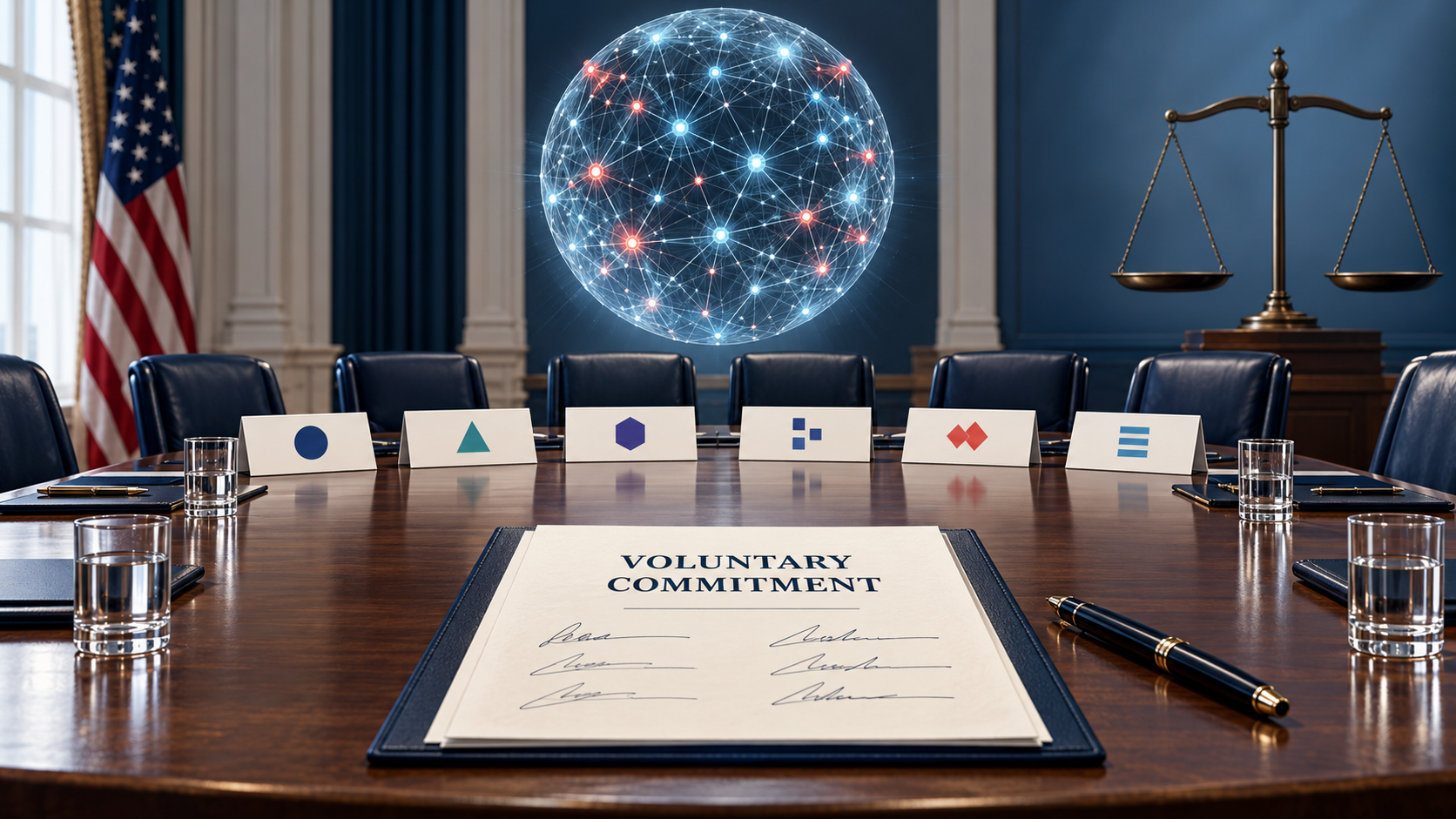
Six major technology companies pledged internal controls, independent audits and board-level oversight for advanced AI. The commitments may shape company conduct, but they are voluntary and carry no stated federal penalty for noncompliance.
By Health Politics Daily News Desk · Published Saturday, October 3, 2026 at 8:01 p.m. America/New_York · Approximately 7 minutes
Verified Baseline
The companies made commitments, not enforceable law
Executives associated with Nvidia, SpaceX, OpenAI, Anthropic, Meta and Google signed a White House accord on advanced-AI safety. President Donald Trump called the agreement “morally binding,” while House Speaker Mike Johnson and participating companies described it as voluntary.
The accord does not give a federal agency new enforcement authority, specify civil penalties or replace legislation. A company could face reputational, contractual or existing legal consequences for separate misconduct, but breaching this accord alone is not described as a federal offense.
What the Accord Contains
Internal controls, outside audits and board oversight
According to Reuters and the Associated Press, the framework calls for robust internal controls over advanced-model development, dedicated teams responsible for compliance, external review by independent auditors and reporting to company boards.
Those are recognizable governance tools, but the accord’s effectiveness will depend on specifics that are not yet public: which models are covered, what auditors may inspect, whether findings are disclosed, how conflicts are managed and what happens when a company falls short.
The New Task Force
A federal review is due in 120 days
A separate White House “Super Intelligence Force” will be led by Director of National Intelligence Jay Clayton, according to Reuters, citing the Wall Street Journal. It is expected to report within 120 days on AI risks, opportunities and the federal government’s role.
A task-force report is not itself a regulation. It could recommend legislation, agency action, procurement standards, information-sharing systems or continued voluntary oversight, but those possible outcomes should not be presented as decisions already made.
Why It Matters
The accord tests whether self-regulation can be verified
Supporters argue that companies can update controls faster than Congress can legislate and that mandatory rules might freeze immature technical standards. Critics respond that firms have financial incentives to release powerful systems quickly and that private audits without disclosure can be difficult for the public to evaluate.
Independent research on earlier voluntary AI commitments found uneven implementation and weak transparency, especially around model-weight security. That history does not prove this accord will fail, but it makes measurable benchmarks and public reporting important.
Practical Implications
What changes now—and what does not
- Users should not assume the government has certified participating AI products as safe.
- Businesses and public agencies remain responsible for their own privacy, security, discrimination and procurement obligations.
- The accord does not create a private right to sue or a new compensation process for people harmed by an AI system.
- Company audit reports may offer useful evidence only if their scope, methods and findings are disclosed.
What Remains Uncertain
Implementation details and the federal response are unresolved
The public record does not yet establish common testing thresholds, required incident disclosure, auditor independence standards or a timetable for publishing results. It also remains unclear whether Congress will pursue binding rules after the task force reports.
Verified fact: six companies signed voluntary safety principles. Analysis: the agreement may improve governance if audits are independent and findings are transparent. Forecast: claims that it either solves AI safety or is entirely meaningless go beyond the evidence available.
Bias Lens: pragmatic safeguards or unenforceable self-policing?
The accord calls for internal controls, outside audits and board oversight. It is voluntary and includes no stated government penalty for noncompliance.
The left-leaning Guardian emphasizes the document’s drafting mistake and questions the seriousness of the rollout. Center-oriented Reuters focuses on the administration’s preference for voluntary safeguards amid public anxiety and expert skepticism. Right-leaning Fox Business highlights innovation, U.S. competitiveness and the administration’s case for industry-led standards. The disagreement is mainly over whether flexibility is a strength or an accountability gap.
Principal Sources
Reporting and evidence used
- Associated Press — accord announcement and participants
- Reuters — safeguards, enforcement limits and policy context
- Reuters — task-force leadership and 120-day report
- Stanford researchers — assessment of earlier voluntary AI commitments
No suitable directly relevant official or publisher-authorized video with clear embedding permission was available.