PERSONAL FINANCE — TAX POLICY — FAMILIES
Trump Accounts Auto-Enrollment: Who Gets the $1,000 and What Parents Must Do
The government has created investment accounts for eligible minors, but automatic creation does not mean every child receives $1,000 without a parent or guardian taking action.
By Health Politics Daily News Desk · Published Wednesday, October 7, 2026 at 8:01 p.m. America/New_York · Approximately 8 minutes

Watch in this article
Pumpjack operating at the Kern River Oil Field
A short CC0 field video provides visual context for reporting on oil production and fuel supply.
Thomas Farley / Wikimedia Commons · CC0 1.0 · License and source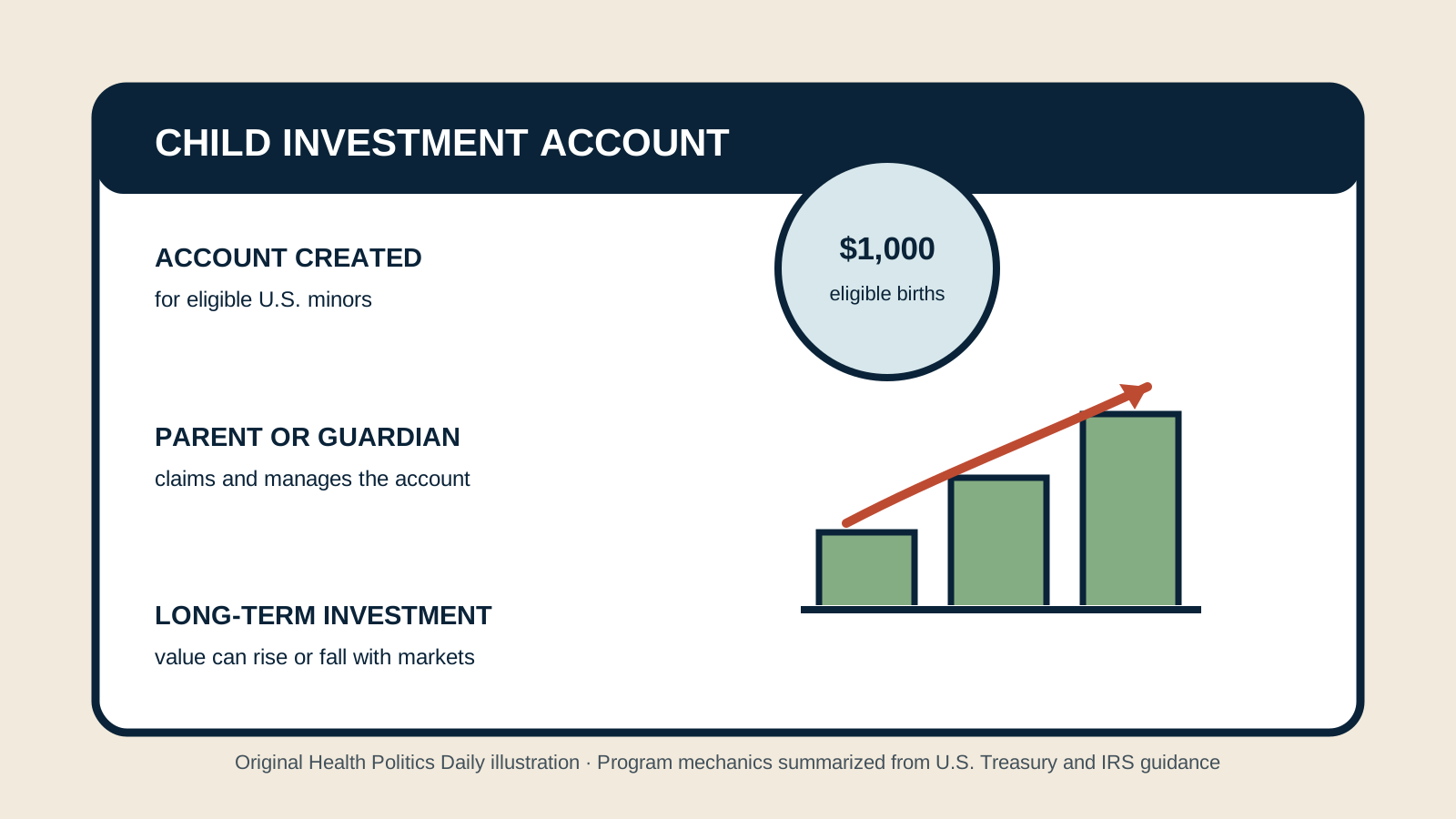
Verified Baseline
Treasury says automatic account creation is complete
The U.S. Treasury says it has created Trump Accounts for eligible Americans under age 18 with Social Security numbers under temporary rules that took effect this month. President Donald Trump highlighted the expansion Wednesday, saying roughly 70 million accounts now exist.
The account is a custodial, tax-advantaged investment account owned by the child. A parent or guardian generally manages it while the beneficiary is a minor. Automatic creation removes the first enrollment step, but families still need to claim or activate the account before they can manage it, contribute or request an eligible federal pilot payment.
Who Gets the Federal Money
The $1,000 is limited to eligible children born from 2025 through 2028
Under IRS and Treasury guidance, the one-time $1,000 pilot contribution is for a U.S. citizen born in 2025, 2026, 2027 or 2028 who has a valid Social Security number and has not already received the payment. A parent or guardian must make the required election; creating the account does not by itself release the money.
Older children who are still minors may have an account and receive family, employer, state, local-government, nonprofit or philanthropic contributions, but they do not qualify for the federal $1,000 solely because they are under 18. The official Trump Accounts portal provides the claim and activation route.
How the Account Works
Investments can grow, but they can also lose value
Family and other individual contributions generally count toward an annual $5,000 limit, adjusted for inflation, with employer contributions limited to $2,500 within that total. Certain broad contributions from governments or charities follow separate rules. Money is invested in designated low-cost funds rather than held as a guaranteed bank balance.
Verified fact: investment gains are not guaranteed, and withdrawals are subject to tax rules. The child takes control at 18, when the account generally becomes subject to traditional IRA rules. Different uses can have different taxes or penalties, so a headline balance is not the same as immediately spendable cash.
Practical Implications
What parents and guardians should verify
- Confirm the child’s eligibility: birth year, citizenship and Social Security number determine eligibility for the $1,000 pilot payment.
- Claim the correct account: use the official government portal or app; unsolicited messages or requests for payment should be treated cautiously.
- Check the funding status: an account can exist before the federal deposit has been elected or processed.
- Read the tax and withdrawal rules: a Trump Account, a 529 education plan and a custodial brokerage account have different purposes and tax treatment.
- Review any donated stock: new rules allow some corporate contributions in company shares that may be subject to a five-year holding period, creating concentration risk.
This is general reporting, not personalized investment or tax advice. Families comparing accounts should use current IRS guidance and, where appropriate, a qualified tax or financial professional.
Why It Matters
Automatic creation broadens access but does not equal equal outcomes
Analysis: creating accounts for minors can reduce paperwork and make philanthropic or employer contributions easier to distribute. But future balances will still vary widely because families have different capacity to contribute and markets deliver uneven returns.
The program arrives amid wider debate over household costs and federal benefits, including the administration’s separate $90 Medicare payment. It also intersects with the borrowing-cost pressures covered in our report on rising Treasury yields and global markets.
What Remains Uncertain
Participation, contributions and long-term results are not yet known
Forecast: automatic creation is likely to increase the number of usable accounts, but the share families will claim, how quickly eligible children receive the $1,000 and how much outside funding will reach lower-income households remain uncertain. Opinion: this report does not endorse or oppose the program or recommend it over another savings vehicle.
Treasury’s temporary regulations and investment framework may evolve. Families should rely on the latest official rules rather than projections about what an account “could” be worth decades from now.
Bias Lens: how coverage is framing automatic enrollment
Treasury has automatically created accounts for eligible minors. The $1,000 payment remains limited to qualifying children born from 2025 through 2028 and requires an election or claim by a responsible adult.
Left-leaning coverage: The Washington Post emphasizes access gaps, corporate-stock concentration risk and the likelihood that families able to contribute more will gain more. Center coverage: The Associated Press places the announcement within the administration’s economic message and explains the $1,000 eligibility window. Right-leaning coverage: Fox News foregrounds the 70 million-account milestone and the administration’s claim that the program expands ownership.
The difference is mostly emphasis: distributional and governance risks, program mechanics and political context, or the scale and stated purpose of the rollout. None of those frames changes the statutory eligibility rules.
Principal Sources
Rules, official guidance and independent reporting
- U.S. Treasury — completion of automatic enrollment
- Federal Register — temporary regulations
- IRS — Form 4547 instructions and pilot contribution election
- SEC Investor.gov — account and investment overview
- The Washington Post — consumer and distributional context
No video is embedded. A Fox News segment and public-event clips were available, but no directly relevant official video with clearly confirmed embedding permission was identified.