HAWAII — ENVIRONMENTAL HEALTH
Maui Wildfire Study Links Elevated Metals to Lung Problems
Researchers found unusually high levels of several metals in 1,400 Maui adults and an association with abnormal lung function. The findings strengthen the case for longer post-disaster monitoring, but they do not prove the fires caused every exposure or breathing problem.
By Health Politics Daily News Desk · Published Monday, September 28, 2026 at 6:00 p.m. America/New_York · Approximately 6 minutes
Verified Baseline
Metal levels were elevated and lung tests were worse
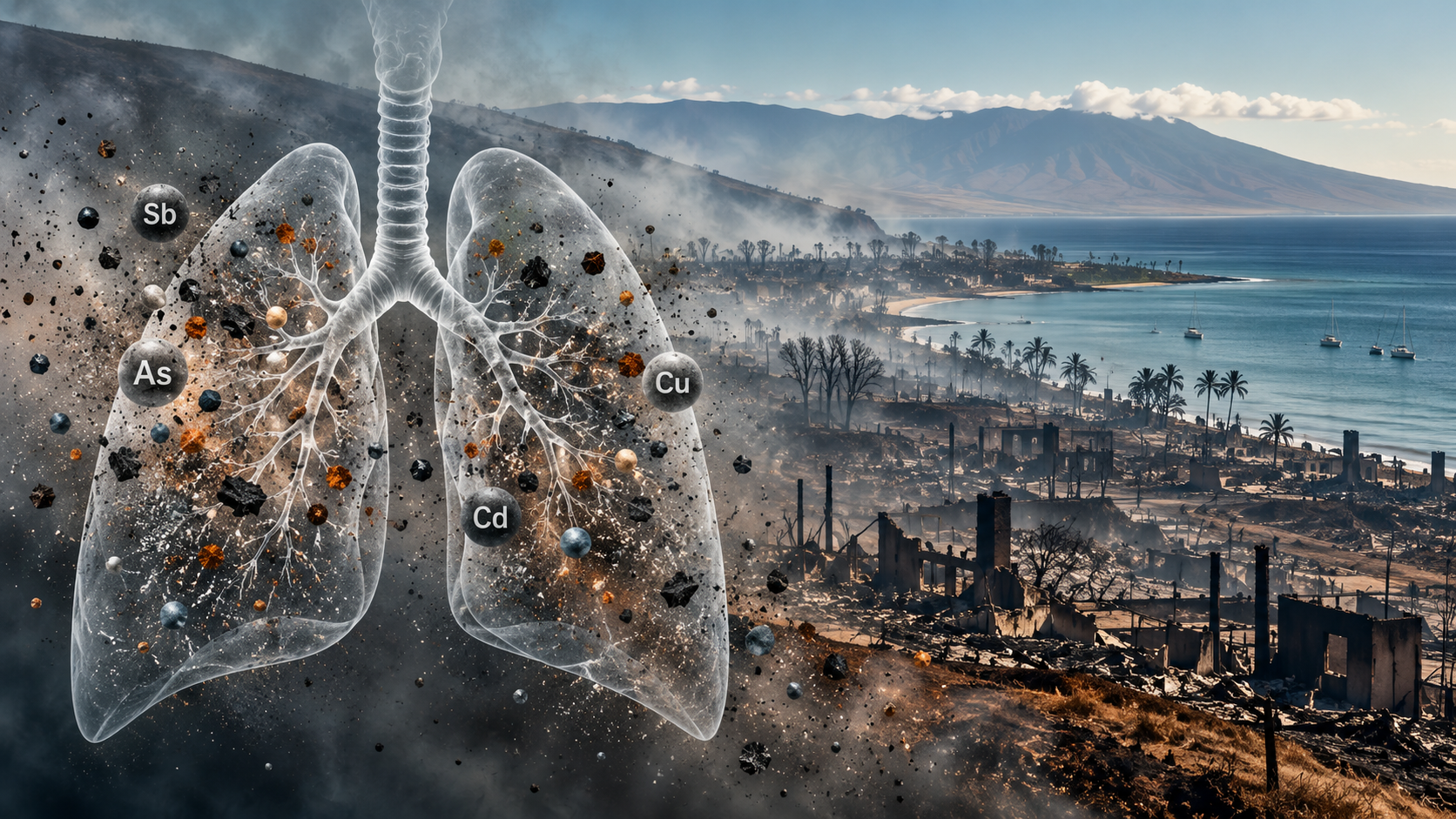
A peer-reviewed study published Monday in the Proceedings of the National Academy of Sciences analyzed urine samples and breathing tests from 1,400 adults on Maui between six and 18 months after the August 2023 fires. The Associated Press reports that antimony was nearly 40 times higher than in national biomonitoring data, while manganese was 3.8 times higher, barium 2.3 times and arsenic 2.2 times.
Participants with higher combined metal levels were more likely to record abnormal lung function, including reduced breathing capacity and difficulty moving air. Arsenic, cadmium, copper and antimony had some of the strongest associations.
Why It Matters
A wildfire’s health effects can outlast visible smoke
Wildland smoke is usually discussed as burned vegetation and fine particles. Lahaina was also an urban fire: homes, vehicles, electronics, paint and other manufactured materials burned together. That more complex mixture can leave contaminants in ash, dust and soil long after flames are gone.
The Hawaii Department of Health’s Maui monitoring portal says heavy metals are among the fire-related substances of greatest environmental concern around Lahaina. The new research does not establish an individual diagnosis, but it adds biological evidence that post-fire exposure deserves long-term attention.
What the Study Cannot Prove
Association is not the same as causation
The researchers did not have comparable samples from the participants before August 2023. Hawaii’s geology, diet, past agricultural and industrial activity and other environmental sources can also affect metal levels. Because the study is observational, it cannot determine how much of each person’s exposure came directly from the wildfire.
Confirmed fact: the measured metal concentrations and lung-test associations exist in this cohort. Analysis: their geographic pattern and the known contents of urban fire debris make fire-related exposure plausible. Uncertainty: the study cannot prove that a specific metal caused a specific participant’s lung impairment.
Bias Lens: a scientific finding, not a partisan verdict
The study measured elevated metals and found statistical associations with abnormal lung function. It also explicitly notes the absence of pre-fire baseline data.
The Associated Press centers the new measurements and the study’s limits. The Guardian’s earlier coverage emphasized survivors’ reported respiratory and mental-health burdens and the need for support. Fox News’ earlier environmental coverage focused on metals and other contaminants reaching reefs and coastal systems. No meaningful left-center-right split has emerged around Monday’s specific data; the clearest difference is whether coverage foregrounds human health, environmental pathways or methodological caution.
Practical Implications
Residents should use official monitoring and clinical care
People concerned about persistent cough, wheezing, shortness of breath or reduced exercise tolerance should discuss symptoms and their exposure history with a health professional. This article cannot determine whether any individual has metal toxicity or wildfire-related lung disease, and consumer “detox” products are not a substitute for testing or medical evaluation.
For environmental conditions, residents can use the state’s metals-monitoring data and follow local guidance during dust-generating work or renewed fire activity. The study supports continued surveillance; it does not establish that every location on Maui is unsafe.
What Comes Next
Researchers are following the cohort over time
The Maui Wildfire Exposure Study is longitudinal, meaning researchers plan to follow participants rather than treat this as a one-time snapshot. A separate five-year, $3.6 million NIH-supported project will examine soil, water, biological samples and heart and lung measures to distinguish wildfire exposures from older contamination.
Future results may clarify which sources matter most, whether metal levels decline and which health effects persist. Until then, the study is a warning signal and a case for monitoring—not a forecast of inevitable disease.
Principal Sources
Evidence and reporting used
- Associated Press — September 28 study report
- Hawaii Department of Health — Maui wildfire monitoring overview
- Hawaii Department of Health — metals data
- University of Hawaii — follow-up environmental-health research
No suitable directly relevant authorized video with clear embedding permission was available.