Health · Pregnancy · Climate
Extreme Heat Is Linked to Higher Preterm Birth Risk Across 49 Studies
A new evidence review and analysis of millions of birth records strengthen the case for including pregnancy in heat-health planning. They show population-level associations—not that heat caused any one person’s outcome.
By Health Politics Daily News Desk · October 30, 2026 at 8:01 a.m. ET
Verified baseline
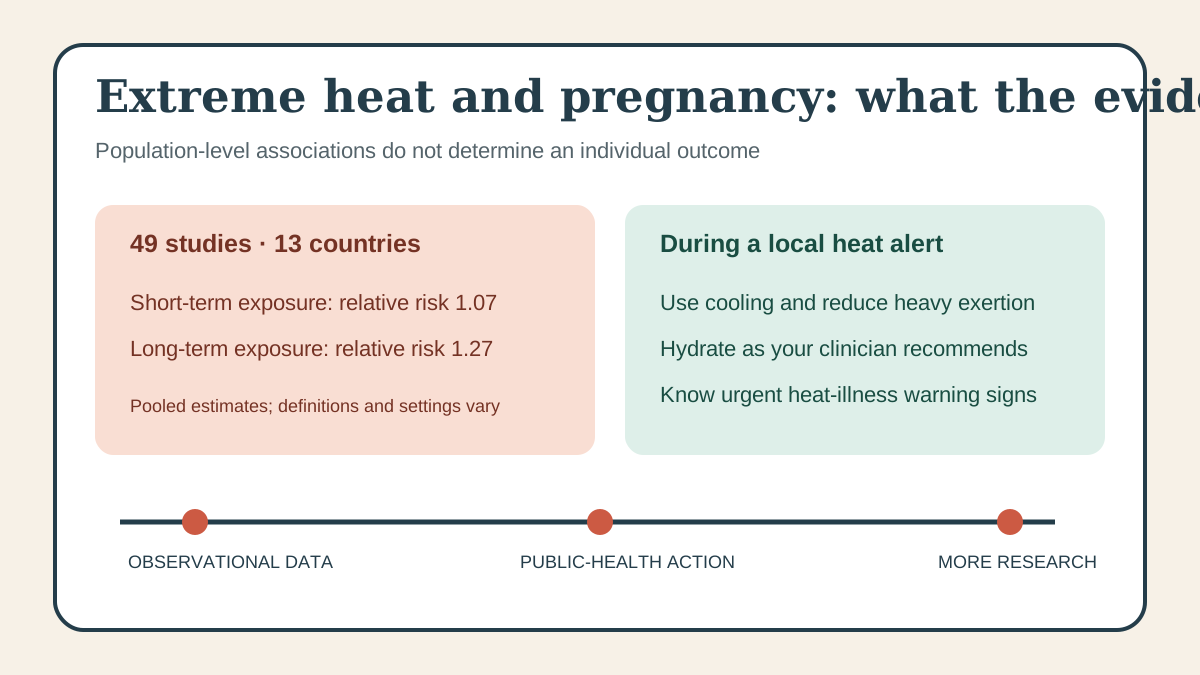
A systematic review published in September pooled 49 studies from 13 countries and found higher preterm-birth risk after both short- and long-term extreme-heat exposure. The authors defined extreme heat relative to local conditions—generally the 90th temperature percentile or higher—rather than using one global temperature cutoff.
Short-term exposure within four weeks of delivery was associated with a 7% higher relative risk of preterm birth. Exposure lasting more than four weeks was associated with a 27% higher relative risk. Those are pooled observational estimates, not absolute probabilities for an individual pregnancy.
What a new birth-record analysis adds
A Reuters investigation published Friday analyzed more than eight million births in Mexico alongside heat-wave data. Its analysis found that heat waves or unusually broad “heat storms” during the last month of pregnancy were associated with preterm-birth rates rising by as much as 18% in some comparisons.
Reuters chose Mexico because the country has near-complete birth records, varied climates and consistent information about gestational age and location. The analysis can identify association and timing but cannot prove that heat caused a specific birth; air conditioning, work exposure, health conditions and other factors are not perfectly captured.
Why pregnancy can increase heat vulnerability
Pregnancy raises metabolic heat, increases blood volume and makes the heart work harder. Dehydration can also reduce the body’s ability to cool itself. A 2026 meta-analysis covering 201,906 pregnant participants found consistent acute physiological stress during heat exposure, including higher maternal core temperature and heart rate and higher fetal heart rate.
That review found signs of greater susceptibility among people with hypertension or preeclampsia, but evidence about placental blood flow was inconsistent. Researchers said biological mechanisms and vulnerability thresholds still need more study.
What health systems are being asked to track
On October 21, the World Health Organization, World Meteorological Organization, UNICEF and UNFPA launched the first common set of indicators for heat effects on pregnant people, newborns and children. The framework asks countries to monitor preterm birth, stillbirth, low birthweight, pregnancy hypertension, child deaths and heat-related health visits.
That framework is a measurement standard, not a new diagnosis or treatment protocol. Better surveillance can reveal when local alerts, cooling access, workplace protections and clinical planning are needed, but it does not establish the correct intervention for every setting.
Practical implications during a heat alert
CDC advises pregnant people to follow local heat alerts, reduce strenuous activity, rest, use air conditioning or another cool location when possible and discuss a heat plan with a clinician. People should not abruptly stop medication or change fluid, salt or electrolyte intake against medical advice, especially when managing hypertension, diabetes or another condition.
Confusion, fainting, inability to cool down or other signs of heat stroke require urgent medical attention. Pregnancy-specific warning signs such as contractions, bleeding, severe headache or reduced fetal movement should be evaluated according to a clinician’s instructions. This is general information, not personalized medical advice.
Fact, analysis, forecast and opinion
Verified fact: multiple evidence reviews find an association between extreme heat and preterm birth, and official agencies now identify pregnancy as a heat-risk condition. Analysis: locally relative heat thresholds matter because a temperature can be dangerous when it is unusual for a population, even if it would be common elsewhere. Forecast: warming is likely to increase exposure, but future pregnancy outcomes will also depend on cooling, housing, work, health access and public policy. Opinion: Health Politics Daily takes no position on party climate platforms; heat alerts and maternal-health systems should communicate evidence, uncertainty and practical protections plainly.
Our earlier report on the modeled global heat-death burden explains why projections are not observed counts. Our coverage of Cyclone Arnab’s evacuation of pregnant residents shows how health systems prepare before extreme weather, while our report on maternal and child-health supplies covers another resilience constraint.
Bias Lens: climate warning, medical guidance or individual adaptation?
Verified baseline: observational studies consistently associate extreme heat with higher preterm-birth risk, while causation for an individual outcome and the precise mechanism remain uncertain.
Left-leaning framing: The Guardian emphasizes climate change, unequal access to cooling and social vulnerability. Center wire framing: Reuters combines global research, personal experience and its Mexico birth-record analysis. Right-leaning framing: Fox Weather reports pregnancy as one of several heat-vulnerable conditions while foregrounding practical weather impacts. These emphases differ, but none replaces the study methods or local clinical guidance.
What remains uncertain
Studies use different definitions of extreme heat, exposure windows and controls for income, air pollution and cooling. Relative-risk increases do not state how many additional preterm births will occur in a particular community. Researchers still need better data from low-resource settings and clearer evidence about mechanisms, protective interventions and longer-term child outcomes.
Principal sources
- Journal of Exposure Science & Environmental Epidemiology — 49-study meta-analysis
- The Lancet Planetary Health — physiological systematic review
- WHO and partners — global monitoring framework
- CDC — heat and pregnancy guidance
- Reuters — global investigation and Mexico analysis
No suitable directly relevant official or publisher-authorized video with clear persistent embedding permission was available, so none was embedded.
No comments yet.