ANIMAL HEALTH — FOOD PRICES — Verified explainer
Will Reopening the Cattle Border Lower Beef Prices? What the Screwworm Rules Mean
The busiest U.S.–Mexico livestock crossing is scheduled to reopen September 24 under tighter inspections. The move expands cattle trade, but it is unlikely to produce immediate relief at the grocery store.
By Health Politics Daily News Desk, United States · Published Wednesday, September 23, 2026 at 11:58 p.m. America/New_York · Approximately 6 minutes

Watch in this article
Pumpjack operating at the Kern River Oil Field
A short CC0 field video provides visual context for reporting on oil production and fuel supply.
Thomas Farley / Wikimedia Commons · CC0 1.0 · License and source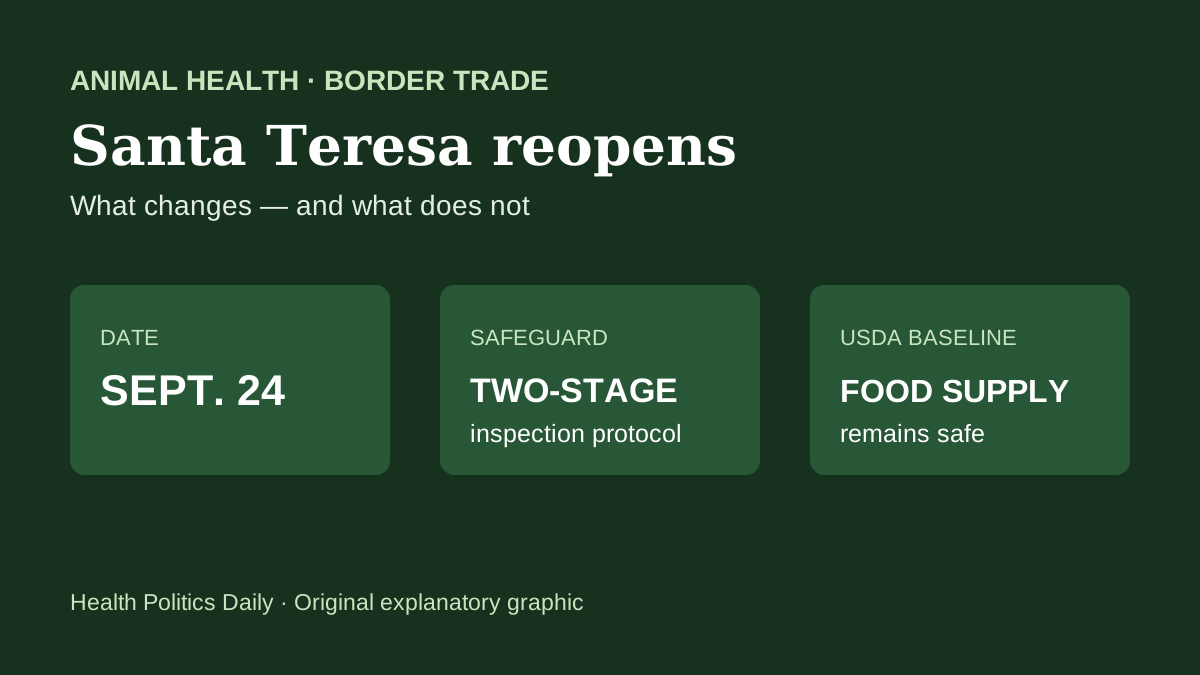
Verified Baseline
Santa Teresa is scheduled to resume livestock imports September 24
The U.S. Department of Agriculture says the Santa Teresa, New Mexico, livestock port will reopen to Mexican cattle under a joint inspection protocol. USDA previously reopened the Douglas, Arizona, crossing on August 24 after closing ports to limit New World screwworm spread.
The timing follows confirmed infections in U.S. animals, including horses in Texas and New Mexico. USDA’s current public guidance says the risk to people and animals nationally remains very low and that this is not a food-safety issue.
What Screwworm Is
The parasite attacks living tissue through open wounds
New World screwworm is the larval stage of a fly that lays eggs near wounds on warm-blooded animals. The larvae can cause rapidly worsening injury and death if an infestation is not treated. Livestock, wildlife, pets and, rarely, people can be affected.
Animal owners in affected areas should inspect wounds, use veterinarian-recommended fly control and promptly report suspicious larvae or enlarging wounds. Those are general biosecurity measures, not a reason for consumers to avoid inspected beef.
How the Reopening Works
Imported cattle face layered checks before entering the U.S.
USDA describes inspections in Mexico followed by a full U.S. inspection, along with treatment, traceability and monitoring requirements. The approach is designed to resume commerce without treating an open border as risk-free.
The safeguards reduce risk; they cannot prove that no infected animal will ever cross. Continued surveillance, rapid case tracing and sterile-fly releases remain central to containment.
Beef Prices
More imports may help supply, but price relief would take time
Mexico historically provides only a small share of total U.S. cattle supply, and reopening is phased. The United States also has its smallest cattle herd in decades after drought and years of weak producer economics. Those constraints cannot be reversed by one port.
Associated Press reporting citing agricultural economists says resumed imports are unlikely to quickly reduce retail beef prices. Any effect would move through feedlots, processors and retailers over time and could be outweighed by other supply and demand forces.
What Remains Uncertain
Case origins and the pace of additional reopenings are unresolved
Investigators have not publicly resolved how every U.S. animal became infected. Future port openings depend on whether surveillance and inspection systems continue to perform as intended. A wider outbreak could prompt renewed restrictions; successful containment could support further normalization.
Bias Lens: screwworm and the cattle border
USDA plans to reopen Santa Teresa on September 24 with layered safeguards. Recent U.S. animal cases are confirmed; USDA says the food supply remains safe and the national risk is very low.
Coverage varies more by subject emphasis than party position. Reuters centers the latest case and policy tension; AP emphasizes consumer prices; agricultural outlets emphasize operations and trade.
Principal Sources
Evidence and reporting used
- USDA APHIS — unified response and risk baseline
- USDA APHIS — current port and outbreak status
- Reuters — New Mexico case and reopening context
- Associated Press — beef-price implications
No suitable directly relevant authorized video with clear embedding permission was available.