U.S. Politics · Justice Department · Congressional Oversight
U.S. Attorney Threatens Legal Consequences Over Senator’s White House Ballroom Inquiry
A federal prosecutor ordered Sen. Richard Blumenthal to preserve records from his White House ballroom donor inquiry, while the senator issued a reciprocal demand and called the move intimidation.
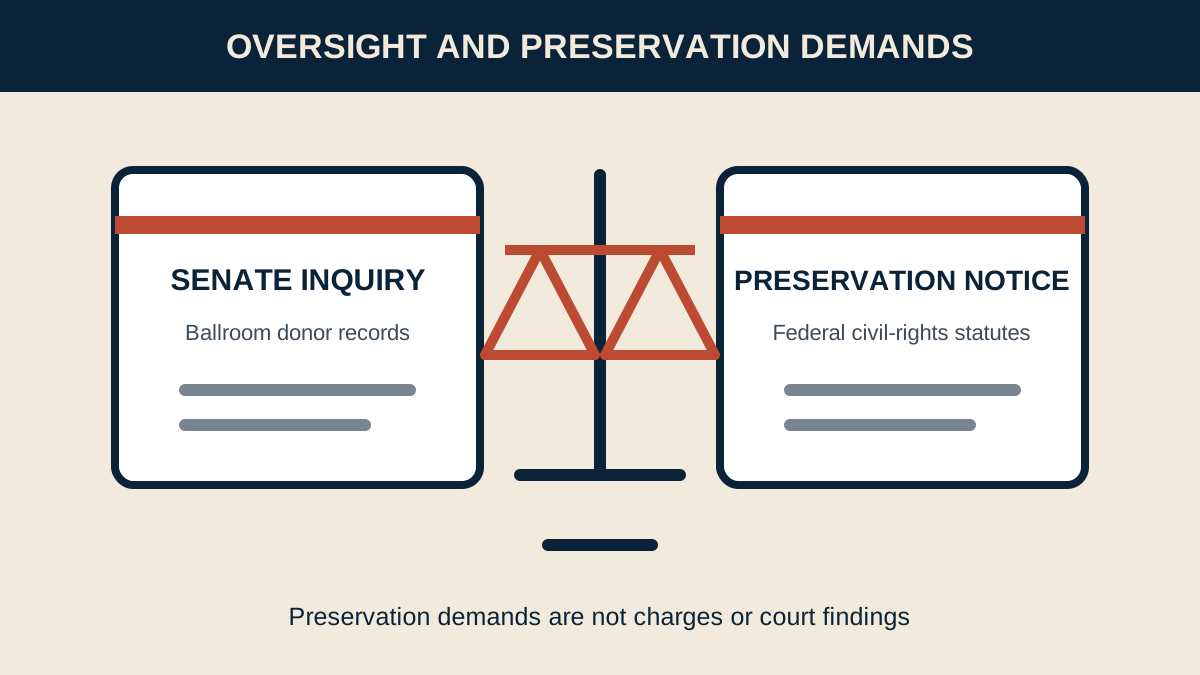
Verified baseline: two officials exchanged preservation demands
U.S. Attorney Aaron Reitz of the Southern District of Texas sent Sen. Richard Blumenthal a November 11 letter directing the Connecticut Democrat, his staff and others working with him to preserve records connected to the senator’s inquiry into donors financing President Donald Trump’s White House ballroom project.
Reitz accused Blumenthal of threatening citizens for associating with the president and cited 18 U.S.C. §241 and 18 U.S.C. §242, two federal civil-rights statutes. According to the letter as reproduced and quoted by Fox News and UPI, Reitz demanded written confirmation by 6 p.m. ET on November 18 and warned of possible legal consequences if relevant material is destroyed.
Blumenthal responded in an official letter that Reitz’s action “purports to initiate an investigation” and is baseless. He directed Reitz to preserve records and communications with the White House or senior Justice Department officials concerning the decision to draft and publish the prosecutor’s letter.
A preservation notice is meant to prevent destruction of potentially relevant evidence. It is not a subpoena, search warrant, indictment or judicial finding. Publicly available records reviewed for this article do not show that Blumenthal has been charged with a crime or that a grand jury has been convened.
What the senator was investigating
Blumenthal is the ranking Democrat on the Senate Permanent Subcommittee on Investigations and is expected to chair it when the new Congress begins in January. His October 21 donor letters sought records about how contributions were solicited, whether donors requested anonymity, which administration officials communicated with donors and whether favorable government action was discussed.
Those letters state the senator’s theory: private financing for a major government construction project could create conflicts if contributors also seek contracts, regulatory decisions or other federal action. They do not establish that any donor paid for a favor. Donors retain First Amendment rights to speech and association, and a congressional request for information does not itself prove corruption.
The new confrontation follows the White House’s separate warning that planned Democratic investigations could cross into criminal conduct. Health Politics Daily’s earlier explainer examines that broader executive–legislative conflict, while our midterm results report explains why committee control will change in January.
What the cited laws do—and do not establish
Section 241 prohibits two or more people from conspiring to injure, oppress, threaten or intimidate someone in the exercise of a federally protected right. Section 242 addresses willful deprivation of rights under color of law. The statutes require proof of specific elements; citing them in a letter does not establish that those elements are satisfied.
The Constitution’s Speech or Debate Clause says members of Congress may not be questioned elsewhere for legislative speech or debate. Courts have extended that protection to some acts integral to legislating, but the boundary is fact-specific and does not immunize every political or unofficial act. No court has decided whether the donor letters at issue here are protected legislative acts or unlawful intimidation.
Reitz’s office is based in Texas, while Blumenthal represents Connecticut and works in Washington. Public reporting has not identified the asserted venue, any target other than the senator, or evidence of a two-person conspiracy. Those are unresolved legal and factual questions, not proof that the prosecutor lacks authority.
Why the dispute matters
Congress depends on information requests, hearings and subpoenas to oversee executive agencies and consider legislation. The Justice Department is also responsible for protecting constitutional rights and enforcing federal criminal law. A prosecutor’s warning directed at a lawmaker’s oversight work therefore raises a separation-of-powers question even before any court becomes involved.
For companies and individuals that received donor inquiries, the exchange creates competing legal signals: preserve records for Congress, preserve records for the prosecutor and avoid destroying material that could become relevant to litigation. It does not require the public to assume either that the donations were corrupt or that the senator’s questions were criminal.
For taxpayers, the immediate issue is transparency around who financed the ballroom, what public money may support the project and whether contributors received government benefits. Those questions remain open. The preservation fight changes the oversight environment; it does not answer the underlying donor questions.
Practical implications
- For document recipients: a preservation notice generally means retaining potentially relevant records, not automatically turning them over. Any production demand, subpoena or warrant would be a separate legal instrument.
- For Congress: Blumenthal can continue voluntary inquiries, but subpoenas and formal committee action depend on Senate rules, committee authority and the next Congress’s organization.
- For the Justice Department: opening a formal criminal case, seeking compulsory process or filing charges would require additional procedural steps that have not been publicly announced.
- For the public: descriptions such as “weaponization,” “corruption” and “abuse of power” are the parties’ competing characterizations. The letters, statutes and any future court filings are the verifiable record.
Fact, analysis, forecast and opinion
Verified fact: Reitz and Blumenthal exchanged written preservation demands, and the prosecutor cited federal civil-rights statutes while warning of legal consequences. Analysis: the clash tests how aggressively the executive branch can scrutinize congressional oversight without chilling legitimate legislative work. Forecast: the November 18 response deadline and January committee transition may generate more letters, hearings or litigation, but no particular next step is assured. Opinion: Health Politics Daily takes no position on either official; both sides should publish operative legal documents and distinguish allegations from proven violations.
Bias Lens: rights protection, intimidation or an unresolved powers dispute?
Verified baseline: a U.S. attorney ordered a senator to preserve records and cited §§241 and 242; the senator denied wrongdoing and issued a reciprocal preservation demand. Neither letter is a criminal charge or court ruling.
Left-leaning — Democracy Docket: frames the letter as an executive threat to constitutionally protected oversight. Center — UPI: leads with the prosecutor’s preservation demand, then summarizes the ballroom inquiry and Blumenthal’s response. Right-leaning — Fox News: presents the dispute as dueling letters and gives prominent space to Reitz’s First Amendment rationale.
The differences concern emphasis and legal framing. Democracy Docket foregrounds congressional protection, Fox foregrounds donor associational rights, and UPI centers the chronology. The common factual core is narrower than any of those interpretations: preservation demands were exchanged, while criminal liability and legislative immunity remain undecided.
What remains uncertain
The public record does not establish whether Reitz has opened a formal criminal investigation, whether Justice Department headquarters approved the letter, what evidence supports the cited statutes or what legal process could follow after November 18. It is also unknown whether donors will voluntarily provide all requested information or whether the next Senate majority will authorize subpoenas.
Any court reviewing the conflict would need a developed factual record about the purpose, scope and manner of the senator’s requests and the prosecutor’s authority. Until then, categorical claims that the inquiry is unquestionably criminal—or unquestionably immune—go beyond what has been verified.
Principal sources
- Sen. Richard Blumenthal — response and reciprocal preservation demand
- Senate office — October donor inquiry and requested records
- U.S. House Office of the Law Revision Counsel — 18 U.S.C. §241
- U.S. House Office of the Law Revision Counsel — 18 U.S.C. §242
- UPI — preservation demand, deadline and donor-inquiry context
No suitable directly relevant official or publisher-authorized video with clear, persistent embedding permission was available, so no video was embedded.
No comments yet.