Finance · U.S. Economy · Inflation
October Consumer Prices Rise 0.4% as Fed Officials Weigh Faster Rate Hikes
Food, shelter, energy and medical costs increased in October, strengthening the case for another Federal Reserve rate increase while leaving the size of the December move unsettled.
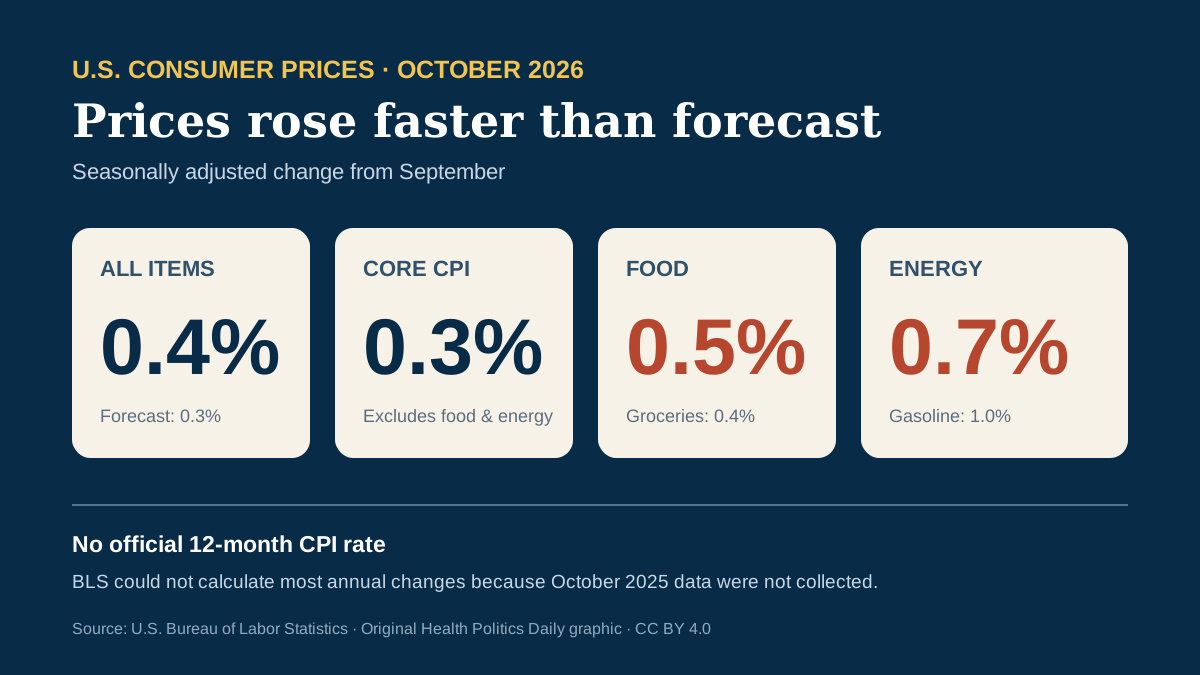
Verified baseline: prices rose more than economists expected
The Consumer Price Index rose 0.4% from September to October on a seasonally adjusted basis, the Bureau of Labor Statistics reported. That was slower than September’s 0.6% increase but above the 0.3% median forecast in a Reuters survey. Core CPI, which excludes volatile food and energy prices, rose 0.3% for a third consecutive month, also above the 0.2% forecast.
Shelter rose 0.3% and accounted for more than 30% of the overall monthly increase. Food rose 0.5%, including a 0.4% rise for groceries. Energy rose 0.7%; gasoline increased 1.0% after a 9.1% September jump. Medical care rose 0.3%, with hospital services up 0.8% and physicians’ services up 0.4%.
The report does not contain the usual official 12-month inflation rate. BLS did not collect most October 2025 price data during a lapse in federal appropriations, so it cannot calculate valid year-over-year changes for most series. Private estimates that fill the gap are analytical approximations, not official CPI readings.
Why the report matters to households
A monthly CPI increase is not a forecast that every household’s bill will rise by the same amount. People buy different mixes of housing, food, transportation, health care and other services, and local price changes can differ from the national average.
The broad pattern nevertheless matters. Grocery prices resumed rising, shelter remained a major contributor and medical-service increases accelerated. Used vehicle prices fell 1.2%, providing relief in one category, but that decline did not offset increases across many services.
For borrowers, another Federal Reserve increase would directly raise some variable rates and could keep credit-card, auto-loan and home-equity borrowing expensive. Fixed mortgage rates and Treasury yields respond to broader market expectations rather than mechanically tracking a single Fed move. Savers may receive higher yields, though bank deposit rates do not adjust uniformly or immediately.
What Fed officials said—and what they did not decide
Before the CPI release, Federal Reserve Governor Christopher Waller said in an official speech that he supported a quarter-point increase in December under his expected outlook. He added that if monthly core CPI came in around 0.3% or higher, a half-point increase should be considered. The reported core reading met that condition.
Dallas Fed President Lorie Logan said in her November 10 policy address that the policy rate was at least half a percentage point below a modestly restrictive level. She supported at least two additional quarter-point increases and said the Fed might move more rapidly this winter.
Those comments are individual views, not a committee decision. The Federal Open Market Committee votes on December 9 after receiving additional employment, spending and price data. A quarter-point move, a half-point move or no change remains possible.
Fact, analysis, forecast and opinion
Verified fact: CPI rose 0.4% and core CPI rose 0.3% in October; food, shelter and energy all increased. Analysis: the combination of broad service-price gains and a solid labor market gives officials more reason to restrain demand. Forecast: a December rate increase is now widely expected, but market probabilities can change and do not bind the Fed. Opinion: Health Politics Daily takes no position on the appropriate interest-rate path.
Important context
The Fed targets 2% inflation using the Personal Consumption Expenditures price index, not CPI. The two measures use different weights and methods. September core PCE inflation was 3.1% over 12 months, and October PCE data will arrive later.
October’s labor report showed employers added 165,000 jobs and unemployment held at 4.1%. Our earlier coverage explains why that labor picture was stronger but uneven. The prior CPI report found September inflation rose 0.6% as gasoline drove more than half the increase; October slowed from that pace, but underlying inflation did not cool as much as forecasters expected.
What remains uncertain
The missing October 2025 price observations limit annual comparisons and make month-to-month readings unusually important. One month cannot establish a lasting trend, and energy prices could change quickly with developments in the Middle East, shipping and refinery capacity.
It is also unclear how much current inflation reflects temporary supply disruptions, tariffs, strong demand, AI-related investment or persistent service-price pressure. The next CPI release is scheduled for December 10, one day after the Fed’s December decision.
Bias Lens: cooling headline, household squeeze or case for faster hikes?
Verified baseline: Monthly CPI rose 0.4%, core CPI rose 0.3%, and BLS did not publish most 12-month changes because October 2025 data are missing. The report exceeded consensus forecasts but slowed from September’s 0.6% monthly rise.
Left-leaning — The Guardian: emphasized that the monthly pace cooled and gasoline costs eased on an unadjusted basis, while noting food and energy pressure and the missing annual comparison. Center — Associated Press: focused on inflation spreading beyond energy shocks and the consequences of faster tightening for mortgages, credit cards and other borrowing. Right-leaning — Fox Business: foregrounded the above-forecast reading, household purchasing power and the likelihood that the Fed will act in December.
All three report the same monthly BLS figures. The framing differs mainly in whether the lead signal is deceleration from September, persistence across the economy or the burden on consumers and monetary-policy response.
Principal sources
- Bureau of Labor Statistics — October 2026 CPI summary
- Bureau of Labor Statistics — detailed CPI tables
- Federal Reserve Governor Christopher Waller — economic outlook speech
- Dallas Fed President Lorie Logan — policy outlook
- Associated Press — inflation breadth and borrowing implications
- Reuters — forecasts and market rate expectations
Publisher-authorized Fox Business video coverage of the CPI report is available on the publisher’s page. It is linked rather than embedded because persistent third-party embedding permission was not clear.
No comments yet.