International Politics · China · Taiwan
G7 Says China’s Actions East of Taiwan Threaten Shipping and Stability
Foreign ministers issued their strongest unified warning yet about Chinese activity in waters east of Taiwan. The declaration raises diplomatic pressure but creates no new sanctions, military commitment or restriction on commercial navigation.
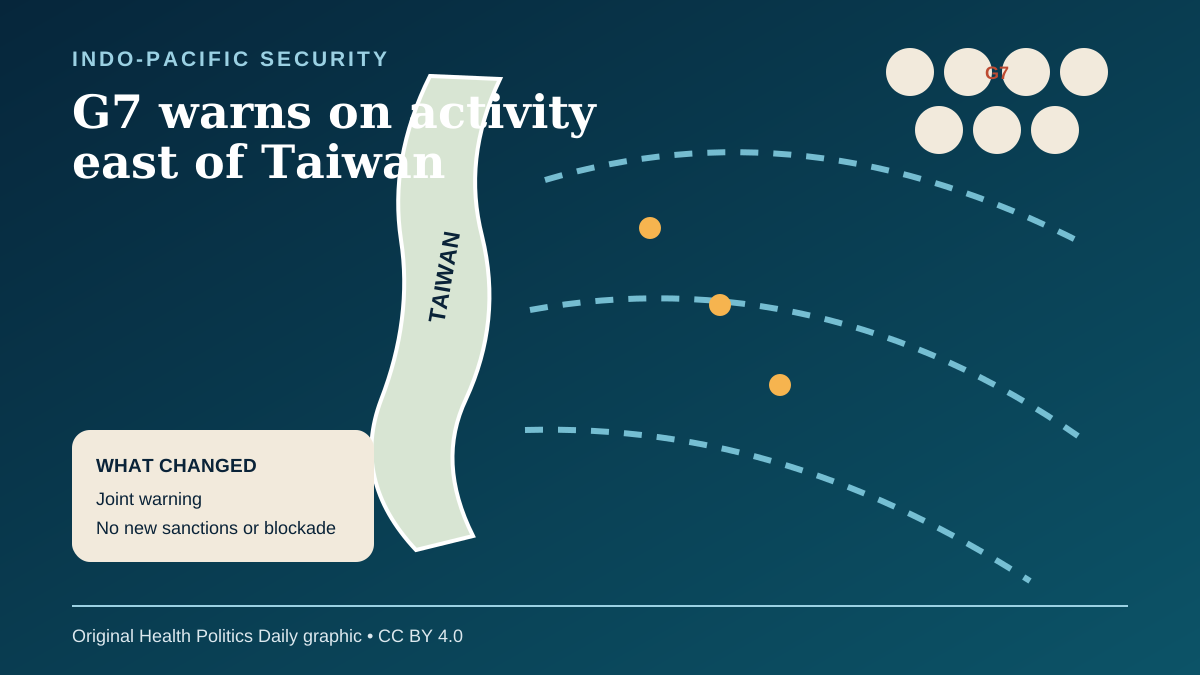
Verified baseline: a joint warning, not a new enforcement action
Foreign ministers from Canada, France, Germany, Italy, Japan, the United Kingdom and the United States said China’s increasingly assertive activity in waters east of Taiwan threatens regional stability, freedom of navigation and the safety of international shipping. The language appears in the joint declaration released by France after the November 9–10 G7 foreign ministers’ meeting in Paris.
The ministers opposed attempts to change the status quo by force, coercion or threats and encouraged constructive cross-strait dialogue. They also supported Taiwan’s meaningful participation in international organizations.
The declaration did not announce sanctions, a naval deployment, an escort program, a mutual-defense guarantee or a new shipping rule. It is a coordinated political statement. Its practical effect depends on whether G7 governments follow it with diplomacy, export controls, maritime operations or other measures that have not yet been announced.
Why the waters east of Taiwan matter
Taiwan’s western side faces the Taiwan Strait and China’s coast. Its eastern side opens into the Philippine Sea and the wider Pacific, making it important for commercial routes and, in a crisis, possible resupply or access by outside forces. Activity there can therefore test pressure beyond the strait itself.
China has conducted regular coast-guard patrols east of Taiwan since June, according to Reuters. Taiwanese officials say overlapping military, coast-guard and civilian activity could rehearse elements of a maritime blockade. That is Taiwan’s assessment, not proof that a blockade has begun or that Beijing has decided to impose one.
Taiwan’s defense ministry reported that from 6 a.m. November 11 to 6 a.m. November 12 local time, it detected seven Chinese military aircraft, six naval ships and two official ships around Taiwan; three aircraft entered the island’s southwestern and eastern air-defense identification zones. An air-defense identification zone is a monitoring area, not sovereign airspace, and entry does not by itself establish an attack.
Beijing and Taipei dispute the legal and political baseline
Beijing claims Taiwan as part of China and says activities east of the island fall within China’s sovereign rights and jurisdiction. In an October Foreign Ministry briefing, spokesperson Mao Ning called Chinese activity in the area lawful and said outside governments—not China—were disrupting stability.
Taiwan rejects Beijing’s sovereignty claim. Its foreign ministry says Chinese vessels have interfered with merchant shipping and tried to assert jurisdiction that Taiwan considers unlawful. A June statement from Taipei said China has no right to act against vessels exercising navigation rights in Taiwan’s claimed exclusive economic zone.
The G7 language aligns with Taipei’s security concerns but does not resolve sovereignty or maritime-boundary disputes. The declaration invokes international law and the United Nations Convention on the Law of the Sea; it does not create an international-court judgment about a specific patrol.
Practical implications for travelers, shippers and businesses
- Commercial routes remain open: neither the G7 nor authorities in the region announced a closure, blockade or general diversion order.
- Operators should use official notices: shipping companies and airlines should rely on navigational warnings, port authorities, aviation notices and insurers—not social-media claims—to assess route changes.
- Supply chains face contingency risk: a real interruption near Taiwan could affect semiconductors, energy shipments and trade across the western Pacific, but the declaration itself does not interrupt deliveries.
- No immediate consumer action is required: the statement does not change travel documents, tariffs, sanctions compliance or product availability by itself.
The site previously examined the agenda for the Trump–Xi summit and the investigation into F-35 parts diverted to Hong Kong. The new G7 declaration adds a collective maritime-security warning; it does not replace those separate diplomatic and export-control processes.
Fact, analysis, forecast and opinion
Verified fact: the G7 declaration warns that Chinese activity east of Taiwan threatens stability and shipping safety, Taiwan welcomed the statement, and Beijing had not issued a specific public response to the declaration at publication. Analysis: speaking jointly raises the diplomatic cost of further pressure and signals that the issue is no longer framed only as a bilateral China–Taiwan dispute. Forecast: patrols, military monitoring and diplomatic protests are likely to continue, but the declaration alone cannot establish whether activity will escalate or recede. Opinion: Health Politics Daily takes no position on Taiwan’s status or on the preferred policy response.
Bias Lens: security warning, neutral reporting or sovereignty dispute?
Verified baseline: the G7 published a joint warning about activity east of Taiwan and supported peaceful dialogue. It did not announce force, sanctions or a legal ruling.
Coverage availability: at publication, the new declaration had not produced enough substantial, directly comparable coverage from clearly left-leaning and right-leaning national outlets to support a responsible three-way ideological comparison. Forcing older or tangential stories into those categories would create false symmetry.
Center — Reuters: foregrounds the joint warning, commercial-navigation stakes, patrol history and the competing positions of Taipei and Beijing. Official G7 — France’s foreign ministry: places Taiwan inside a broader rules-based Indo-Pacific agenda. Official Chinese position — China’s foreign ministry: treats patrols as lawful sovereign activity and external criticism as interference. Official Taiwanese position — Taiwan’s foreign ministry: describes the activity as unlawful maritime harassment.
These are differences in institutional position and evidentiary emphasis, not substitutes for independent verification. Official statements establish what governments claim and do; they do not automatically prove the opposing side’s intent.
What remains uncertain
China’s foreign ministry had not issued a specific response to the new G7 language by publication. It is unknown whether G7 members will coordinate additional measures, whether patrol frequency or behavior will change, or whether any government will release evidence clarifying the blockade-rehearsal assessment.
The declaration does not define thresholds for future action. A coast-guard patrol, an order directed at a merchant ship, a military exercise and an actual blockade are legally and operationally different events; reporting should not collapse them into one category.
Principal sources
- France Diplomatie — G7 foreign ministers’ joint declaration
- Taiwan Ministry of National Defense — November 12 activity report
- Taiwan Ministry of Foreign Affairs — position on eastern-waters patrols
- China Ministry of Foreign Affairs — stated legal and sovereignty position
- Reuters — patrol history, regional context and Taiwan’s response
No directly relevant official or publisher-authorized video with clear, persistent embedding permission was available at publication, so no video was embedded.
No comments yet.