Health · Pharmaceutical Finance · Clinical Trials
Blackstone Will Fund Up to $1.5 Billion of Pfizer’s Monthly Obesity-Drug Trials
The agreement shifts part of the development cost and risk for berobenatide to Blackstone. It does not make the experimental monthly GLP-1 medicine available to patients or establish that it is safe and effective.
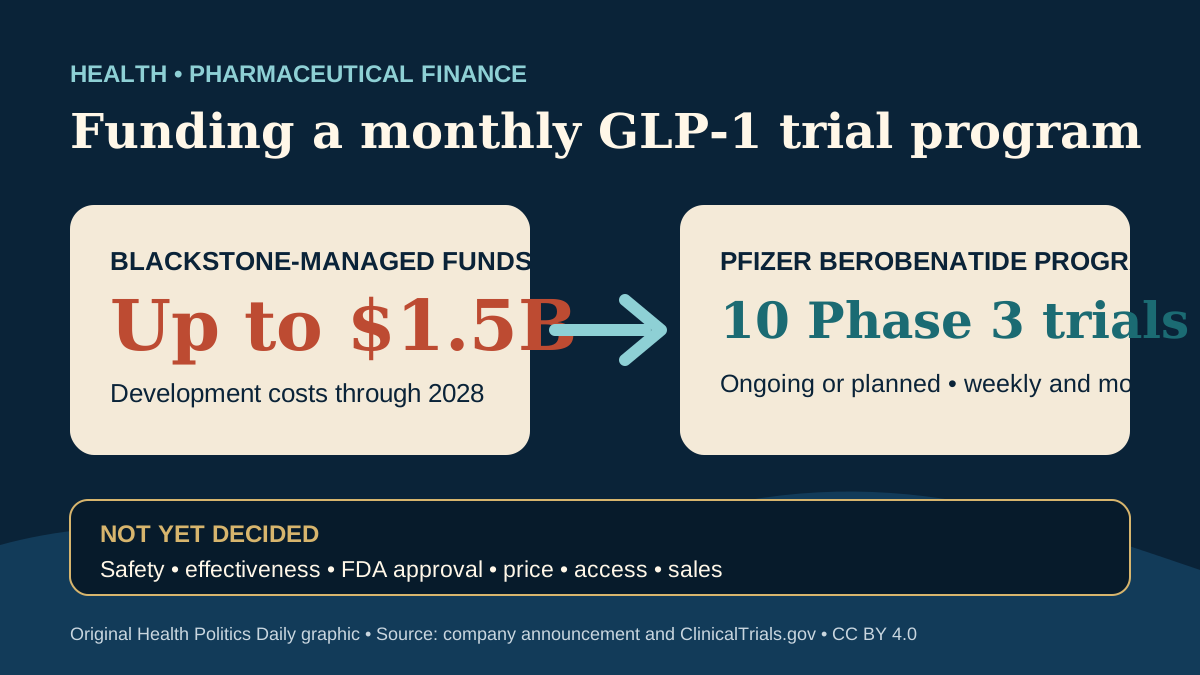
Verified baseline: development funding, not a drug approval
Pfizer and Blackstone Life Sciences announced that Blackstone-managed funds will pay up to $1.5 billion of development costs through 2028 for berobenatide, an injectable GLP-1 receptor agonist being tested for chronic weight management and obesity-related conditions.
In return, Blackstone could receive milestone-based payments if monthly berobenatide monotherapy wins U.S. regulatory approval and later reaches specified sales levels. The companies did not disclose the payment amounts. Reuters reported that Blackstone receives no ownership stake or rights to the medicine, while Pfizer retains control of development.
The words up to matter. The headline figure is a ceiling tied to future development spending, not $1.5 billion delivered immediately. It is also not a forecast of sales, a valuation of the drug or an FDA judgment about the evidence.
What berobenatide is—and what is still being tested
Berobenatide, also identified as PF-08653944 and formerly MET-097, is designed to activate the GLP-1 receptor. Pfizer is studying weekly and monthly regimens, including use for obesity and related conditions such as obstructive sleep apnea and knee osteoarthritis.
Pfizer says it has 10 ongoing or planned Phase 3 studies in the program. A ClinicalTrials.gov record for one monthly Phase 3 study lists 258 planned participants with obstructive sleep apnea and overweight or obesity, with a primary completion estimate of June 2028. A registry record describes a study plan; it is not a result.
Earlier Phase 2b findings were presented by Pfizer at an American Diabetes Association meeting. The company reported nearly 16% non-placebo-adjusted weight loss in one weekly-dose extension at 32 weeks and said the results supported monthly-dose testing. Those figures were sponsor-reported, came from a particular trial population and dosing design, and cannot establish how an approved product would perform in routine care.
Why the financing structure matters
Late-stage drug programs can require multiple large trials, manufacturing preparation and regulatory work before a company knows whether a medicine will reach the market. External funding lets Pfizer share part of that financial exposure while continuing a broad development program.
Blackstone’s return is contingent: the agreement links payments to regulatory approval and commercial milestones. That can align the investor’s payoff with success, but it also creates future financial obligations for Pfizer if the program works. The companies did not publish enough detail to calculate the deal’s eventual cost or compare it directly with ordinary borrowing.
For investors, the agreement may preserve Pfizer cash for other research, but it does not remove clinical, regulatory or commercial risk. For patients, financing can keep trials moving; it does not shorten the FDA’s evidence requirements or guarantee access, insurance coverage, price or supply.
Practical implications for patients and trial participants
- No prescription change: berobenatide is investigational and is not an approved alternative to existing GLP-1 medicines.
- Trial eligibility is specific: study criteria, locations, risks and procedures vary. A registry listing is not a recommendation to enroll.
- Monthly dosing remains a research question: convenience is a potential benefit, but safety, durability, adherence and comparative effectiveness still require evidence.
- Existing safety information still governs approved products: the deal does not change the FDA’s new class-wide vision-loss warning or any current label.
This report provides general information, not personalized medical or investment advice. Decisions about treatment or trial participation belong with qualified clinicians and the official study team; investment decisions require an individual assessment of risk.
Fact, analysis, forecast and opinion
Verified fact: Blackstone may fund up to $1.5 billion of berobenatide development costs through 2028, with potential milestone payments tied to approval and sales. Analysis: the arrangement shares development risk and gives Pfizer more flexibility across its pipeline. Forecast: the funding can support the planned trials, but trial completion, FDA approval, launch timing and market uptake cannot be predicted. Opinion: Health Politics Daily takes no position on the companies, the medicine or their securities.
Bias Lens: financing breakthrough, pipeline bet or evidence still in progress?
Verified baseline: the agreement covers up to $1.5 billion in development costs; berobenatide remains experimental; Blackstone’s potential payments depend on future approval and sales milestones.
Primary-source framing — Pfizer and Blackstone: emphasize development momentum, flexibility and the potential of monthly dosing. Center news framing — Reuters: leads with the financing terms and places the program in Pfizer’s broader effort to rebuild its pipeline. Business-market framing — The Wall Street Journal: foregrounds the size of the deal and competition in weight-loss drugs.
A meaningful left–center–right split has not emerged around this technical financing announcement. Assigning partisan labels to thin or unrelated coverage would create false symmetry; the material difference is whether coverage emphasizes corporate strategy, transaction mechanics or the evidence that patients still need.
What remains uncertain
The companies have not disclosed the schedule of Blackstone’s funding, the size of potential milestone payments or the full economic return Blackstone could receive. The Phase 3 program has not established long-term safety, effectiveness, the best dose, the value of monthly administration, performance against approved competitors or whether regulators will approve any indication.
Price and access are also unknown. Even if berobenatide eventually receives approval, coverage decisions, manufacturing capacity and negotiated prices would determine how widely it is used. Related context includes the site’s reports on WHO childhood-obesity guidance and a separate drug-company acquisition involving an experimental medicine.
Principal sources
- Pfizer — November 11 funding announcement and program details
- Blackstone Life Sciences — agreement terms and risk disclosures
- ClinicalTrials.gov — monthly Phase 3 obstructive-sleep-apnea study record
- Pfizer — sponsor-reported Phase 2b results and Phase 3 plan
- Reuters — independent reporting on ownership, milestones and pipeline context
No suitable directly relevant official or publisher-authorized video with clear persistent embedding permission was available, so none was embedded.
No comments yet.