International Politics · Ukraine · Diplomacy
Russia and Ukraine Agree to Large Prisoner Exchange but No Ceasefire
The first direct talks in nine months produced a humanitarian commitment in principle, while territory, security guarantees and Europe’s role remain unsettled.
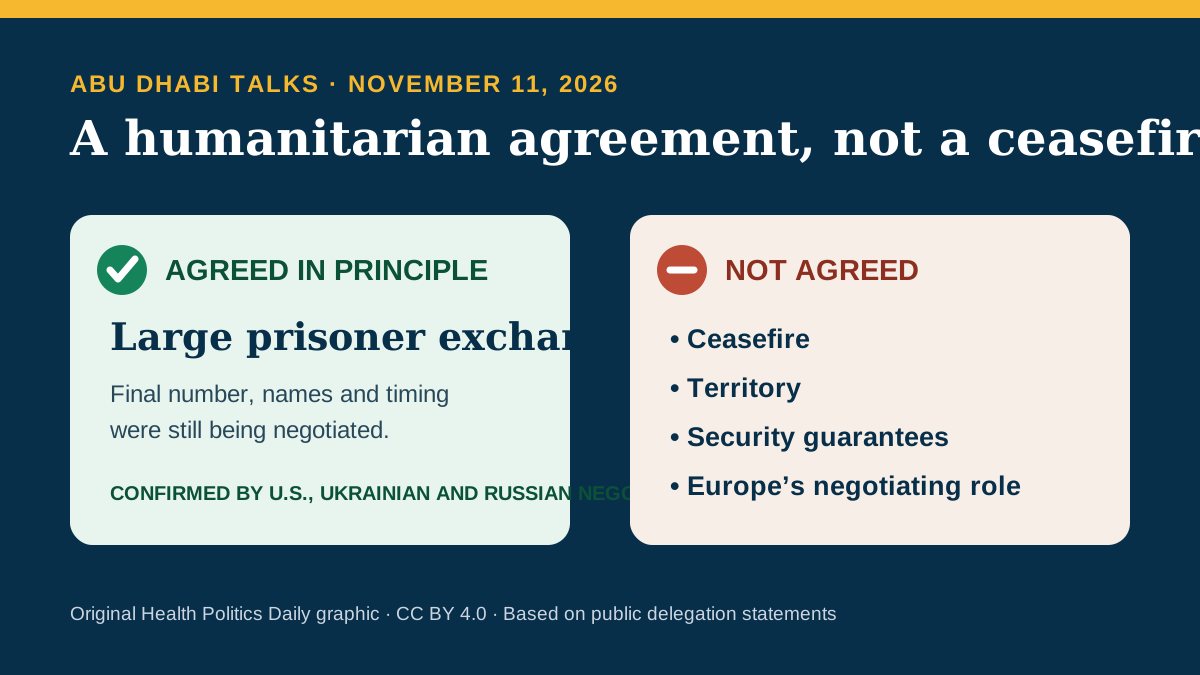
Verified baseline: an exchange was agreed in principle
Russian and Ukrainian negotiators agreed in principle to a large exchange of prisoners of war as two days of U.S.-mediated talks ended in Abu Dhabi. Ukrainian lead negotiator Rustem Umerov said the parties were still working on details and implementation; Russian delegation head Vladimir Medinsky separately confirmed a fundamental agreement. U.S. envoy Jared Kushner said the final number would be worked out Thursday.
The exact scale was not final at publication. A Russian general told the state news agency TASS that more than 1,000 people on each side could be involved, while Ukrainian President Volodymyr Zelenskyy had discussed possible formats of 1,000-for-1,000 or 1,500-for-1,500 before the talks concluded. Those figures are negotiating positions and reported expectations, not a completed exchange list.
The parties did not announce a ceasefire, territorial agreement or comprehensive peace framework. Fighting continued during the negotiations, and the central disputes over occupied territory, postwar security guarantees and participation by European governments remain open.
What the agreement means for prisoners and families
If implemented, the exchange would return a large number of captives to their home countries and end months or years of uncertainty for some families. But an agreement in principle does not identify who will be released, when transfers will occur or whether civilians and other detainees will be included alongside recognized prisoners of war.
Lists typically require identity checks, confirmation of custody, medical coordination and arrangements for a safe transfer. Families should rely on their governments’ official prisoner-coordination channels rather than social-media lists or requests for money. Publicly naming a captive before authorities confirm a transfer can create false hope and expose relatives to scams.
Under the Third Geneva Convention, prisoners of war must be treated humanely. The exchange negotiations are a separate process from investigations into mistreatment, missing persons, detained civilians or children transferred from occupied areas.
Why no ceasefire emerged
The humanitarian channel is narrower than a political settlement. Russia continues to demand changes involving Ukrainian-held territory and the future European security order. Ukraine says territorial decisions belong at the leaders’ level and that European countries must participate in decisions affecting the continent’s security.
Representatives from European governments, the European Union and NATO were in Abu Dhabi but were not part of the direct trilateral sessions. Medinsky questioned their role; Ukraine and the United States said Europe would be integral to durable postwar security arrangements. That disagreement is not procedural trivia: European states would be central to sanctions, reconstruction, military support and any future security guarantee.
What happens next
Kushner and U.S. envoy Steve Witkoff said they would travel to Moscow on Thursday to meet President Vladimir Putin, then go to Dublin to meet Zelenskyy. The stated agenda includes finalizing the prisoner-exchange numbers and testing whether positions on territory and security can be narrowed.
Those meetings are diplomatic steps, not evidence that a peace deal is imminent. A verifiable ceasefire would require agreed terms, a start time, geographic scope, monitoring and consequences for violations. None of those elements was announced in Abu Dhabi.
Fact, analysis, forecast and opinion
Verified fact: all three delegations confirmed a large prisoner exchange in principle, with details still being negotiated. Analysis: the agreement shows the humanitarian channel can function even while the political gap remains wide. Forecast: an exchange may occur within weeks, but timing and scale can change until lists and logistics are complete. Opinion: Health Politics Daily takes no position on the territorial or security terms the parties should accept.
Important context
Prisoner exchanges have occurred throughout the war without producing a durable ceasefire. A 1,000-for-1,000 exchange was completed over three days in May 2025 after talks in Istanbul. The latest negotiations therefore matter for the people released, but their humanitarian value should not be presented as proof that the wider war is close to ending.
The site previously reported when Russia agreed in principle to resume three-way talks and when a limited Oleshky ceasefire enabled aid and evacuations. The Abu Dhabi outcome is the first concrete result of the new negotiating round, while remaining far short of a national ceasefire.
What remains uncertain
Officials have not published the final number of captives, names, eligibility rules, transfer locations or a binding timetable. It is also unclear whether the next round will include European representatives, whether leaders will meet directly or whether either side will modify its territorial demands.
Claims that the exchange is already complete, that a ceasefire has begun or that a peace agreement has been reached are unsupported by the public record as of 11:58 a.m. Eastern time Wednesday.
Bias Lens: humanitarian result, diplomatic opening or warning about unresolved risks?
Verified baseline: Russia and Ukraine agreed in principle to a large prisoner exchange. The number and timing were not final, and no ceasefire or territorial settlement was announced.
Left-leaning — The Guardian: foregrounded Ukraine’s insistence on European participation and the risk of continental security decisions being made without Europe. Center — Associated Press: led with the prisoner exchange, then emphasized the absence of a major breakthrough and the concrete next diplomatic stops. Right-leaning — Fox News Digital: in its pre-outcome coverage, emphasized U.S. mediation, leverage and safeguards against another Russian invasion; it had not published a comparably detailed outcome article when this report was completed.
The factual overlap is substantial. The main framing difference is whether the talks are viewed first through European exclusion, the limited humanitarian result or the U.S. effort to build enforceable security arrangements. The timing difference in Fox’s article is stated to avoid presenting pre-talk expectations as post-talk reporting.
Principal sources
- President of Ukraine — official pre-talk priorities and European participation
- Reuters — delegation statements, unresolved issues and next steps
- Reuters — Medinsky’s post-talk statement
- Associated Press — prisoner exchange agreement and meeting schedule
- Kyiv Independent — Umerov’s statement and implementation status
- International Committee of the Red Cross — Third Geneva Convention
No directly relevant official or publisher-authorized video with clear, persistent embedding permission was available at publication, so no video was embedded or linked.
No comments yet.