Finance · United Kingdom · Monetary Policy
Bank of England Raises Interest Rate to 4% in 8–1 Vote
The first increase since August 2023 aims to prevent higher energy costs from becoming persistent inflation. It raises some borrowing costs, may improve savings returns and does not commit policymakers to another increase.
By Health Politics Daily News Desk · November 5, 2026 at 8:02 a.m. ET

Verified baseline
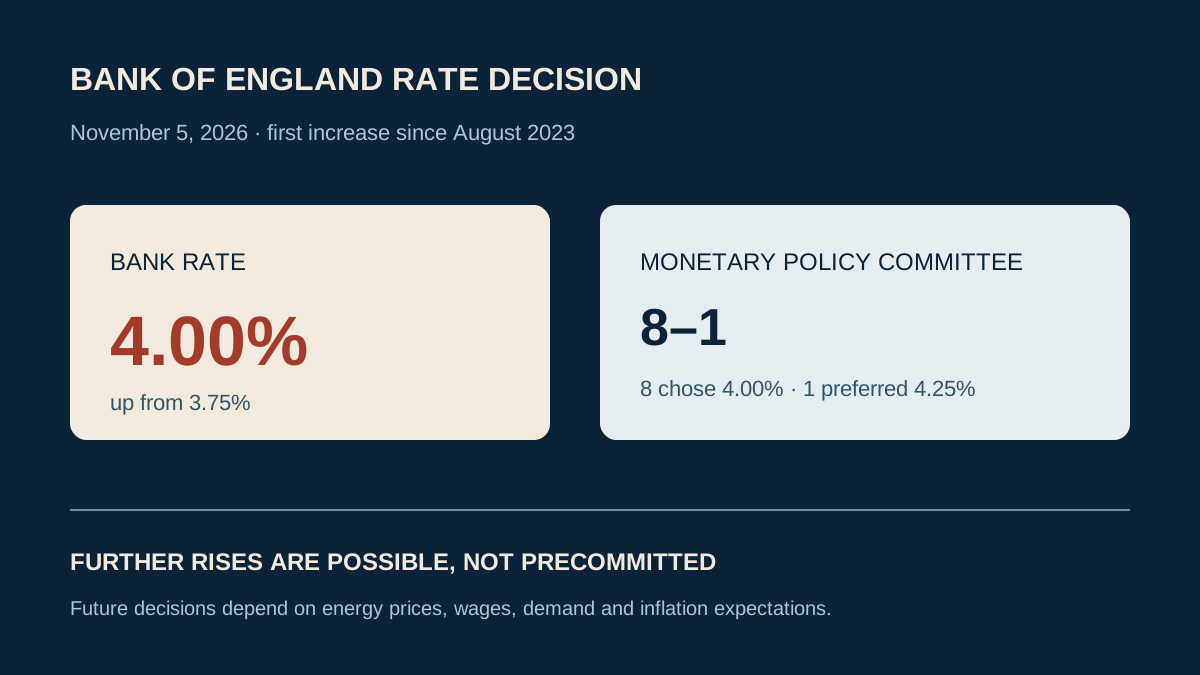
The Bank of England increased Bank Rate from 3.75% to 4% on November 5, its first rise since August 2023. Eight members of the nine-person Monetary Policy Committee supported the quarter-point increase; Catherine Mann preferred a half-point move to 4.25%.
The official decision and minutes cited inflationary pressure from higher energy costs. UK consumer-price inflation was 3.5% in September, above the Bank's 2% target, and policymakers projected inflation could approach 5% by mid-2027.
Why the Bank raised rates now
Higher oil, gas and electricity costs from the Middle East conflict are feeding into household bills and business expenses. The direct effect is already visible; the harder question is whether workers seek compensating wage increases and companies raise prices more broadly, creating persistent “second-round” inflation.
The committee said evidence of those wider effects remained limited, but inflation pressure in the pipeline was sufficient to act. The decision was therefore preventive as well as responsive: policymakers are trying to stop temporary energy shocks from changing longer-term price and wage behaviour.
What it means for mortgages and other borrowing
Borrowers on variable or tracker mortgages can see payments rise relatively quickly when Bank Rate increases, depending on contract terms. Fixed-rate borrowers keep their current payment until the fixed period ends, but new offers and refinancing rates already reflect market expectations and may not move by exactly 0.25 percentage points.
Credit cards, business loans and other variable-rate products may also become more expensive. Lenders set retail rates using funding costs, credit risk, competition and margins as well as Bank Rate, so there is no universal pass-through.
What it means for savers
Banks and building societies may raise savings rates, especially where they compete for deposits, but they are not required to pass on the full increase. Existing fixed-rate savings accounts remain governed by their contracts. Comparing annual equivalent rates, access conditions and deposit protection matters more than assuming every account will improve equally.
This is general financial information, not personalized borrowing, savings or investment advice.
Why another increase is possible—but not certain
Governor Andrew Bailey said a further rise could be justified without news that softens inflation risks, but policymakers did not announce a preset series. Several members said another near-term increase might be warranted; others stressed weak demand and uncertainty.
Oil prices fell sharply after the U.S. midterms as investors reassessed the probability of further Iran-war escalation. If that decline lasts, the UK inflation outlook could improve. If energy costs stay high or feed into wages and services prices, the case for more tightening would strengthen.
Fact, analysis, forecast and opinion
Verified fact: Bank Rate rose to 4% in an 8–1 decision, with the dissenter favouring 4.25%. Analysis: the Bank is weighing above-target inflation against the risk that higher borrowing costs weaken demand. Forecast: inflation may approach 5% next year, but that is a conditional projection, not a measured outcome. Opinion: Health Politics Daily takes no position on the appropriate rate.
Bias Lens: inflation defence or household squeeze?
Verified baseline: the Bank raised its policy rate by 0.25 percentage points after all nine members supported an increase; eight chose 4% and one chose 4.25%.
Left-leaning — The Guardian: emphasizes the energy shock, construction weakness and pressure on households alongside the inflation rationale. Center — Associated Press: foregrounds the decision, vote, inflation path and conditional outlook. Right-leaning — The Sun: focuses heavily on mortgage payments, consumer pain and the possibility of another pre-Christmas rise.
The outlets select different consequences and levels of urgency. Those framing choices do not change the decision or vote, and the Bank has not promised another increase before Christmas.
What remains uncertain
The path of the Iran conflict, energy prices, wages, services inflation and household demand will shape the next decision on December 17. Forecasts are ranges around assumptions; they cannot tell an individual borrower exactly when a lender will change a product rate.
Principal sources
- Bank of England — November decision and minutes
- Bank of England — November Monetary Policy Report
- Reuters — policymakers' views and rate outlook
- Associated Press — decision and economic context
No suitable directly relevant authorized video with clear persistent embedding permission was available at publication.
No comments yet.