Finance · U.S. Politics · Markets
Dow Jumps 1,569 Points as Oil Falls 8.7% After Midterms
U.S. shares rallied while crude prices plunged as investors reassessed political gridlock, the Iran war and regulation. The moves show rapidly changing expectations—not settled policy or a guaranteed economic path.
By Health Politics Daily News Desk · November 5, 2026 at 5:56 a.m. ET

Watch in this article
Pumpjack operating at the Kern River Oil Field
A short CC0 field video provides visual context for reporting on oil production and fuel supply.
Thomas Farley / Wikimedia Commons · CC0 1.0 · License and source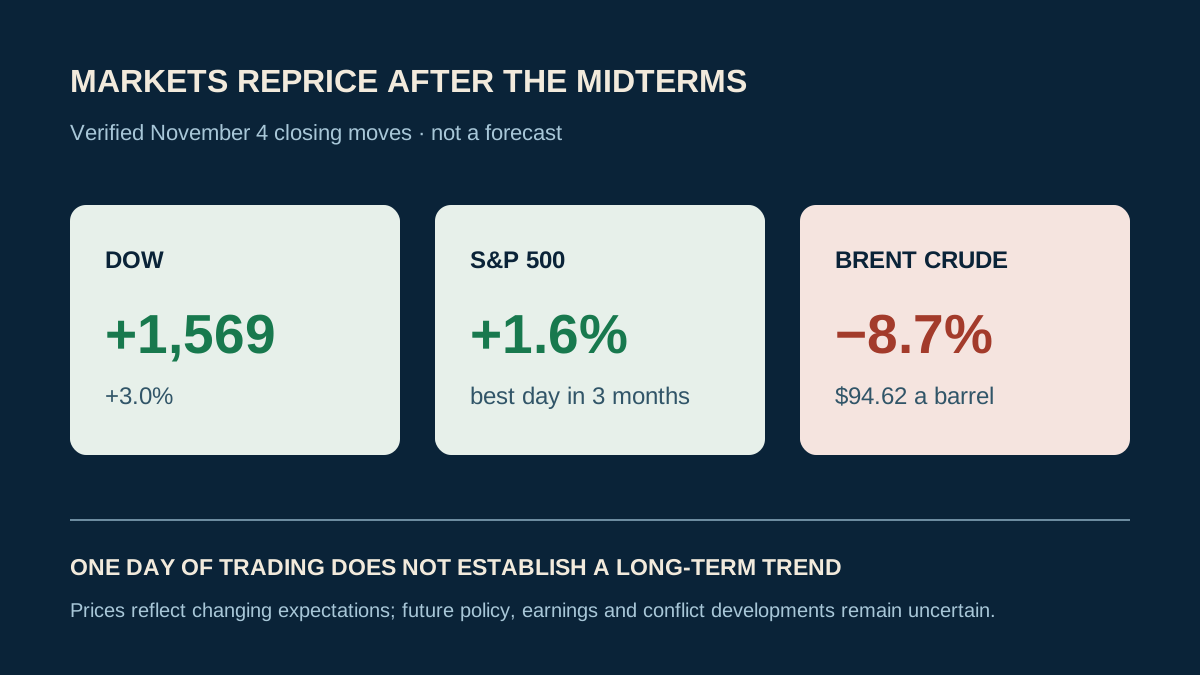
Verified baseline
The Dow Jones Industrial Average closed November 4 at 53,356.12, up 1,569.40 points, or 3.03%, according to S&P Dow Jones Indices data published by the Federal Reserve Bank of St. Louis. The Associated Press reported that the S&P 500 gained 1.6%, its strongest day in three months, while the Nasdaq rose 1.4%.
Brent crude, the global oil benchmark, fell 8.7% to $94.62 a barrel. Reuters reported that the contract had dropped about 20% for the week by early Thursday, although that weekly move was not final.
Why investors reacted
Democrats' capture of both chambers of Congress ended uncertainty over the election result and made major new legislation from the Republican White House less likely without bipartisan support. Investors often call that “gridlock,” but the label does not mean government stops: executive actions, investigations, appropriations deadlines and agency decisions can still move markets.
Oil prices also reflected expectations that a weakened administration may be less likely to escalate the U.S.–Iran war. That is an investor interpretation, not a ceasefire announcement. President Trump has continued to defend the conflict, and Congress taking office does not itself end military operations.
Winners and losers were uneven
Hospital operators and discount retailers serving lower-income consumers rose as traders anticipated that Congress could protect or restore health and food assistance, the AP reported. Renewable-energy shares also advanced.
Energy producers, defense contractors, data-centre companies and several politically exposed businesses fell. Reuters said investors were also reassessing possible scrutiny of artificial-intelligence infrastructure and Big Tech. Those sector moves price expectations about future rules and spending; they do not show that Congress has enacted any of them.
What lower oil could mean for households
Crude oil is a major input into gasoline, diesel and transportation costs. If the fall persists, it can reduce pressure on fuel prices and inflation. But retail prices adjust with lags and also reflect refining, distribution, taxes and regional supply.
The U.S. Energy Information Administration says geopolitical disruptions can add a risk premium to crude prices and that the effect may recede when supply concerns ease. Its October forecast assumed Brent would average $105 a barrel in the fourth quarter—an estimate made before the election and subject to revision on November 10.
Fact, analysis, forecast and opinion
Verified fact: major U.S. indexes rose sharply on November 4 while Brent crude fell 8.7%. Analysis: reporting linked the moves to election certainty, divided government and reduced expectations of Iran-war escalation. Forecast: lower crude could ease inflation if sustained, but one session cannot establish that path. Opinion: Health Politics Daily offers no recommendation to buy or sell any security.
Bias Lens: relief rally or unresolved risk?
Verified baseline: the closing index values and oil-price decline are measurable. Explanations for them are market interpretations, and no post-election law or Iran settlement had produced those moves.
Left-leaning — The Washington Post: emphasizes a “blue wave,” lower oil and sectors expected to benefit from congressional constraints. Center — Associated Press: leads with verified index and commodity moves, then balances sector winners with warnings that earnings and rates matter more over time. Right-leaning/business — Fox Business: foregrounded policy uncertainty, regulation and divided-government implications while markets were still trading.
These are differences in emphasis and publication timing, not proof that one account caused or predicted the market. Political orientation does not replace checking the underlying closing data.
What remains uncertain
It is unknown whether the stock rally or oil decline will persist. The administration's Iran policy, congressional priorities, central-bank decisions, corporate earnings and economic data can reverse prices quickly. Market moves also do not measure whether households or businesses are better off; distribution matters.
Principal sources
- Federal Reserve Bank of St. Louis — Dow Jones closing data
- U.S. Energy Information Administration — October oil-market outlook
- Associated Press — U.S. market close and sector moves
- Reuters — global oil, currency and equity reaction
No suitable directly relevant authorized video with clear persistent embedding permission was available at publication.
No comments yet.