Finance · Technology · Markets
Nasdaq Falls 2.6% as AI Spending Fears Hit Technology Shares
The technology-heavy index recorded its steepest decline since June as investors reassessed the cost and timing of returns from artificial-intelligence infrastructure. The session was not a uniform market collapse: most U.S. stocks rose.
By Health Politics Daily News Desk · October 23, 2026 at 4:01 a.m. ET

Watch in this article
Pumpjack operating at the Kern River Oil Field
A short CC0 field video provides visual context for reporting on oil production and fuel supply.
Thomas Farley / Wikimedia Commons · CC0 1.0 · License and source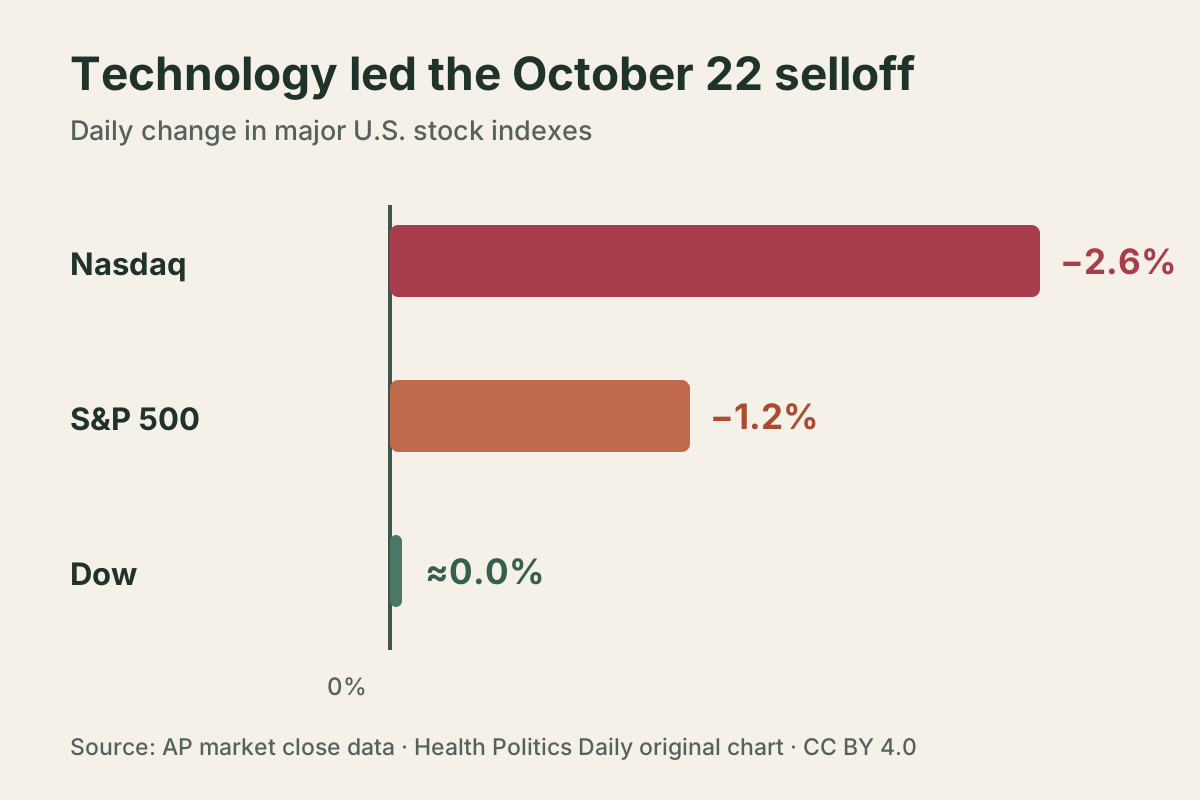
The Nasdaq Composite fell 694 points, or 2.6%, to 26,008.86 on Thursday, its largest percentage drop since June. The S&P 500 lost 1.2% in its worst session since July, while the Dow Jones Industrial Average was almost unchanged.
The headline indexes obscured an important detail: a majority of U.S. stocks rose, according to the Associated Press. Losses in a relatively small group of highly valued technology and chip companies were large enough to pull down indexes that weight companies by market value.
Meta's results focused attention on the cost of AI
Meta reported third-quarter revenue of $64.6 billion, 26% higher than a year earlier. But its official earnings release also showed $34.91 billion in quarterly capital expenditures and negative free cash flow of $2.12 billion. Meta shares fell about 7% as investors weighed strong revenue against the scale of spending required for data centers and other AI infrastructure.
That does not prove AI investments will fail. It shows that markets are questioning how quickly spending can translate into durable profits. Other chip and technology shares also declined, reinforcing a global pullback that began in Asian markets.
Why one group can move the entire index
The Nasdaq and S&P 500 are weighted heavily toward their largest companies. When a megacap stock falls, it can have more influence on the index than gains across many smaller businesses. The Dow's near-flat finish and positive market breadth therefore are not contradictions; they describe different slices of the same session.
Practical implication: retirement savers can check whether a broad-market or technology fund is more concentrated than its label suggests, but a single volatile session is not a reliable signal to buy or sell. This article provides general market information, not personalized investment advice.
Treasury prices rose as investors sought safety
U.S. government bond prices rose sharply, pushing the 10-year yield down by roughly 19 basis points in its largest one-day move since March 2023, Reuters reported. Bond prices and yields move in opposite directions. Lower Treasury yields can eventually reduce some borrowing benchmarks, but the pass-through to mortgages, corporate loans and consumer credit is neither immediate nor guaranteed.
Oil moved the other way: Brent crude reached a five-month high near $114 amid Middle East supply concerns. That combination—lower bond yields but more expensive energy—creates mixed signals for the Federal Reserve because weaker risk appetite can cool demand while higher fuel costs can add inflation pressure.
Fact, analysis, forecast and opinion
Verified fact: the Nasdaq fell 2.6%, the S&P 500 fell 1.2% and Meta disclosed $34.91 billion in quarterly capital expenditures. Analysis: the gap between the Nasdaq, Dow and market breadth shows that losses were concentrated rather than universal. Forecast: coming earnings reports may either ease concerns by showing faster AI-related revenue or deepen them by revealing additional financing needs; neither outcome is assured. Opinion: market coverage should disclose index concentration and avoid presenting one session as proof of a lasting boom or crash.
For context, read our earlier coverage of the Nasdaq's October record alongside elevated Treasury yields, Brent oil's rise above $110 and the IMF's assessment of AI growth and financial risk.
Bias Lens: AI spending, market breadth and household pressure
Verified baseline: the Nasdaq fell 2.6%, the S&P 500 fell 1.2%, the Dow was nearly flat and Meta reported strong revenue alongside negative free cash flow. These figures do not establish that AI is either a bubble or a guaranteed source of future growth.
Left-leaning — The Guardian: places the technology selloff beside oil prices and household cost pressure. Center — Associated Press: stresses the contrast between falling headline indexes and gains for most stocks. Center-right business coverage — The Wall Street Journal: emphasizes corporate spending, earnings expectations and capital constraints. The outlets agree on the market move; their leads reflect different audiences and economic lenses.
What remains uncertain
One trading day cannot establish a long-term change in technology valuations. It remains unclear how quickly major AI projects will generate revenue, how much additional debt or equity financing companies may use, and whether the selloff will spread beyond technology. Friday's international trading does not guarantee how U.S. markets will open or close.
Principal sources
- Meta — third-quarter 2026 results
- SEC filing — Meta earnings exhibit
- Associated Press — market close and breadth
- Reuters — U.S. market close
- U.S. Treasury — official interest-rate statistics
No suitable directly relevant official or publisher-authorized video with clear embedding permission was available, so none was embedded.