Health · Infectious Disease · Bird Flu
Washington Resident Dies From H5N1 After Exposure at Infected Dairy
The Yakima County resident had underlying health conditions and became infected after dairy exposure. The death is serious, but health officials report no known person-to-person transmission and continue to assess general-public risk as low.
By Health Politics Daily News Desk · November 4, 2026 at 6:00 a.m. ET

Watch in this article
Pumpjack operating at the Kern River Oil Field
A short CC0 field video provides visual context for reporting on oil production and fuel supply.
Thomas Farley / Wikimedia Commons · CC0 1.0 · License and source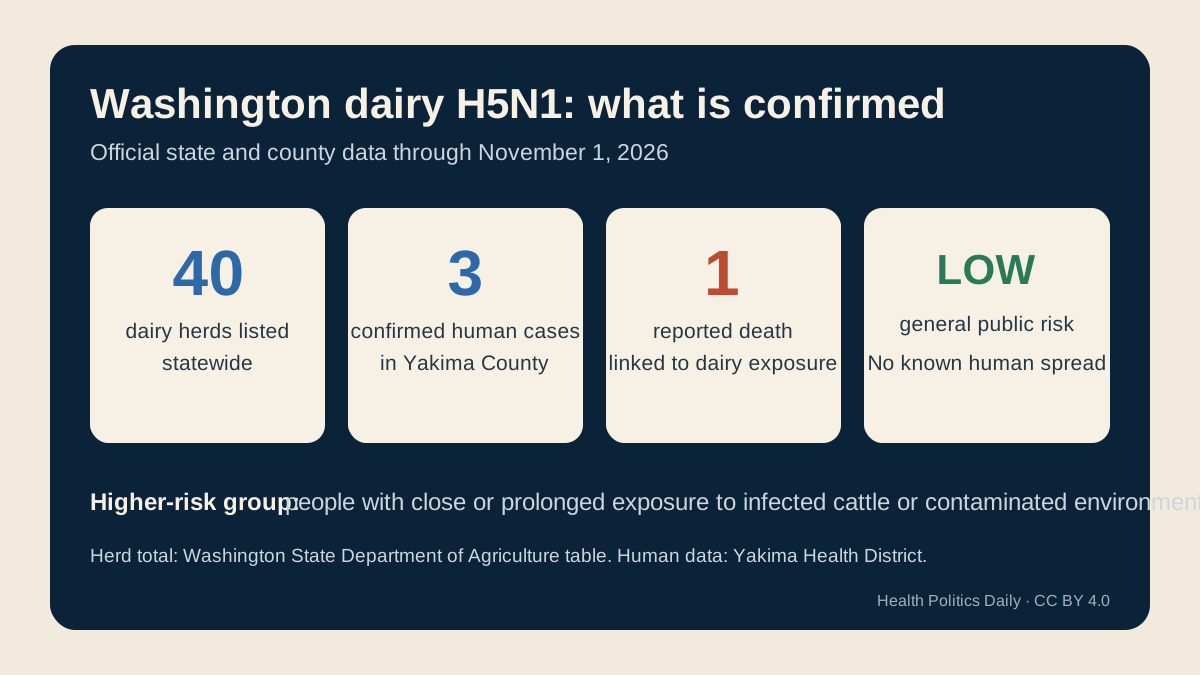
Verified baseline
A Yakima County resident who had been hospitalized with severe H5N1 avian influenza died after exposure at a dairy with infected cattle, the Yakima Health District reported. Officials said the person had underlying health conditions and withheld identifying details to protect the family's privacy.
The district lists three confirmed human cases linked to dairy exposure in Yakima County. It is monitoring close contacts with the Washington State Department of Health. Officials have not reported infection spreading from this patient to another person.
The cattle outbreak expanded quickly
Washington confirmed its first H5N1 detections in dairy cattle on October 8. The state agriculture department's table lists 40 affected herds through October 30—39 in Yakima County and one in Benton County.
Sequencing from the first farms identified the B3.13 cattle-associated strain that has circulated in U.S. dairy herds since 2024. State officials said the available sequence did not show evidence of adaptation for human-to-human transmission.
Why the public-health risk is unequal
For people without contact with infected animals or contaminated farm environments, officials continue to describe risk as low. Risk is higher for dairy workers, veterinarians, cullers and others with close or prolonged exposure to infected cattle, raw milk, manure or contaminated equipment.
Analysis: a death demonstrates that sporadic animal-to-human infections can be severe, especially for people with underlying conditions. It does not by itself show that the virus has become easier to transmit between people. Those are different questions requiring contact monitoring, surveillance and genetic evidence.
Practical precautions
- Exposed workers: follow employer and public-health instructions for respirators, eye protection, gloves and protective clothing; report symptoms promptly.
- People finding sick or dead animals: avoid unprotected contact and notify the appropriate state wildlife or agriculture authority.
- Consumers: pasteurized milk remains the safer choice; pasteurization inactivates influenza viruses. Do not drink raw milk from potentially infected animals.
- After a possible exposure: contact a healthcare professional or local health department for individualized guidance, especially if fever, cough, eye redness or breathing symptoms develop.
This article provides general public-health information, not a diagnosis or personalized medical advice.
Fact, analysis, forecast and opinion
Verified fact: one dairy-exposed Yakima resident died, three human cases are confirmed locally, and no person-to-person spread is known. Analysis: the principal immediate risk is concentrated among people exposed to infected cattle and environments. Forecast: more animal detections or sporadic exposed-worker cases are possible, but current evidence does not establish sustained human spread. Opinion: worker protection, prompt testing and transparent sequence reporting should remain priorities.
Bias Lens: how to frame a fatal case without distorting risk
Verified baseline: the patient died after exposure at an infected dairy; the general-public risk remains low; no U.S. person-to-person transmission has been documented.
A conventional left-center-right comparison is not especially meaningful for this case because the central dispute is evidentiary, not ideological. Official/local — Yakima Health District: emphasizes the fatality, farm-exposure risk and contact monitoring. Center/wire — Associated Press: places the death in the national outbreak and notes the absence of transmissibility markers. Public-health reference — CDC: emphasizes national surveillance, low public risk and the distinction between animal exposure and community spread.
The main framing danger runs in both directions: presenting one death as proof of a general-population emergency, or using the low overall risk to minimize the materially higher risk faced by exposed workers.
What remains uncertain
Officials have not released the patient's age, occupation, complete clinical history or detailed exposure pathway. The national CDC summary available during reporting had not yet incorporated the newest death. Continued sequencing and monitoring will be needed to determine whether additional cases are linked only to animal exposure and whether the outbreak reaches more herds.
Principal sources
- Yakima Health District — local human cases, fatality and risk guidance
- Washington State Department of Agriculture — herd detections and sequencing
- Washington State Department of Health — statewide human surveillance
- CDC — national H5 surveillance and risk assessment
- Associated Press — national context and genetic-analysis reporting
No suitable directly relevant official or publisher-authorized video with clear persistent embedding permission was available.
No comments yet.