Health · Ebola · United Kingdom
British Ebola Patient Evacuated From Congo to London Isolation Unit
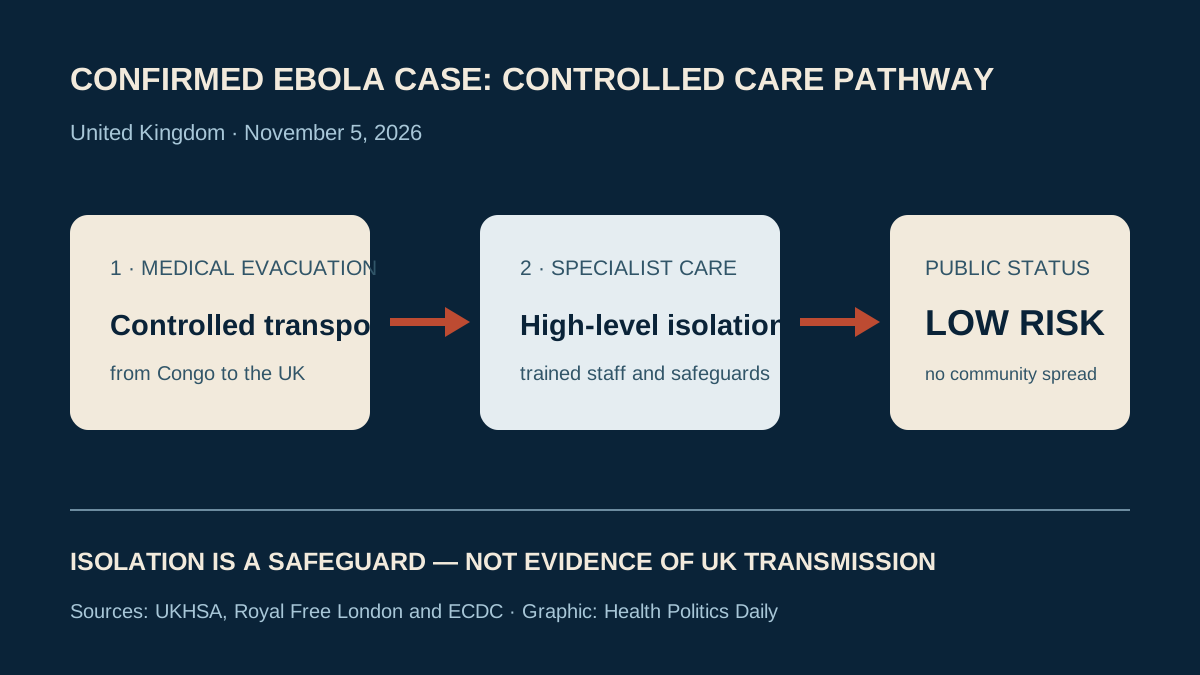
The healthcare worker has a confirmed infection and is receiving specialist care. Controlled transport and high-level isolation are designed to prevent exposure; officials say the risk to the public remains low.
What happened
A British healthcare worker who tested positive for Ebola in the Democratic Republic of the Congo was medically evacuated to the United Kingdom for specialist treatment, according to British authorities and the European Centre for Disease Prevention and Control. The patient was reported in stable condition and was transferred under established high-consequence infectious-disease procedures.
The patient is expected to receive care at the Royal Free Hospital in London, whose high-level isolation unit is the UK's lead treatment centre for contact high-consequence infectious diseases. The unit uses restricted access, controlled ventilation, dedicated laboratory capacity and waste decontamination systems.
Why officials say public risk is low
Ebola is transmitted through direct contact with the blood or other body fluids of a symptomatic infected person, or with contaminated materials. UK Health Security Agency guidance says there is no evidence of natural airborne transmission. A medically managed transfer therefore differs from an undetected infection moving through ordinary public settings.
Officials have not reported community exposure in Britain. The low-risk assessment is not a claim that Ebola is mild; it reflects the controlled evacuation, specialist ambulance transport and isolation safeguards surrounding this patient.
What the evacuation does—and does not—mean
The transfer gives the patient access to a team and facility built for rare, dangerous infections. It does not mean Ebola is spreading in London, nor does it by itself require travel or trade restrictions. British authorities said they did not expect disruption to international travel or commerce.
The evacuation also does not identify exactly how the worker was infected. Healthcare personnel face elevated risk because caring for severely ill patients can involve exposure to infectious fluids, even when protective protocols are in place.
Fact, analysis, forecast and opinion
Verified fact: a British healthcare worker with confirmed Ebola was evacuated from Congo to the UK for specialist treatment; public-health procedures were activated and authorities assess public risk as low. Analysis: the case demonstrates both the occupational risk facing outbreak responders and the purpose of dedicated isolation capacity. Forecast: officials may release additional clinical or contact-monitoring information, but the patient's outcome and any contact assessments cannot be predicted. Opinion: Health Politics Daily does not identify the patient or speculate about the source of infection beyond official evidence.
Bias Lens: imported case or public-health threat?
Verified baseline: the patient has a confirmed infection, was transferred through controlled medical procedures and is being treated in specialist isolation. Officials report low public risk and no evidence of UK community transmission.
A reliable left-center-right divide has not emerged, so forcing one would misrepresent the coverage. Public-health baseline — UKHSA: explains transmission, symptoms and the low UK public-risk assessment. Center — Associated Press: centers the evacuation, specialist facility and outbreak scale. Left-leaning — The Guardian: places more emphasis on the humanitarian worker and the wider Congo outbreak.
The difference is emphasis, not a factual dispute. No credible source reviewed reports ordinary airborne spread or established transmission in Britain.
What remains uncertain
Authorities have not publicly provided detailed clinical information, a confirmed exposure route or a complete contact assessment. Patient privacy limits what should be reported, and the outcome of specialist treatment remains uncertain.
Principal sources
- ECDC — November 5 outbreak and European evacuation update
- UKHSA — Bundibugyo Ebola guidance and UK risk assessment
- Royal Free London — high-level isolation unit safeguards
- Associated Press — evacuation and outbreak context
No suitable directly relevant authorized video with clear persistent embedding permission was available at publication.
No comments yet.