Global Health · Ebola · Vaccine Research
WHO Adds Two Bundibugyo Ebola Vaccines to Congo Trial
The Oxford–Serum Institute and Moderna candidates are designed for the virus driving Congo's outbreak. They still require national authorization to enter the trial, and there is no evidence yet that either prevents illness.
By Health Politics Daily News Desk · November 4, 2026 at 12:00 p.m. ET

Watch in this article
Pumpjack operating at the Kern River Oil Field
A short CC0 field video provides visual context for reporting on oil production and fuel supply.
Thomas Farley / Wikimedia Commons · CC0 1.0 · License and source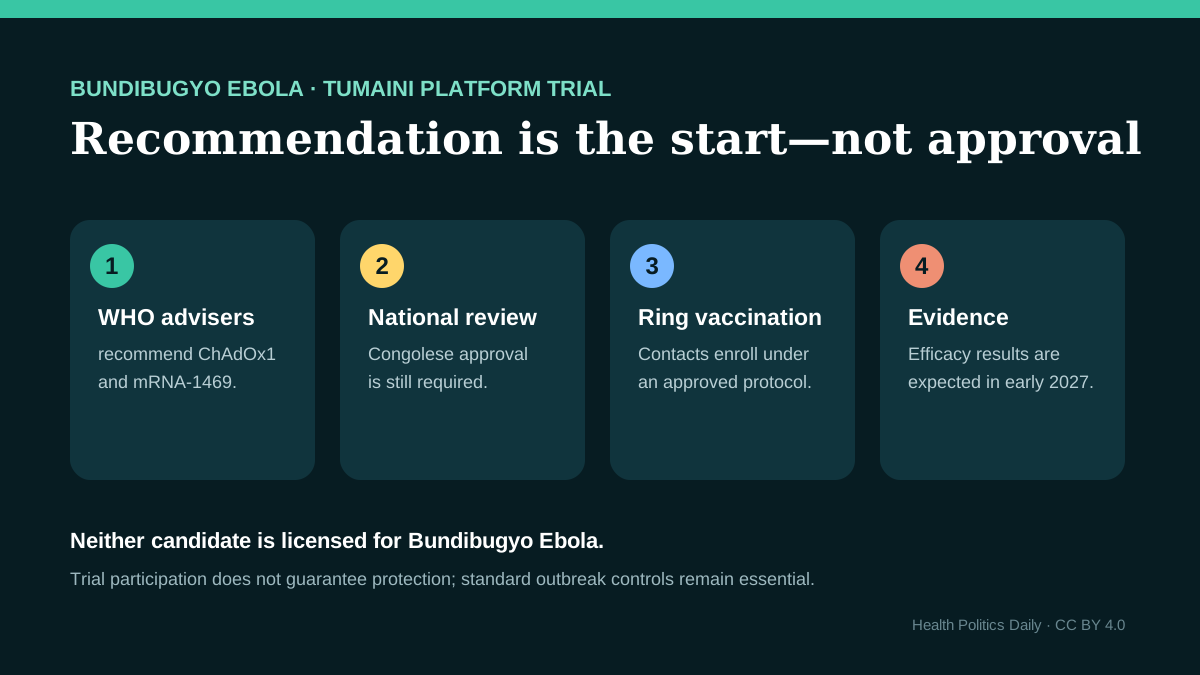
Verified baseline
World Health Organization expert advisers recommended adding two experimental vaccines to the ongoing Tumaini trial in the Democratic Republic of the Congo: Oxford University's ChAdOx1 candidate, developed with the Serum Institute of India, and Moderna's mRNA-1469.
Both are specifically designed against Bundibugyo virus, the Ebola species behind the current outbreak. Neither vaccine is licensed for Bundibugyo Ebola, and trial participation will begin only after Congolese national approvals.
How the trial works
Tumaini is an adaptive Phase 2/3 platform trial led by Congo's Institut National de Recherche Biomédicale with national and international partners. A platform design allows researchers to evaluate several candidates within one protocol rather than building a separate trial for every product.
The trial uses ring vaccination: researchers identify contacts of a person with confirmed Ebola and contacts of those contacts, then invite eligible people into a defined vaccination group. Four rings were active when WHO announced the additions, with more being prepared.
Ervebo, a licensed vaccine against a different Ebola species formerly called Zaire ebolavirus, was the first candidate in Tumaini. Its ability to protect against Bundibugyo virus is also being studied and should not be assumed.
What is known about the candidates
ChAdOx1 uses the adenovirus-vector platform associated with Oxford's COVID-19 vaccine. An early-stage study in healthy adults began in Uganda in October to assess safety and immune response. Moderna's mRNA-1469 entered a separate first-in-human study earlier this year.
Those early studies can identify common safety signals and whether the vaccines provoke an immune response. They cannot by themselves establish that a vaccine prevents Bundibugyo Ebola during an outbreak. Tumaini is intended to generate that efficacy evidence.
Why this matters now
There is no vaccine specifically approved for Bundibugyo virus disease. The current outbreak is the largest recorded Bundibugyo outbreak and has already passed 10,000 confirmed cases and 5,000 deaths, according to Congolese situation reports.
Running trials during an outbreak can answer urgent questions while transmission is occurring, but it also creates ethical and operational challenges. Participation must be voluntary, trial information must be understandable, standard outbreak control must continue and research cannot replace isolation, contact tracing, clinical care or safe burials.
Practical implications
- People in affected areas: the announcement does not create a generally available vaccine. Eligibility and enrollment are determined by the trial team and national authorities.
- Trial participants: informed consent, follow-up and adverse-event monitoring remain essential; participation does not guarantee protection.
- Health workers: personal protective equipment, infection prevention and exposure reporting remain necessary regardless of vaccination status.
- Governments and donors: manufacturing, cold-chain capacity, price and equitable access will matter if a candidate proves effective.
Fact, analysis, forecast and opinion
Verified fact: WHO advisers recommended two Bundibugyo-specific candidates for Tumaini, subject to national approval. Analysis: adding two different technology platforms improves the chance of generating useful comparative evidence during the outbreak. Forecast: WHO expects vaccine results in early 2027, but enrollment, transmission patterns and data quality could change that timeline. Opinion: Health Politics Daily does not recommend any experimental product; access decisions belong to participants, Congolese authorities and trial clinicians under approved protocols.
Bias Lens: breakthrough, experiment or access test?
Verified baseline: two experimental, strain-specific vaccines have been recommended for a Congolese trial; neither is approved; effectiveness is unknown; national authorization is still required.
A conventional left-center-right comparison is not meaningful for this early technical development because ideologically distinct outlets have not yet produced substantial original coverage. Comparing source roles is more informative. Official — WHO: emphasizes scientific progress and partnership. Research institution — Institute of Tropical Medicine: explains trial governance and adaptive design. Access advocate — MSF Access Campaign: focuses on affordability, public funding and future supply.
These frames answer different questions. None changes the central uncertainty: only properly collected trial evidence can show whether either candidate protects people.
What remains uncertain
WHO has not announced the exact enrollment date for either new candidate. Researchers do not yet know their real-world efficacy, duration of protection, rare adverse effects or performance across age and risk groups. The number of outbreak cases available for comparison and community willingness to participate will affect how quickly the trial can reach conclusions.
Principal sources
- World Health Organization — November 4 recommendation and trial update
- Institute of Tropical Medicine — Tumaini design and governance
- University of Oxford — ChAdOx1 early-stage study
- European Centre for Disease Prevention and Control — vaccine and outbreak context
- MSF Access Campaign — affordability and supply considerations
No suitable directly relevant authorized video with clear persistent embedding permission was available at publication.
No comments yet.