Health · Household Finance · Family Caregiving
Family Caregivers Spend $11,508 a Year on Average, AARP Study Finds
Average out-of-pocket caregiving costs rose 59% from 2021, according to a new expense-diary study. The burden was much heavier for lower-income households, dementia caregivers and people performing complex medical tasks.
By Health Politics Daily News Desk · October 31, 2026 at 4:00 p.m. ET
Verified baseline
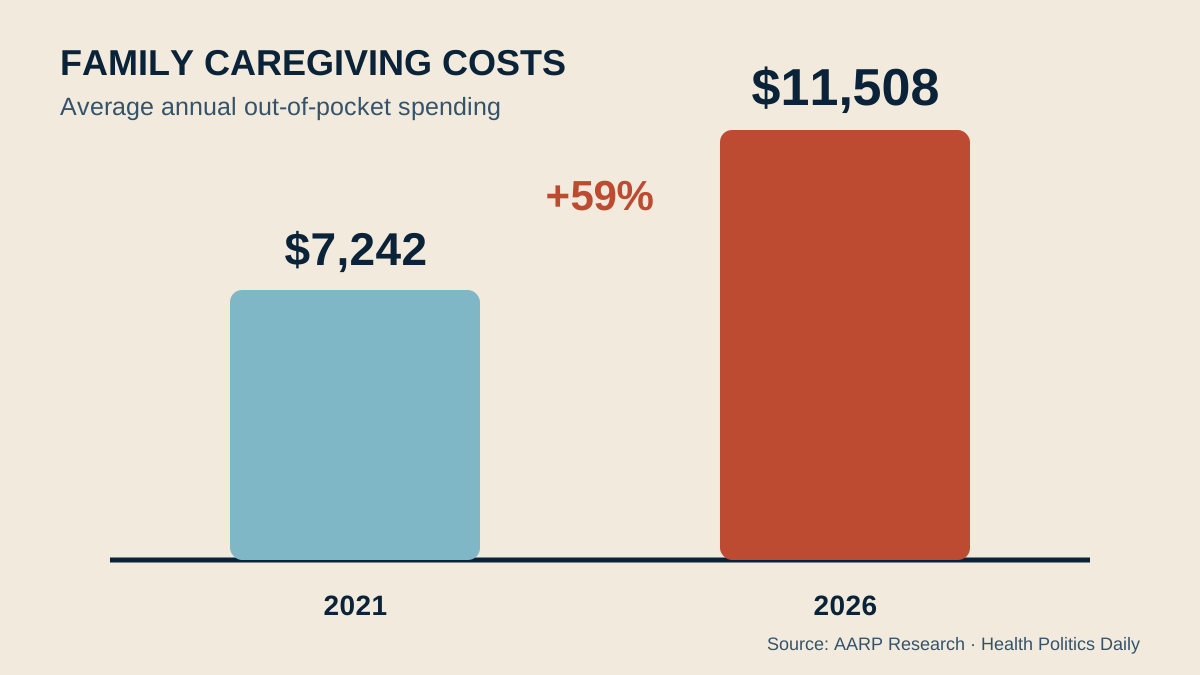
A new AARP study estimates that U.S. adults caring for an adult relative or friend spend an average $11,508 a year out of pocket. That is $4,266, or 59%, more than the $7,242 reported in AARP's 2021 study.
Nearly nine in 10 caregivers reported expenses. On average, those costs consumed 31% of annual household income. Housing and household costs accounted for 42% of spending, while medical expenses accounted for 29%.
Who reported the greatest pressure
Caregivers in households earning under $40,000 spent an average equal to 76% of household income. Caregivers for someone with Alzheimer's disease or another dementia spent $15,846 on average, compared with $10,221 for caregivers supporting someone without dementia.
People performing at least three medical or nursing tasks averaged $15,648 in annual costs, nearly twice the $7,948 average among caregivers who performed none. These are group averages and cannot predict any individual household's needs.
Work and retirement effects
Among working caregivers, 65% reported at least one work disruption, such as changing hours, taking leave or adding work. Respondents who dipped into retirement savings reported average annual caregiving costs of $17,907; those who borrowed money or took loans averaged $16,580.
The study does not establish that caregiving alone caused every job or financial change. More demanding care can simultaneously raise expenses, reduce work flexibility and increase the likelihood of borrowing.
How the study was conducted
AARP recruited U.S. adults age 18 and older who currently care for an adult relative or friend. The 2,538-person analytic sample completed a recruiting survey and a one-week expense diary in June and July 2026. Results were weighted to federal population benchmarks.
Diary data can capture small purchases that respondents may forget in a long retrospective survey, but one week may not represent irregular annual costs. The findings are also subject to sampling, nonresponse and measurement error, and AARP is an advocacy organization seeking policy support for caregivers.
Practical implications
- Caregivers: keep records of transportation, household, medical and home-modification costs; eligibility and tax treatment vary by program and expense.
- Families: discuss work schedules, respite, legal authority and emergency plans before care becomes more intensive when possible.
- People seeking help: the federal Eldercare Locator connects families with local aging and caregiver services.
- Medical decisions: do not reduce medication or needed care solely because of a survey statistic; ask clinicians and coverage programs about safer options.
Fact, analysis, forecast and opinion
Verified fact: AARP's sample averaged $11,508 in annual out-of-pocket caregiving costs. Analysis: income shares show the burden is highly unequal even when dollar averages are similar. Forecast: an aging population may increase demand, but this study does not project future national spending. Opinion: Health Politics Daily favors transparent cost information and accessible support while endorsing no specific bill.
Bias Lens: private family responsibility or public-policy problem?
Verified baseline: the study used a 2,538-person weighted sample and one-week expense diaries; average reported annual costs were $11,508, or 31% of household income.
A strict left-center-right comparison is not especially meaningful for the underlying measurement. Advocacy frame — AARP: uses the results to support tax credits, leave and affordable home care. Center/wire frame — Associated Press: places caregiver costs beside Medicare, prescriptions and Social Security as election concerns. Fiscal conservatives may emphasize targeting, eligibility and the cost of new benefits, while social-policy advocates emphasize unpaid labor and household risk. Those are policy judgments; the study's methods and limits should be evaluated independently.
What remains uncertain
The study does not estimate the total amount spent by all U.S. caregivers, identify every source of reimbursement or show how costs vary within every state. It also cannot determine which proposed tax credit, paid-leave or home-care policy would provide the greatest benefit per public dollar.
Principal sources
- AARP Research — 2026 study, methodology and detailed findings
- AARP — release and policy response
- Associated Press — health-cost and election context
- U.S. Administration for Community Living — Eldercare Locator
No suitable directly relevant official or publisher-authorized video with clear persistent embedding permission was available.
No comments yet.