Finance · Technology · Consumer Policy
DoorDash Agrees to Buy Instacart for $17 Billion
The delivery companies say combining restaurant logistics with grocery technology will expand choice and reduce duplicate membership costs. The agreement is not yet a merger: shareholder and antitrust reviews are expected to extend into late 2027 or 2028.
By Health Politics Daily News Desk · October 29, 2026 at 4:00 p.m. ET
Verified baseline
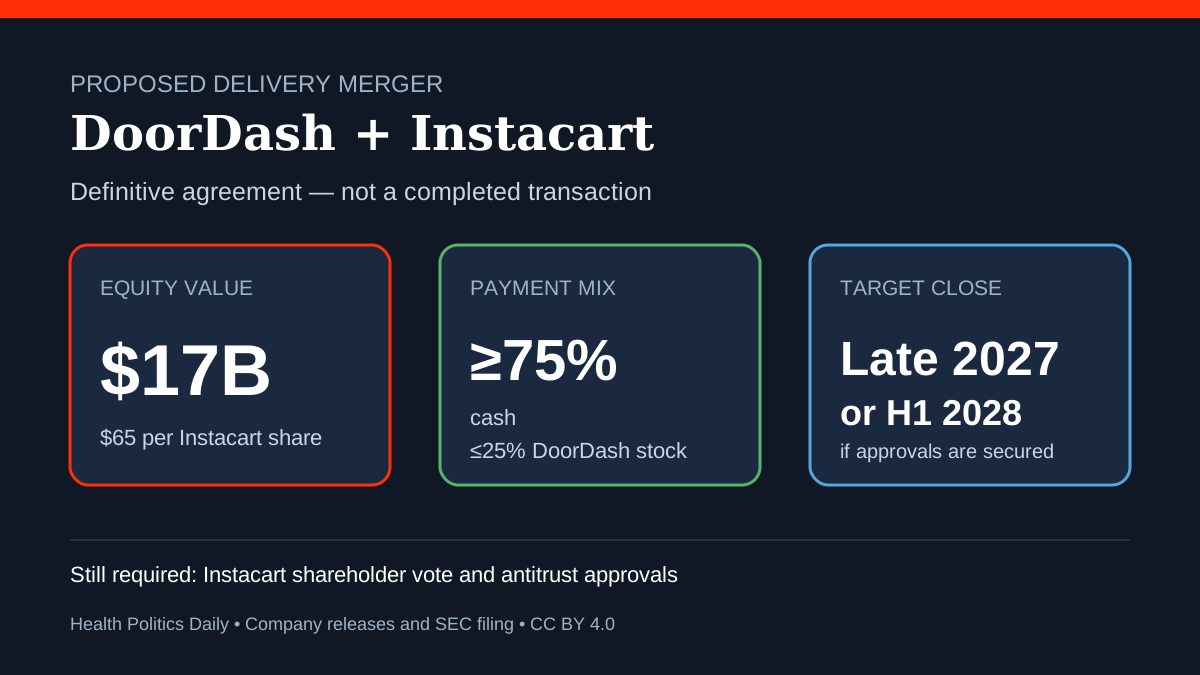
DoorDash and Instacart signed a definitive agreement valuing Instacart at approximately $17 billion, or $65 per share. That price is 26% above Instacart’s October 22 closing price, the last trading day before public reports of a possible deal.
The consideration will be at least 75% cash and no more than 25% DoorDash stock. Instacart shareholders may elect cash, stock or a combination, subject to proration. DoorDash expects to use cash on hand and debt financing for the cash portion and has arranged a 364-day bridge facility with JPMorgan.
Instacart shareholders must approve the transaction, and regulators in the United States, Canada and Israel must clear it. The companies target closing in late 2027 or the first half of 2028. Until then, they continue as independent businesses.
What could change for customers and stores
DoorDash says it will retain the Instacart brand, app and enterprise technology. It promises that grocers will remain free to use other delivery platforms and that DashPass and Instacart+ members would eventually receive both memberships for one fee, which the companies estimate could save members $100 million annually.
Those are post-closing commitments, not present benefits. Prices, service fees, delivery availability and retailer relationships can still change, and the agreement does not guarantee lower grocery prices. Instacart currently specializes in grocery fulfillment while DoorDash has expanded from restaurants into groceries and retail.
Why regulators may scrutinize the deal
The transaction combines two major delivery platforms at a time when food affordability is politically sensitive. Reuters reported that the Federal Trade Commission is likely to examine competition, fees and consumer effects. New York City’s consumer and worker protection agency criticized the consolidation, while the companies argue that combined scale would help local merchants compete with Amazon and Walmart.
Antitrust review is not a finding of illegality. Regulators will need to define the relevant markets and assess whether the deal reduces competition or creates efficiencies that benefit consumers and merchants. The unusually long target timetable signals that the companies expect substantial review.
Practical implications
- Customers: nothing changes immediately; accounts, subscriptions and delivery terms remain separate until a closing.
- Instacart shareholders: the $65 offer is subject to approval, closing conditions and payment-election limits; it is not a guaranteed immediate payout.
- Gig workers: DoorDash promises flexibility and optional access to more order types, but pay formulas, fees and worker classification remain unresolved.
- Grocers and restaurants: the companies promise no grocery exclusivity, but merchants may still evaluate how greater platform concentration affects commissions and bargaining power.
Fact, analysis, forecast and opinion
Verified fact: the boards approved a $17 billion agreement with at least 75% cash consideration. Analysis: DoorDash is using scale and debt capacity to accelerate grocery expansion. Forecast: the FTC may demand information, conditions or litigation, but no outcome is predetermined. Opinion: Health Politics Daily takes no investment position; consumers and workers need measurable commitments rather than merger marketing alone.
Our earlier report on the FTC’s personalized-pricing and pay inquiry explains another active review involving both companies. Our coverage of Alphabet’s investment and cash-flow tradeoff offers broader technology-finance context.
Bias Lens: efficiency or concentration?
Verified baseline: the parties signed an agreement, but the businesses remain separate and the deal requires shareholder and regulatory approvals.
Left-leaning — The Guardian: emphasizes platform concentration and consequences for gig workers. Center — Associated Press and Reuters: foreground transaction mechanics, market shares and regulatory review. Right-leaning — Fox Business: emphasizes corporate strategy, shareholder value and expansion beyond restaurants. These frames address different stakeholders; none establishes whether regulators will approve the deal.
What remains uncertain
Regulatory timing and remedies are unknown. It is also unclear how the combined company would integrate worker systems, merchant fees, advertising, customer data and partnerships such as Instacart’s relationship with Walmart. DoorDash disclosed termination fees under specified circumstances, but those provisions do not guarantee closing.
Principal sources
- DoorDash and Instacart — transaction announcement
- Instacart — transaction terms and closing conditions
- Reuters — competition and financing context
- Associated Press — grocery-delivery market context
The companies’ official investor webcast is linked through DoorDash Investor Relations. It is not embedded so the publisher retains its playback and accessibility controls.
No comments yet.