Consumer Policy · Technology · Labor
FTC Orders Nine Companies to Disclose Personalized Pricing and Pay Practices
The compulsory study asks how personal data and algorithms may shape what people pay, what work they are offered and what gig workers earn.
By Health Politics Daily News Desk · October 28, 2026 at 8:00 p.m. ET
Verified baseline
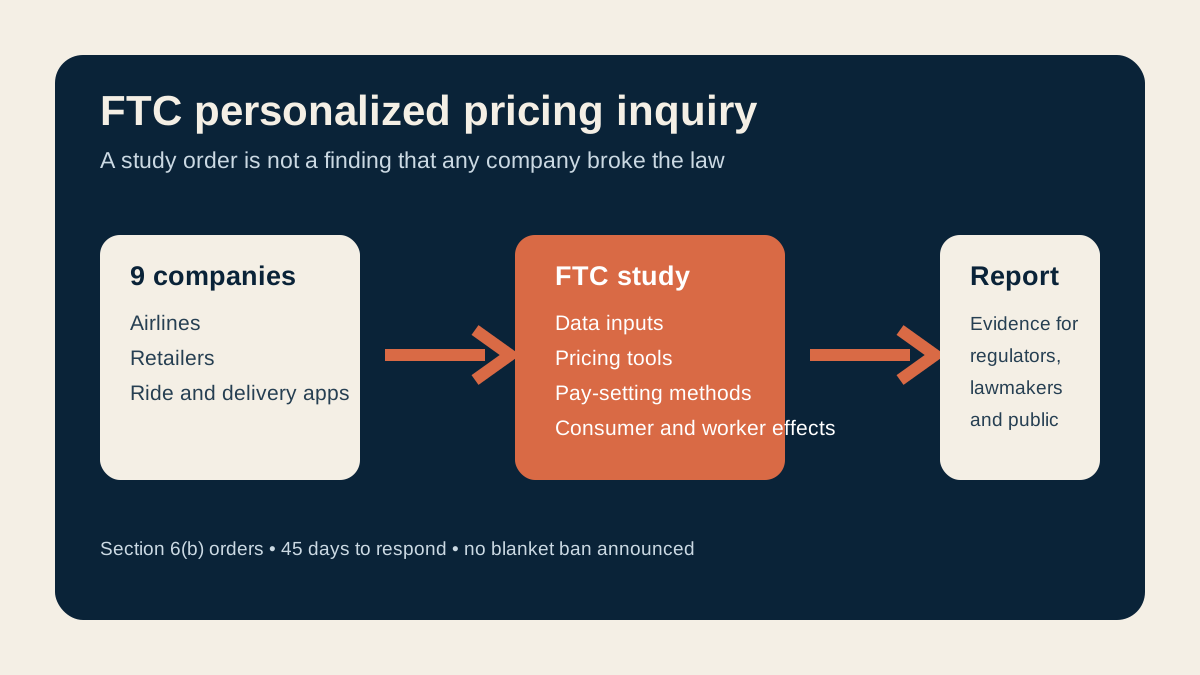
The Federal Trade Commission on Wednesday issued compulsory study orders to Delta, United, JetBlue, Lyft, Uber, DoorDash, Instacart, Target and Walmart. The agency wants records showing whether and how the companies use personal information, loyalty status or algorithmic tools to vary consumer prices, job offers or worker compensation.
The orders are information demands under Section 6(b) of the FTC Act. They are not accusations, lawsuits or findings that any recipient used unlawful personalized pricing. The companies have 45 days after receiving the orders to respond; the FTC may seek a federal court order if a recipient does not comply.
What the FTC is asking for
The official inquiry notice asks for the data inputs, tools and procedures used to set or adjust prices and compensation. Examples include location, browsing history, income, phone use and a driver's history of accepting prior offers. It also seeks evidence about how those systems affect prices, pay and job opportunities.
The agency says the study will produce evidence for regulators and lawmakers. It has not announced a publication date or a company-by-company scorecard.
Why personalized pricing is hard to see
Dynamic pricing changes prices with broad conditions such as demand, inventory or time. Personalized pricing goes further by using information about a particular person to determine the price or offer that person sees. From outside a platform, two customers or workers may not know that they received different offers—or why.
That opacity is the policy problem. A price difference is not automatically illegal. The FTC has said, however, that undisclosed use of personal data may violate consumer-protection law when it conflicts with reasonable expectations or a company's representations. In August, the agency proposed disclosure-focused enforcement guidance while acknowledging that it lacks authority to ban all personalized pricing categorically.
What the companies say
Delta said it has never used, tested or planned fares that target customers with individualized offers based on personal data. JetBlue said its fares reflect demand and seat availability rather than browsing history or personal information. Walmart and Target have separately said they do not raise an individual's prices based on personal characteristics or shopping history. The inquiry will test practices and documentation rather than treat those statements as either proven or false.
At publication, not every recipient had issued a new public response. The absence of a response is not evidence of a particular practice.
Practical implications
- For shoppers and travelers: the orders do not change prices today or create a refund right. Comparing offers while signed in and signed out may reveal differences, but it cannot establish why a price changed.
- For gig workers: the study may clarify whether acceptance history, phone usage or other personal data influences pay offers. No compensation formula has been invalidated.
- For companies: recipients must preserve and disclose detailed records. Other businesses should compare their disclosures with the data actually used by pricing systems.
- For lawmakers: the eventual report could inform disclosure rules or legislation, but any future action would require separate legal steps.
This is general reporting, not legal or financial advice.
Fact, analysis, forecast and opinion
Verified fact: nine companies received compulsory FTC study orders with a 45-day response period. Analysis: the inquiry closes an evidence gap left by the FTC's earlier focus on intermediary pricing vendors rather than businesses that make final offers. Forecast: the findings could support enforcement, disclosure standards or legislation, but none is guaranteed. Opinion: Health Politics Daily takes no position on whether personalized pricing should be prohibited.
For related consumer-protection context, see our coverage of the FTC and state checkout-pricing lawsuit against Dollar General and the New Mexico privacy judgment against Meta. Those are separate legal matters and do not establish what any recipient in this inquiry does.
Bias Lens: consumer harm, business practice and enforcement limits
Verified baseline: the FTC issued study orders; it has not found that any recipient violated the law, and several recipients deny using personal data to set individualized prices.
A fresh left-center-right split is not yet meaningful because much of the first-wave reporting follows the same official record. Center-oriented Reuters emphasizes the agency's information gap, AI-enabled pricing and state legislation. The Associated Press gives more space to company denials and the distinction between personalized and ordinary demand pricing. Right-leaning Fox Business previously foregrounded Walmart's pledge not to use individualized pricing while also reporting critics' skepticism. These are framing choices, not proof that one account is more accurate; the FTC order and eventual evidence remain the baseline.
What remains uncertain
The public does not yet know which systems each company uses, which personal data enter them, how often two people receive different prices or pay offers, or whether any practice is deceptive or unfair under current law. The inquiry's timetable, the scope of any public disclosures and any enforcement consequences also remain unknown.
Principal sources
- Federal Trade Commission inquiry announcement
- FTC proposed personalized-pricing policy statement
- Reuters, including company responses and policy context
- Associated Press, including company responses
No suitable directly relevant official or publisher-authorized video with clear embedding permission was available, so no video was embedded.
No comments yet.