U.S. policy · Consumer protection · Retail
FTC and 20 States Sue Dollar General Over Alleged Checkout Overcharges
A federal complaint alleges the discount chain repeatedly charged more at checkout than prices shown on shelves, tags and advertisements. Dollar General rejects the suggestion that it willfully disregarded customers and says it will defend itself.
By Health Politics Daily News Desk · October 27, 2026 at 12:03 p.m. ET
Verified baseline
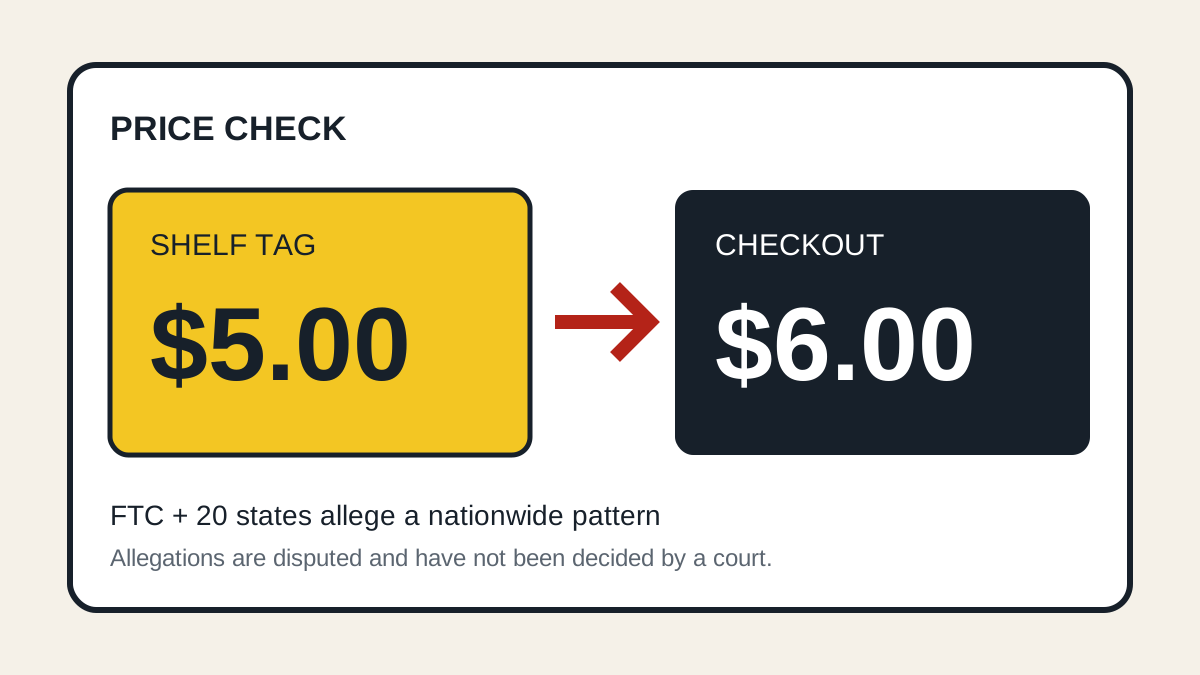
The Federal Trade Commission and 20 states filed a civil lawsuit Monday in the U.S. District Court for the Middle District of Tennessee. They allege Dollar General routinely charged customers more at the register than prices displayed on shelves, price tags and advertisements, despite extensive corporate knowledge of the problem.
The complaint is an allegation, not a judgment. The FTC says it files a complaint when it has reason to believe the law has been or is about to be violated and litigation is in the public interest; a court will decide the case.
What the complaint alleges
The 95-page complaint says Dollar General received at least 29,265 complaints categorized as “Did Not Honor Marked Price” from January 2023 through March 2026 across all 48 states where it operates. It also cites thousands of failed inspections, company audits and seven settlements with six state enforcement agencies totaling more than $6 million since 2019.
The plaintiffs say the alleged discrepancies affected millions of purchases and produced millions of dollars in overcharges. They assert violations of the FTC Act, the Gramm-Leach-Bliley Act and state consumer-protection and weights-and-measures laws. They seek a permanent injunction, monetary relief, civil penalties and other remedies; no refund program has been ordered.
Dollar General’s response
Dollar General said the lawsuit wrongly suggests it abandoned its mission or willfully disregarded customers. In a company statement reported by The Guardian, it said its goal is complete accuracy between shelf and register prices, that store teams are expected to correct discrepancies and that it has enhanced price-accuracy processes.
The company said it cooperated with the investigation, disputed the government’s compensation calculations and will defend the litigation vigorously. Those assertions, like the government’s claims, will be tested through the legal process.
Why this matters to shoppers
A difference of even a few cents can compound across multiple purchases, especially for households on tight budgets. The complaint says roughly 80% of Dollar General stores are in towns of 20,000 people or fewer and that the company markets low-priced essentials to low- and fixed-income shoppers.
At checkout, shoppers can compare the register price with the shelf label, save a photo of the label when practical, retain the receipt and ask store staff to correct a mismatch. State rules and complaint channels differ. Those steps document a transaction; they do not establish that every discrepancy is unlawful or that compensation is guaranteed.
Fact, analysis, forecast and opinion
Verified fact: the FTC and 20 states filed a complaint seeking injunctive and monetary relief. Analysis: the bipartisan state coalition and complaint history make the case consequential for retail pricing controls beyond one chain. Forecast: discovery and motions may clarify the scale and causes of any mismatches, but the timing and outcome are uncertain. Opinion: Health Politics Daily supports clear shelf pricing, prompt correction of errors and due process for the accused company.
Bias Lens: consumer harm, enforcement facts or compliance risk?
Verified baseline: regulators filed a complaint alleging repeated overcharges; Dollar General disputes willful wrongdoing, and no court has ruled on the merits.
Left-leaning coverage: The Guardian emphasizes effects on cash-strapped shoppers and employee accounts of understaffing. Center coverage: Reuters foregrounds the lawsuit, complaints, inspections and earlier settlements. Right-leaning business coverage: The Wall Street Journal frames the case as a corporate compliance and pricing-misconduct dispute.
The outlets differ mainly in emphasis—household consequences, procedural facts and compliance exposure—rather than on the core fact that the lawsuit was filed. Political labels describe general editorial orientation, not the accuracy of any individual report.
What remains uncertain
The public record does not yet establish how many transactions involved a mismatch, what share were corrected at the register or the final amount of any consumer loss. The court must also decide whether the alleged conduct violated each cited law and, if so, what relief is appropriate.
Principal sources
No suitable official or publisher-authorized video with clear downstream embedding permission was available, so no video was embedded.