Finance · Technology · Artificial Intelligence
Alphabet Shares Fall as AI Spending Drives $9.1 Billion Cash Outflow
Google’s parent reported fast revenue and cloud growth, but a record infrastructure bill and a second straight quarter of negative free cash flow reset the debate over the price of the AI buildout.
By Health Politics Daily News Desk · October 29, 2026 at 6:01 a.m. ET
Verified baseline
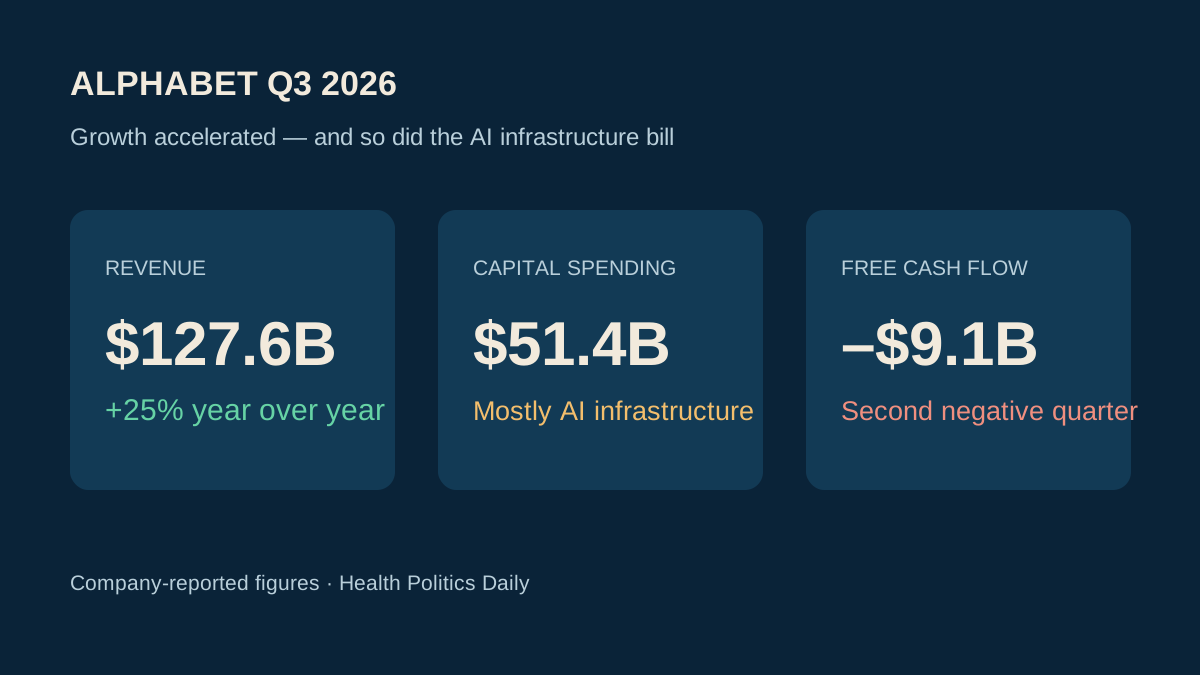
Alphabet reported third-quarter revenue of $127.6 billion, up 25% from a year earlier. Google Cloud revenue more than doubled to $30.7 billion, while Google Search and other revenue rose 12% to $63.35 billion. Operating income increased 30% to $40.6 billion.
The cash-flow picture moved in the opposite direction. Alphabet said operating cash flow was $42.3 billion and capital expenditures were $51.4 billion, producing negative free cash flow of $9.1 billion. Management attributed the result mainly to AI infrastructure, TPU inventory and a $5.2 billion European Commission fine payment. Reuters reported that shares fell about 10% in extended trading as revenue, advertising and adjusted earnings missed analyst estimates.
Why the market focused on cash
Free cash flow is not the same as profit. It measures cash remaining after operations and capital spending; a negative quarter can reflect investment that may produce future revenue. Alphabet remained profitable, with $26.2 billion in net income, and Cloud’s operating income reached $11.1 billion.
The uncertainty is timing and scale. Capital spending exceeded operating cash generated during the quarter, and management said 2027 capital expenditures would rise significantly from an already elevated 2026 plan. The company has not said when quarterly free cash flow will turn positive.
Practical implications
- Shareholders: the after-hours move is a market reaction, not a final measure of long-term value; prices can change when regular trading opens.
- Cloud customers: strong demand and a $561 billion backlog signal expansion, while capacity costs could pressure margins.
- Advertisers: Search revenue still grew, but management said AI Mode is changing query and ad patterns. The economics remain unproven.
- Workers and communities: the buildout implies more data-center, energy and supply-chain demand; this release did not quantify local employment, power or water effects.
Fact, analysis, forecast and opinion
Verified fact: revenue rose 25%, Cloud revenue rose 103%, capital spending was $51.4 billion and free cash flow was negative $9.1 billion. Analysis: investors treated the cash shortfall and spending outlook as more consequential than headline growth. Forecast: Cloud demand may support future returns, but the timing and margins cannot be known from one quarter. Opinion: Health Politics Daily takes no investment position; the relevant test is growth and cash conversion over multiple quarters.
For context, our report on Meta’s $95 billion AI financing separates announced capacity from completed funding. Our coverage of the earlier AI-spending market split explains why investors have rewarded cash generation unevenly across large technology companies.
Bias Lens: growth story or spending warning?
Verified baseline: Alphabet grew revenue and operating income, reported a second negative free-cash-flow quarter and said capital spending would rise significantly again in 2027.
A left-center-right political comparison is not meaningful for a corporate earnings release. Instead, compare the financial frames: Alphabet leads with revenue, Search and Cloud momentum; Associated Press balances growth against the earnings miss and investment loss; Reuters foregrounds cash burn and market expectations. These are choices of financial emphasis, not different underlying company figures.
What remains uncertain
It is not clear how quickly the infrastructure will produce revenue and free cash flow, whether AI Mode will support Search-like advertising economics, how much 2027 spending will rise, or how premarket losses will translate into the closing share price. Analyst estimates are forecasts, not company results.
Principal sources
- Alphabet Investor Relations — Q3 2026 results and earnings materials
- U.S. SEC — Alphabet filings
- Alphabet Investor Relations — official earnings call webcast
- Reuters — market expectations and share reaction
- Associated Press — results and context
The official earnings call is linked rather than embedded so readers can use the publisher’s own video page and controls.
No comments yet.