Finance · Canada · Artificial Intelligence
Canada to Invest Up to C$1.6 Billion in Cohere AI Stake
Ottawa is joining a record-sized private funding round to keep a national AI champion anchored in Canada. Taxpayers gain an equity interest rather than making a simple grant, but the government has not disclosed the ownership percentage or full commercial terms.
By Health Politics Daily News Desk · October 29, 2026 at 1:55 p.m. ET
Verified baseline
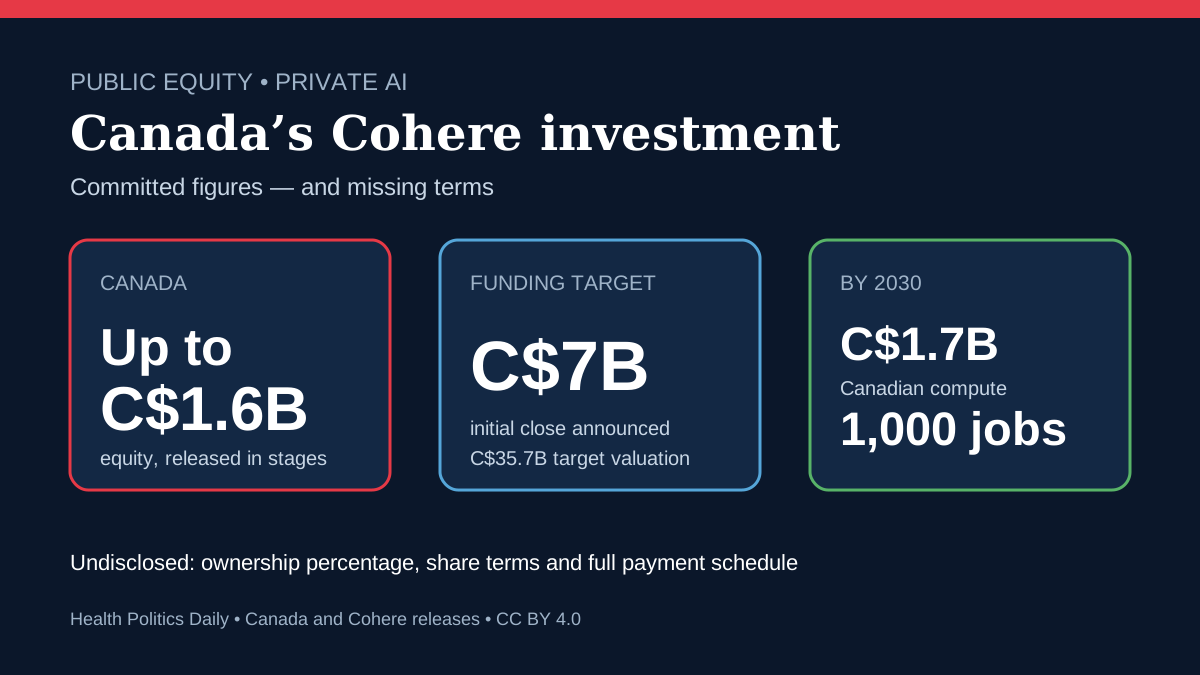
Prime Minister Mark Carney announced that Canada will make a commercial equity investment of up to C$1.6 billion in Toronto-based Cohere. The investment will be made in stages and tied to regular reporting on company commitments, according to the government.
Cohere separately announced an initial close of a Series E funding round targeting as much as C$7 billion at a target valuation of C$35.7 billion. Germany’s Schwarz Group is the lead investor; Nvidia, Bell Ventures and other private investors are also participating. Cohere and Reuters said the round has only completed an initial close, and neither disclosed how much has been committed so far or when the full round will close.
Cohere committed to maintain its Canadian incorporation and headquarters, create at least 1,000 Canadian technical jobs by 2030, invest at least C$1.7 billion in additional Canadian computing infrastructure by then, support domestic research partnerships and continue working with the Canadian AI Safety Institute.
What an equity investment means
An equity investment gives the government an ownership interest whose value can rise or fall. It is different from a grant: Canadians could share in a successful company’s gains, but public money is also exposed if the business underperforms. Ottawa has not disclosed its ownership percentage, the class or price of shares, investor protections, exit rights or detailed payment schedule. Those omissions prevent an independent assessment of whether the terms are favourable.
The C$1.6 billion is a maximum rather than a completed payment. The government says funds will be released in stages against company commitments; it has not published the milestones or consequences for missing them.
Why Canada is doing this
The policy is an industrial and national-security bet. Canada wants domestic capacity to build and operate advanced AI systems rather than relying entirely on foreign providers for sensitive government and business data. Cohere focuses on enterprise and regulated-industry customers and is combining with Germany’s Aleph Alpha, giving the company a transatlantic footprint.
The investment also raises a “national champion” question: whether government capital corrects a scale-up financing gap or places taxpayers behind one selected company in a fast-changing market. Both possibilities remain open because the commercial terms and Cohere’s audited financials are not public.
Practical implications
- Taxpayers: the investment can produce gains or losses; there is no guaranteed return and no disclosed ownership share yet.
- Workers and researchers: Cohere has promised 1,000 technical jobs and Canadian research partnerships by 2030, but those are future commitments.
- Businesses and agencies: more Canadian-hosted AI capacity could expand data-location choices, but “sovereign” does not automatically establish security, privacy or performance.
- Investors: C$35.7 billion is a target private-market valuation, not a public stock price or guarantee of value.
Fact, analysis, forecast and opinion
Verified fact: Canada committed up to C$1.6 billion and Cohere announced the initial close of a round targeting C$7 billion. Analysis: Ottawa is accepting venture-style risk to retain AI capability and potential financial upside in Canada. Forecast: jobs, infrastructure and returns depend on future milestones, customer demand and a completed financing round. Opinion: Health Politics Daily takes no investment position; public evaluation should focus on disclosed terms, enforceable milestones, concentration risk and eventual returns.
For context, see our report on Alphabet’s AI infrastructure spending and cash outflow and coverage of the Bank of Canada’s latest rate increase.
Bias Lens: national champion or taxpayer risk?
Verified baseline: this is a staged equity investment, not a completed C$1.6 billion grant; Cohere has announced commitments, while Canada’s stake size and detailed terms remain undisclosed.
Fresh reporting does not yet support a responsible left-center-right publisher comparison without forcing labels. Instead, compare named institutional frames: the Government of Canada emphasizes sovereignty, jobs and shared upside; Reuters emphasizes the funding structure and missing stake terms; Conservative MP Michael Cooper’s earlier parliamentary scrutiny questioned whether prior Cohere support sufficiently benefited Canadian suppliers. That is a political viewpoint, not evidence that today’s equity terms are poor. Disclosure and results are needed to test both promotional and taxpayer-risk claims.
What remains uncertain
Canada has not published its ownership percentage, share class, valuation basis, governance rights, downside protections, payment milestones or exit plan. Cohere has not disclosed the amount raised in the initial close or a final closing date. The company’s 2030 promises are measurable, but their enforcement provisions are not public.
Principal sources
- Government of Canada — investment and commitments
- Cohere — Series E announcement
- Reuters — financing and undisclosed terms
- BetaKit — Canadian policy context
No suitable directly relevant official or publisher-authorized video with clear persistent embedding permission was available.
No comments yet.