U.S. Trade Policy · Manufacturing · Robotics
Trump Orders Robotics Import Talks but Imposes No Immediate Tariffs
The president accepted a national-security finding on foreign machinery, then chose negotiations before deciding whether to impose new trade barriers.
By Health Politics Daily News Desk · October 29, 2026 at 2:00 a.m. ET
Verified baseline
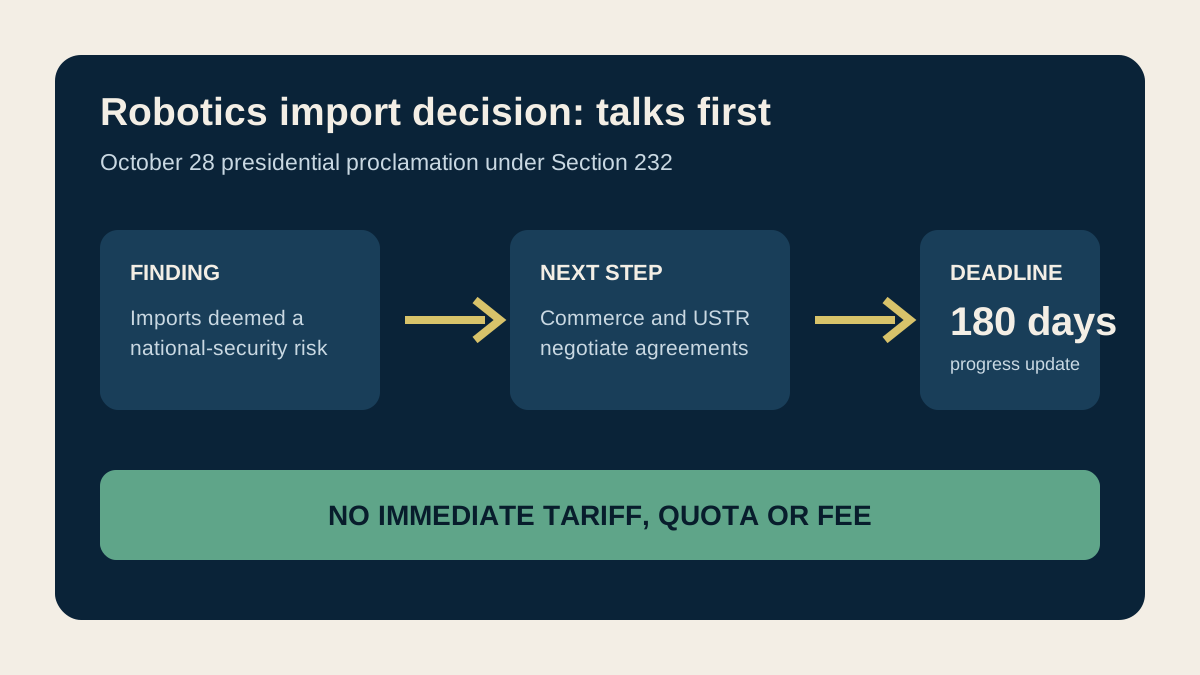
President Donald Trump determined that imports of robotics, industrial machinery and related parts are entering the United States in quantities or circumstances that threaten to impair national security. His October 28 proclamation directs the Commerce secretary and U.S. trade representative to negotiate agreements with trading partners and provide a progress update within 180 days.
The proclamation does not impose a new tariff, quota or fee now. It says the president may consider those measures later depending on the status or outcome of negotiations. The distinction matters for importers, manufacturers and investors making near-term decisions.
What equipment is in scope
The underlying Section 232 investigation covered a broad manufacturing base: programmable and computer-controlled mechanical systems, machine tools used for cutting, welding and handling workpieces, stamping and pressing machines, industrial ovens and autoclaves, and laser- and water-cutting equipment. The proclamation does not publish a final tariff schedule or product-by-product exclusion list because no tariff was imposed.
The White House says U.S. producers cannot currently satisfy domestic demand and argues that dependence on foreign equipment creates defense and critical-infrastructure risk. That is the administration's national-security judgment; the proclamation does not quantify how much capacity negotiations would relocate or how quickly domestic production could expand.
Why the decision matters
Robotics and industrial machinery are inputs into factories rather than only final consumer products. Immediate tariffs could therefore raise equipment costs for companies trying to automate, expand or build U.S. plants. Choosing talks first avoids that immediate charge while creating uncertainty about future prices and sourcing.
Potential beneficiaries include U.S. machinery and component producers if agreements or later incentives support domestic capacity. Potentially exposed companies include manufacturers that rely on specialized foreign machines with limited U.S. substitutes. Actual effects depend on which countries, products and remedies are eventually covered.
Practical implications
- Importers: existing tariff treatment remains in place unless a separate action applies; the proclamation itself creates no new duty today.
- Manufacturers: firms can map foreign machinery and component exposure, but should not assume a tariff rate or effective date that has not been announced.
- Workers and communities: domestic investment could support jobs, while higher equipment costs could slow some factory projects; neither outcome is guaranteed.
- Trading partners: negotiations may produce country-specific agreements, but the proclamation names no completed deal.
This is general reporting, not legal, trade-compliance or investment advice.
Fact, analysis, forecast and opinion
Verified fact: the proclamation establishes a national-security finding, orders negotiations and requires a 180-day update without imposing an immediate tariff. Analysis: the administration preserved leverage while avoiding an immediate cost increase for machinery users. Forecast: tariffs, quotas, fees or production incentives remain possible after or during the talks, but their scope and timing cannot yet be predicted. Opinion: Health Politics Daily takes no position on the Section 232 finding or whether future restrictions should be imposed.
For related trade context, see our reports on the U.S.–China trade truce and the Canada–Ontario industry response to U.S. tariffs. Those policies use different measures and do not determine the outcome of the robotics talks.
Bias Lens: security resilience, negotiating leverage and factory costs
Verified baseline: the White House found a national-security threat, ordered talks and left future remedies open; it imposed no immediate tariff, quota or fee.
Specific left-center-right coverage of this narrow proclamation was not meaningfully developed at publication time, so forcing partisan labels would mislead. The White House fact sheet emphasizes defense needs, domestic capacity and investment. Center-oriented Reuters leads with the absence of immediate tariffs and the relief for manufacturers dependent on imports. Business-focused Bloomberg frames the action as a delay and places it in the administration's broader effort to rebuild its tariff strategy. Those lenses differ in emphasis, but agree on the operative text.
What remains uncertain
The administration has not identified negotiating partners, target import levels, country exemptions, tariff rates, quotas, fees or a domestic incentive design. It is also unclear whether agreements will be reached within 180 days, how manufacturers will respond before then or whether later action will face litigation.
Principal sources
- White House — presidential proclamation
- White House — policy fact sheet
- Reuters — independent corroboration and industry context
- Bloomberg — trade-policy context
No suitable directly relevant official or publisher-authorized video with clear persistent embedding permission was available, so no video was embedded.
No comments yet.