Finance · Aerospace · Supply chains
Boeing 777 Freighter Production Halted by Supplier Dispute
A sole-source wing-component disruption also affected 767 and KC-46 work; the companies settled, but 777 freighter assembly had not resumed.
By Health Politics Daily News Desk · October 23, 2026 at 10:04 p.m. ET
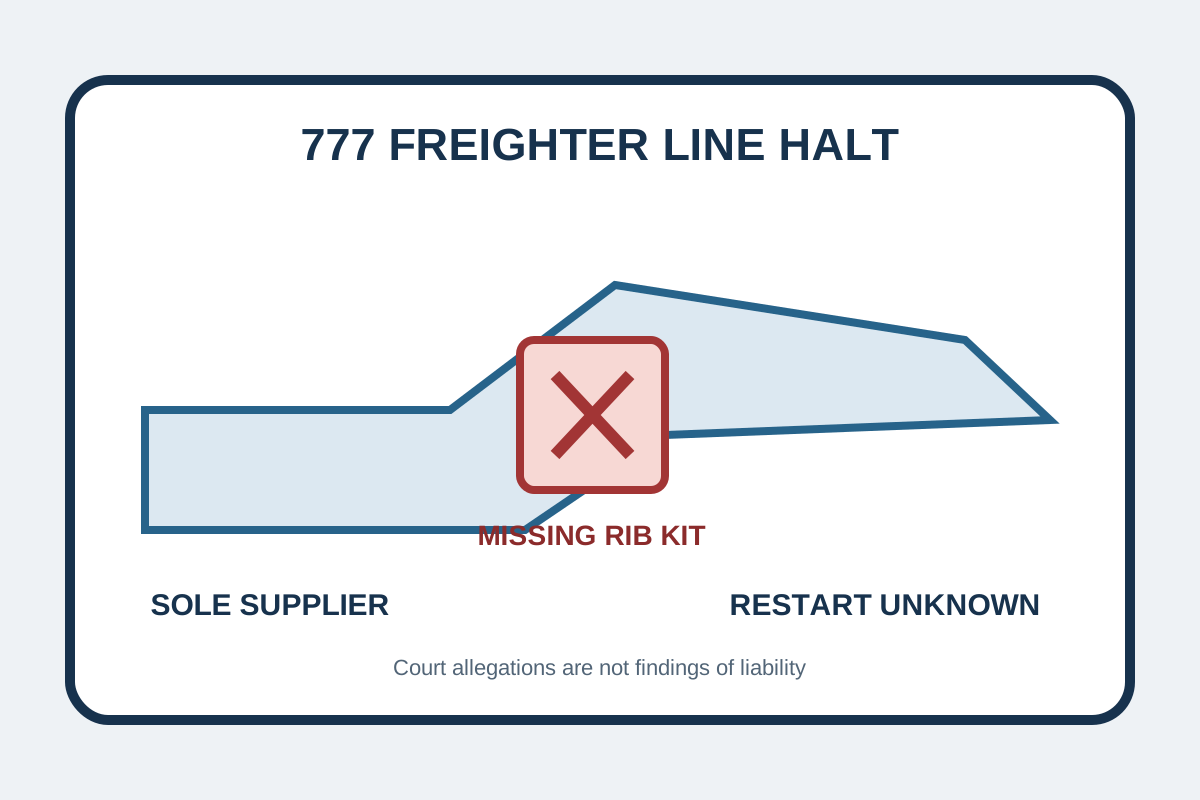
Boeing's 777 freighter production has been halted for nearly two months after a dispute with Florida supplier Vaero interrupted deliveries of a critical wing assembly, according to workers and court filings reviewed by Reuters.
The disruption also affected Boeing 767 production, including commercial freighters and KC-46 aerial refueling tankers. Boeing and Vaero reached a settlement in late September, but 777 freighter work had not restarted as of Friday.
What stopped the line
In an August complaint, Boeing alleged that Vaero stopped delivering trailing-edge rib kits used in 777 freighter and 767 wings and sought tens of millions of dollars in additional compensation. Vaero was the sole supplier. The allegations describe Boeing's litigation position; the settlement did not establish public findings of liability.
Court filings said the stoppage could cost Boeing as much as $6.5 million per day. Workers told Reuters that two partially assembled 777 freighters were removed from final assembly. Boeing is working to bring production of the kit in-house.
Why it matters
The 777 freighter carries high-value and time-sensitive cargo on long routes, while the 767 line supplies both commercial customers and the U.S. military's KC-46 program. A component shortage can delay deliveries and cash receipts even when demand remains strong.
The newer 777X program uses a different composite wing and was not affected by this particular shortage. The production halt is not evidence of an aircraft safety defect or an in-service grounding.
Practical implications
Air-cargo operators awaiting aircraft may have to adjust fleet planning, leases or retirement schedules if delivery dates move. Investors should distinguish an assembly interruption from a canceled order or permanent program shutdown; Boeing had not published a revised delivery schedule.
Fact, analysis, forecast and opinion
Verified fact: Boeing sued over undelivered parts, the companies settled and Reuters documented an ongoing 777 freighter production halt. Analysis: reliance on one supplier for a critical wing kit turned a commercial dispute into a multi-program bottleneck. Forecast: in-house production may reduce future dependence, but restart timing and delivery effects cannot yet be quantified. Opinion: Boeing should disclose material delivery changes promptly while preserving the distinction between court allegations and proven misconduct.
For related context, see our reporting on corporate restructuring risk, the technology-led market selloff and SpaceX and Tesla governance discussions.
Bias Lens: operational disruption, litigation claims and market framing
Verified baseline: production stopped after component deliveries ceased, a settlement followed, some 767 parts resumed and the 777 freighter line had not restarted. No public finding assigned legal fault.
Center — Reuters: foregrounds worker accounts, court documents and program effects. Investor-focused — Investing.com: emphasizes financial exposure and affected production. A meaningful left-right split was not present in original reporting, so this lens does not force political symmetry onto a commercial supply-chain dispute.
What remains uncertain
Boeing had not publicly provided a restart date, revised customer-delivery schedule, total financial impact or the time needed to qualify in-house production. The settlement terms are not public, and the extent of continuing 767 or KC-46 disruption is unclear.
Principal sources
- Reuters — workers, court filings and production status
- Investing.com — market-focused corroboration
- Aerospace Global News — 777 freighter program context
No suitable directly relevant official or publisher-authorized video with clear embedding permission was available, so none was embedded.