Public health · France · Emerging infections
France Reports First Documented Human Shamonda Virus Infection
The virus was found in one severely immunocompromised patient who later died. Investigators have not established whether it caused the death, and health agencies have identified no wider-spread signal.
By Health Politics Daily News Desk · October 22, 2026 at 11:55 a.m. ET

Watch in this article
Pumpjack operating at the Kern River Oil Field
A short CC0 field video provides visual context for reporting on oil production and fuel supply.
Thomas Farley / Wikimedia Commons · CC0 1.0 · License and source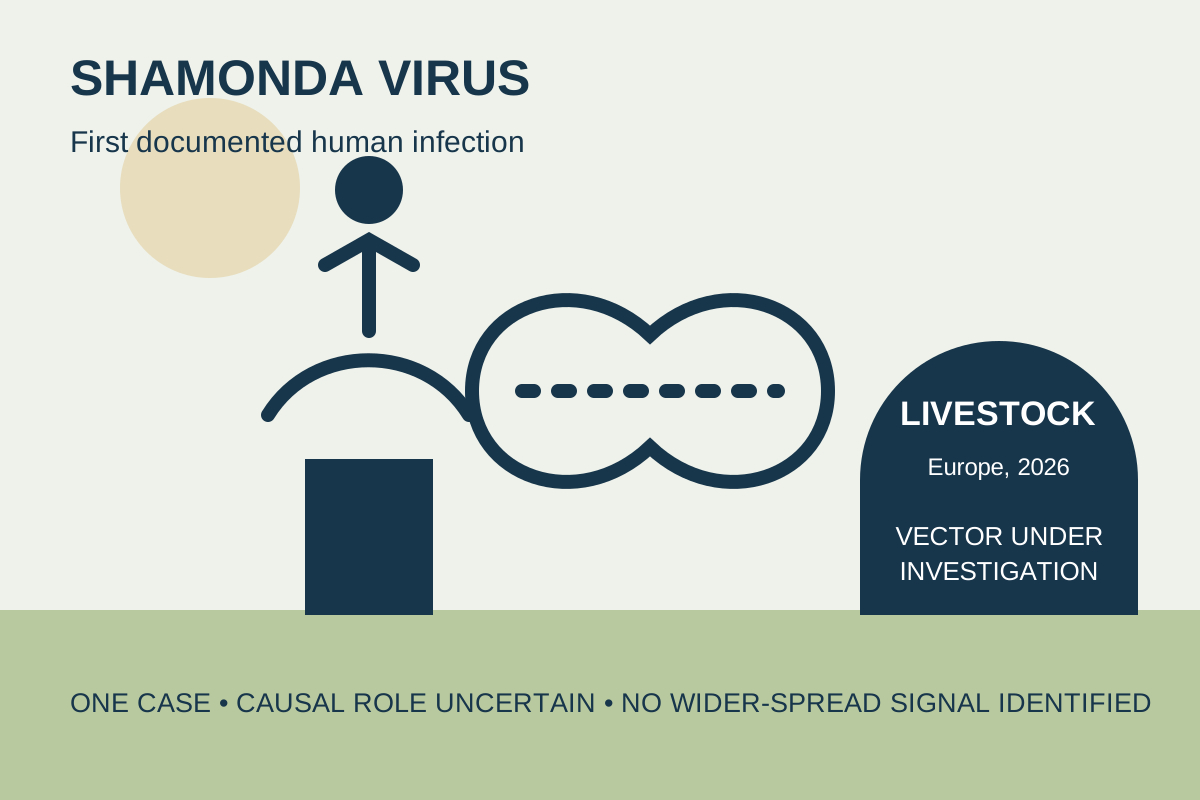
French authorities reported the first documented human infection with Shamonda virus, an insect-borne orthobunyavirus previously detected in animals. The European Centre for Disease Prevention and Control said the patient was being treated for a serious illness that made them more susceptible to infection and complications, and died in early October.
The case is scientifically important because it crosses a previously unrecorded species boundary. It is not evidence of an outbreak. ECDC says the cause or contribution of the virus to the death and the route of infection remain under investigation; French officials and the World Health Organization said no risk to the general population has been identified at this stage.
What authorities know
Shamonda virus had been detected in European farm animals for the first time in summer 2026 and has since been found in multiple countries. It typically spreads among animals through bites from infected Culicoides midges. Officials suspect a vector-borne infection in eastern France, but the specific midge species and exact exposure are not confirmed.
There is no reported evidence of person-to-person transmission. Cooler weather is reducing activity for many biting-midge species, though seasonal patterns vary by place and species. ECDC is working with European laboratories to strengthen testing and identify any additional cases.
Fact, analysis, forecast and opinion
Verified fact: one human infection has been documented in a severely immunocompromised patient who died. Analysis: a first detection justifies surveillance and laboratory work, but the patient's unusual vulnerability limits conclusions about risk to healthy people. Forecast: additional testing may clarify whether rare infections have been missed; there is not enough evidence to predict wider spread. Opinion: Health Politics Daily favors transparent surveillance without treating one case as proof of an epidemic.
Practical implications
- No general travel or medical restriction has been announced because of this case.
- People should not infer that contact with cattle or another person is a demonstrated transmission route.
- Clinicians and laboratories in affected regions may receive updated testing guidance as the investigation develops.
This article provides public-health information, not personalized medical advice. For related coverage, see our reports on early U.S. flu surveillance and Nigeria's Ebola contact tracing.
Bias Lens: scientific first or outbreak alarm?
Verified baseline: one infection is documented; the patient's severe immune compromise, the virus's role in the death and the exposure route remain under investigation. Authorities have not identified sustained human spread.
Left-leaning — The Guardian: treated the development as one item in broader European live coverage and repeated the no-general-risk assessment. Center — Associated Press: led with the first-known-case fact and foregrounded the patient's immune compromise and official risk assessment. Right-leaning — WELT: emphasized the death and first-ever human detection while also reporting that officials saw no public risk. The differences are mainly headline emphasis, not a factual dispute.
What remains uncertain
Investigators have not established whether Shamonda virus caused or contributed to the patient's death. They also do not know whether other human infections occurred without being recognized, which vector carried the virus, or whether the virus has biological features that could support transmission between people. Those questions require case finding, laboratory analysis and time.
Principal sources
- ECDC situation statement, October 22
- French authorities' press release
- Reuters corroborating report
- Associated Press corroborating report
No suitable directly relevant official or publisher-authorized video with verified embedding permission was available, so none was embedded.