European security · Romania · Maritime safety
Romanian F-16s Down Two Drones Over Territorial Waters Near Sulina
Romania confirms two interceptions on October 17. Fresh reporting separates the defence minister’s assessment of Russian origin from the still-unresolved evidence about the drones’ mission.
By Health Politics Daily News Desk · October 18, 2026 at 12:00 p.m. ET
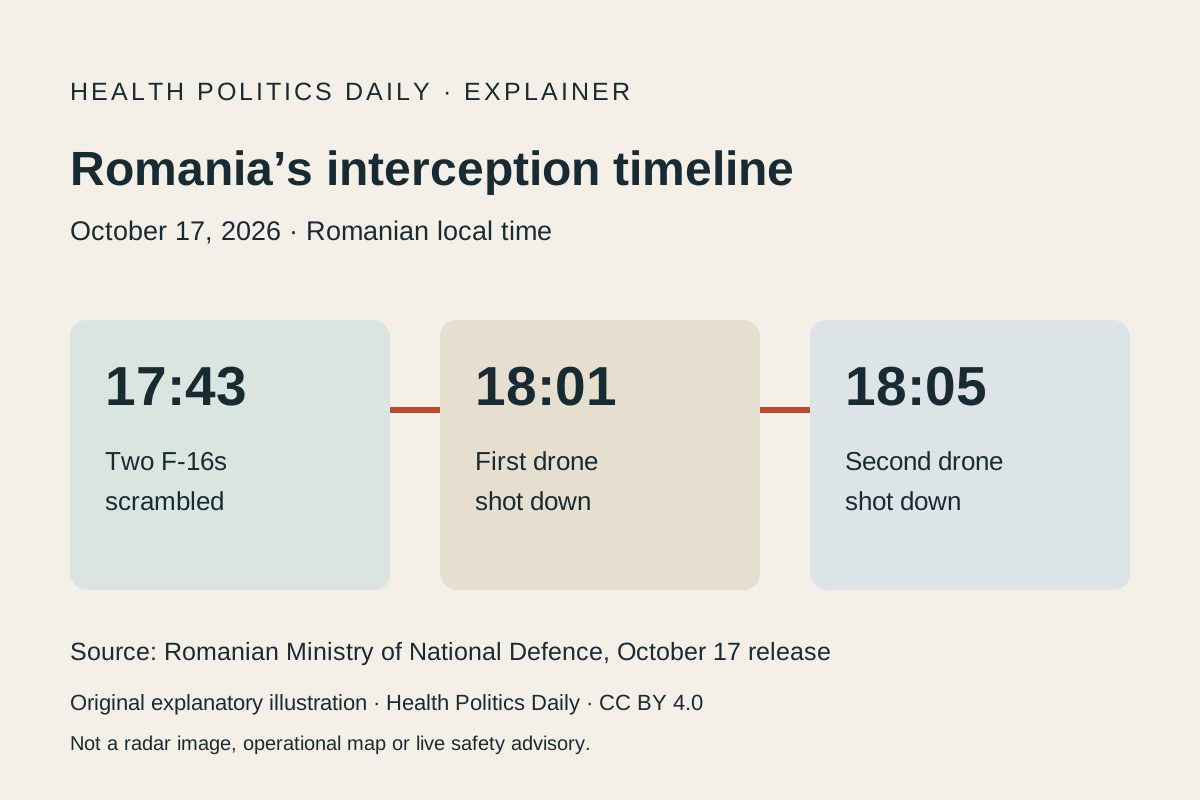
Romania says its fighter aircraft destroyed two drones over the country’s territorial waters on Saturday, October 17, bringing the security risks around Black Sea shipping into sharper focus. The interception is confirmed by the Romanian Defence Ministry; responsibility and intent require a more qualified account.
In reporting published October 18, Reuters quoted Defence Minister Radu Miruță assessing the drones as likely Russian. That assessment should not be presented as a publicly demonstrated reconstruction of who launched them, their intended targets or why they entered Romanian airspace.
What the official timeline establishes
The ministry’s October 17 English-language release says two Romanian F-16s left Borcea at 17:43 after radar detected approaching aerial targets. It records shoot-downs at 18:01 and 18:05, both over Romanian territorial waters. These are Romanian local times, not Eastern Time.
Euronews independently reported the government’s account, locating the interceptions near Sulina on Romania’s Black Sea coast. The location matters: this is a coastal and maritime incident, not a report of drones being destroyed over a Romanian city.
Why the location matters for people and trade
Sulina connects the Danube shipping system with the Black Sea. Reuters places the interceptions against recent attacks on commercial vessels nearby. For crews, port workers and communities that depend on maritime traffic, the immediate question is whether authorities can keep navigation and coastal activity safe—not simply which aircraft carried out an interception.
Analysis: An airborne object crossing a national boundary, a successful interception and attribution to a particular state are different findings. Confirming one does not automatically settle the others. This distinction is especially important when a military incident occurs close to civilian transport routes: headlines can establish that a danger was confronted without establishing its intended victim.
The wider maritime concern is also explored in our reporting on a drone incident and ship sinking off Bulgaria. That is a separate event, not evidence that the same operator or mission was involved here.
Practical implications—and the limits of this report
This article is not a live navigation warning, evacuation notice or airspace advisory. Anyone making operational decisions should consult current notices from the relevant maritime, aviation and local authorities. A retrospective interception timeline cannot establish present conditions along an entire coastline.
Readers should also distinguish this incident from Lithuania’s separate investigation after an air alert. Similar vocabulary across several countries does not establish a shared cause.
What remains uncertain
The cited accounts do not provide a complete public forensic chain establishing launch location, guidance instructions and intended destination. Initial technical descriptions should not substitute for that evidence. Nor does reporting on this interception establish a new alliance-wide military policy. No forecast of further incursions is offered here.
Bias Lens: confirmed interception, different editorial emphasis
Verified baseline: Romania’s ministry reports two shoot-downs over territorial waters on October 17. Attribution and intent are separate questions.
Center—Reuters: The incident report emphasizes operational facts and officials’ attribution assessment.
Left-leaning—The Guardian: Its broader Black Sea report foregrounds shipping risks. It is contextual coverage, not an equivalent account of these interceptions.
Additional comparison—Euronews: Its October 17 report emphasizes the authorities’ account and coastal location. No sufficiently matched right-leaning report was verified for this edition; none is invented or relabeled. These observations describe the linked articles, not every report by their publishers.
Sources and media
The ministry provides the primary interception record; Reuters and Euronews supply corroborating reporting and context. The original timeline illustration is licensed CC BY 4.0. No directly relevant authorized video with sufficiently clear rights was verified, so no video is embedded.