Health · Mental Health · Clinical Research
HHS Funds Ibogaine PTSD Research, but the Awards Do Not Authorize Patient Trials
The federal government committed up to $4.9 million to prepare evidence, manufacturing and regulatory materials for possible U.S. studies of ibogaine. No patient trial has been authorized, and the drug's serious heart and neurological risks remain central to the review.
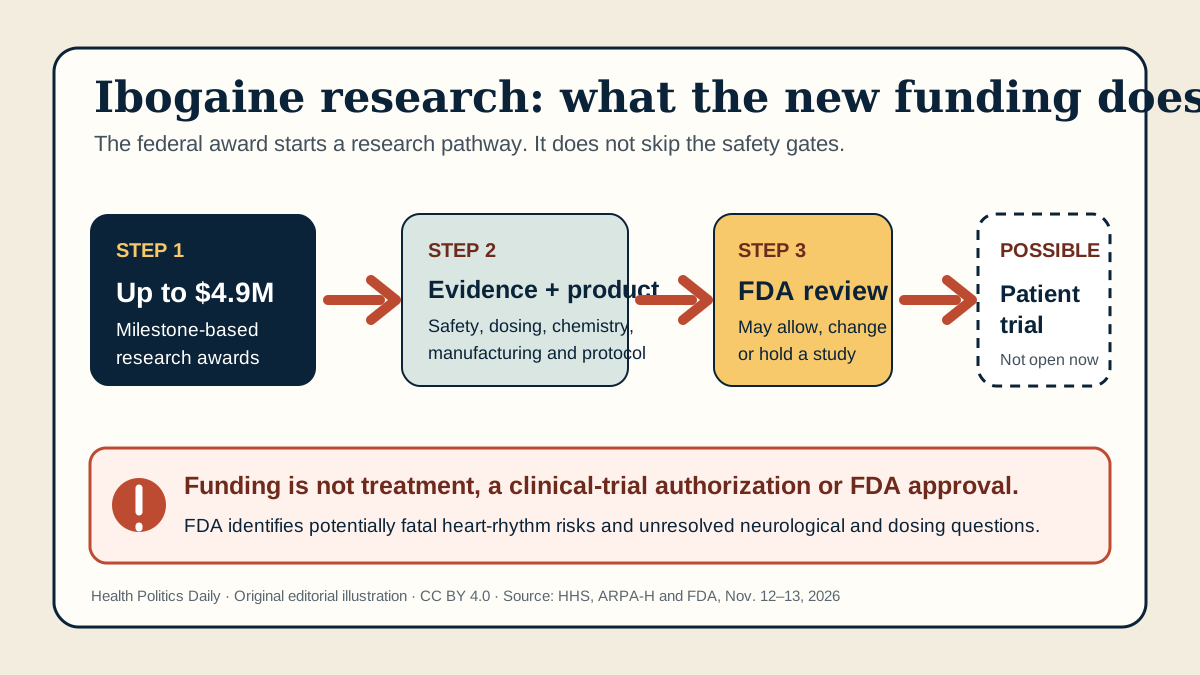
Verified baseline: federal money is funding groundwork, not treatment
The U.S. Department of Health and Human Services announced an initial commitment of up to $4.9 million over five years for work intended to make rigorous U.S. research on ibogaine possible. The projects focus on a consistent drug product, manufacturing, dose and safety information, and the material needed for future Investigational New Drug applications to the Food and Drug Administration.
The announcement does not authorize a clinical trial, enroll patients, provide treatment or establish that ibogaine is safe or effective for post-traumatic stress disorder. HHS explicitly says the awards do not fund human-subject research. An FDA-reviewed application and appropriate independent oversight would still be required before a U.S. patient trial could begin.
The two selected teams have different assignments. A Mark Cuban Cost Plus Drug Company-led project has an award listed at up to $4.2 million to build a domestically manufactured, single-molecule ibogaine hydrochloride research product and its regulatory foundation. A separate Beond project, listed at up to $800,000, will assemble clinical data on dosing, safety, effects and durability from its treatment program in Mexico. These are award ceilings tied to milestones; they are not a guaranteed lump-sum payment.
Why ibogaine is attracting attention—and why evidence remains limited
Ibogaine is a psychoactive compound associated with the iboga plant of West and Central Africa. Veterans, people with substance-use disorders and advocates have described rapid improvements after treatment in countries where clinics offer it, creating pressure to study those reports systematically. Testimonials can identify questions worth testing, but they cannot by themselves show whether a drug works, how long an effect lasts or whether benefits outweigh harms.
ARPA-H says no current Investigational New Drug application permits U.S. clinical research on ibogaine as a psychiatric treatment. Much of the available evidence comes from observational studies or clinics outside the United States, where patient selection, product purity, dosing, follow-up and reporting can vary. That makes controlled, independently reviewed research particularly important.
The federal project also arrives as interest in psychedelic and rapid-acting mental-health treatments expands. HHS separately announced a $20 million National Institute of Mental Health funding opportunity for a research network covering compounds such as ketamine, esketamine and psilocybin. That separate opportunity should not be added to the $4.9 million ibogaine commitment as though it were one ibogaine award.
The safety problem is not a footnote
FDA says ibogaine can substantially prolong the heart's QT interval, increasing the risk of life-threatening ventricular arrhythmias and death. The agency also identifies neurological toxicity in animal studies, impaired coordination and cognition, uncertainty about an appropriate starting dose, and weaknesses in the existing human evidence.
In an October request for public input, FDA asked about dose escalation, participant eligibility, cardiac and neurological monitoring, stopping rules, care settings, informed consent and independent safety oversight. Comments are due November 20. FDA also made clear that the request does not predetermine how it will rule on any future application.
Those risks explain why a standardized research product and detailed protocol come before patient enrollment. They also make unmonitored use materially different from a carefully screened early-phase study with electrocardiography, laboratory testing, emergency capability and an independent monitoring plan.
What the announcement means for veterans and families now
- No new treatment entitlement: the awards do not add ibogaine to VA benefits, authorize prescribing or create an open enrollment program.
- No proof of benefit: the program is designed to generate evidence, not confirm advocates' claims in advance.
- No announced U.S. trial date: future sponsors must complete the preparatory work and obtain regulatory clearance before recruiting participants.
- Existing care remains available: people seeking help for PTSD can use established VA and civilian care pathways while research proceeds. This report does not recommend starting, stopping or changing any treatment.
- Future trial listings require verification: if a study opens, eligibility, locations, risks and contacts should appear in an official registry and consent materials rather than in promotional posts alone.
How the regulatory path works
A research award and an FDA drug approval are separated by multiple decisions. The projects first need a reproducible research product and enough chemistry, manufacturing, toxicology and protocol information to support an Investigational New Drug application. FDA can allow the study to proceed, request changes or place it on clinical hold if risks are not adequately addressed.
An allowed early-phase study would initially answer safety, dosing and feasibility questions; it would not equal approval. Demonstrating efficacy generally requires later controlled trials that can distinguish the drug's effect from patient expectations, intensive accompanying care and natural changes over time. Psychedelic studies face an additional design challenge because participants may infer whether they received the active drug.
Even a positive trial would not guarantee a commercial product, insurance coverage or VA availability. Manufacturing standards, larger studies, an FDA marketing application, labeling, controlled-substance rules, clinician training and payment decisions would remain separate steps.
Fact, analysis, forecast and opinion
Verified fact: HHS committed up to $4.9 million for two milestone-based projects that prepare regulatory, manufacturing and evidence foundations for possible ibogaine studies; the awards do not authorize human-subject research. Analysis: the immediate policy change is a shift from anecdote-led advocacy toward a defined federal evidence pathway, not a new treatment option. Forecast: an Investigational New Drug application may follow if the teams meet their milestones, but no filing date, FDA decision or patient-trial start is guaranteed. Opinion: Health Politics Daily neither endorses nor opposes eventual approval; the appropriate standard is transparent evidence of benefit, risk and manufacturing quality.
Bias Lens: breakthrough, controversy or research process?
Verified baseline: the awards provide up to $4.9 million for pre-trial development, do not treat patients and do not establish FDA approval. Ibogaine has unresolved efficacy questions and documented risks, including potentially fatal heart-rhythm problems.
Left-leaning coverage — The Washington Post: places the ibogaine award inside the administration's broader psychedelic-policy push and emphasizes both veteran advocacy and safety questions. Center-oriented wire coverage — Associated Press: leads with the drug's controversy, the role of political and media advocates, the limited evidence base and the distinction between preparation and patient research. Right-leaning coverage — Fox News: presents the administration announcement live and centers the federal push and potential relevance to veterans with PTSD.
The differences are mainly emphasis: political context and the wider psychedelic agenda, the tension between advocacy and scientific uncertainty, or the administration's stated objective. These labels describe editorial framing, not whether a source's individual factual claim is correct. All three frames should be tested against the same HHS, ARPA-H and FDA records.
What remains uncertain
HHS has not announced when either team will finish its milestones, when an application will reach FDA, what exact trial design would be proposed or whether FDA will allow it to proceed. The Beond data set's completeness, comparability and independent validation will matter because clinic records are not automatically equivalent to a prospective controlled trial.
It is also unknown whether ibogaine will show a durable benefit for PTSD, which patients—if any—could safely receive it, how its risks compare with existing options, or what treatment would cost if a product eventually earns approval. HHS says results will be made public whether they show benefit, no benefit or harm, but publication methods and timing are still to be defined.
For related context, our report on FDA's psychedelics hearing explains why public testimony does not equal drug approval. Our coverage of the federal shift toward human-based research examines what new development methods can and cannot establish, and our FDA rare-disease review explainer separates accelerated process from lowered evidence standards.
Principal sources
- HHS — awards, funding scope and separate NIMH opportunity
- ARPA-H — selected teams and pre-trial objectives
- ARPA-H — semi-synthetic ibogaine hydrochloride award
- ARPA-H — ibogaine data project award
- FDA — proposed study safeguards, risks and public-comment process
- Associated Press — independent reporting on the announcement and evidence limits
- Reuters — federal funding and trial-preparation context
Video: Fox News published a directly relevant video page for the HHS announcement. It is linked rather than embedded because persistent third-party embedding permission was not clear.
Discussion
Reader comments
Discuss the reporting, not other readers. Claims should be sourced; threats, harassment, misinformation, medical misinformation and personal data are removed.
Comments are publicly visible after automated and editorial review. Guest comments are stored on this device until submitted; account details are governed by our Privacy Policy.