Health · Infectious Disease · Vaccination
PAHO Reviews U.S. and Mexico Measles-Elimination Status After Yearlong Outbreaks
An independent commission is testing genetic and epidemiological evidence against a 12-month standard. A decision is expected next week, but “elimination” does not mean zero cases—and losing the label would not change risk overnight.
Verified baseline: the review is underway; the outcome is not
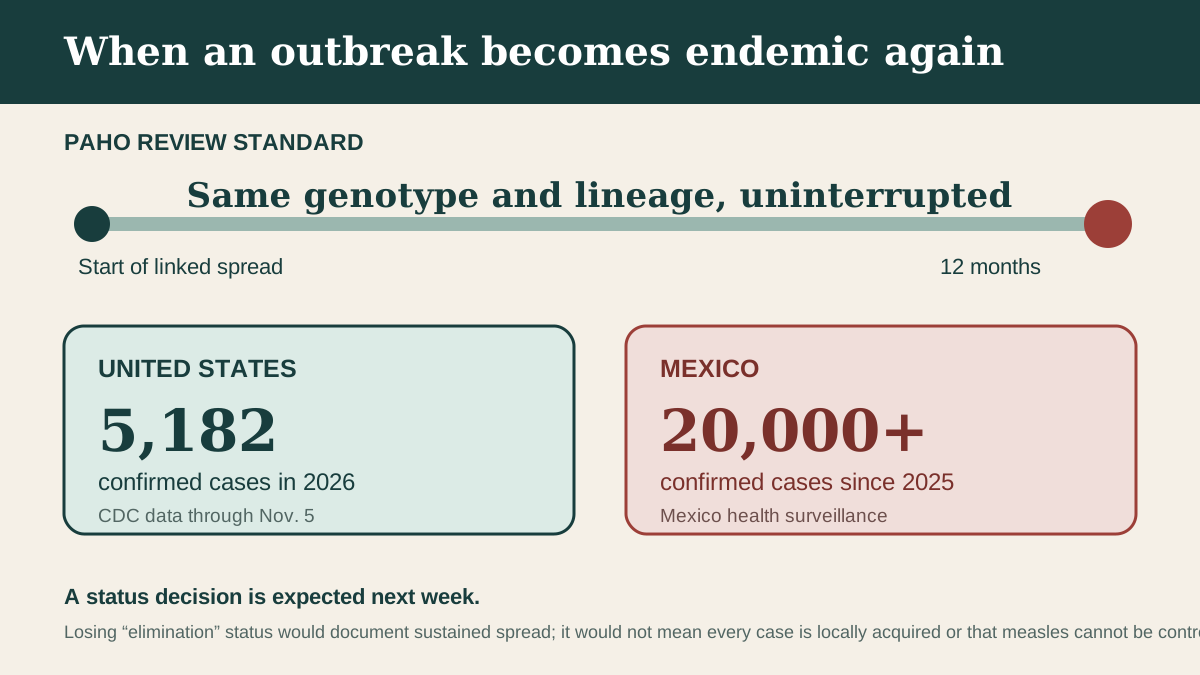
The Pan American Health Organization’s independent Regional Verification Commission is reviewing whether measles transmission has been reestablished in the United States and Mexico. Under the PAHO standard, endemic transmission returns when epidemiological and laboratory evidence shows that the same virus genotype and lineage has circulated continuously for 12 months or more in a country or defined area.
The commission is meeting this week and will make a technical recommendation to PAHO Director Jarbas Barbosa. PAHO and current reporting indicate a public decision is expected next week. Until Barbosa accepts and announces the recommendation, claims that either country has already lost its status are forecasts, not verified outcomes.
The United States was declared to have eliminated endemic measles in 2000. Mexico achieved elimination later as part of the Americas’ regional verification. Elimination never meant the virus had been eradicated worldwide or that imported cases could not occur. It meant imported infections did not sustain a domestic chain for at least 12 months.
The evidence the commission is weighing
CDC data through November 5 list 5,182 confirmed U.S. cases in 2026, more than twice the 2,289 recorded in all of 2025. Ninety-six percent of this year’s cases were linked to outbreaks, including chains that began in 2025. The 2026 total is the country’s highest since 1991.
Mexico’s November 3 surveillance report counted 20,386 confirmed cases since the beginning of 2025 across all 32 states and 530 municipalities. Later Mexican reporting put the cumulative total above 20,500 and deaths at 50. The national curve has declined from its early-2026 peak, but a declining outbreak can still satisfy the 12-month criterion if linked transmission never fully stopped.
Case totals alone do not decide elimination status. The commission examines onset dates, exposure links, viral genotype and lineage, laboratory quality, surveillance sensitivity and whether apparent gaps in cases represent a real break in transmission. That is why the meeting is technical and closed, and why public counts cannot independently prove the result.
What would change if elimination status is lost?
The designation would formally acknowledge that measles is again spreading endemically rather than appearing only through separately contained importations. It would place the United States or Mexico on a path that requires at least 12 consecutive months without endemic transmission, supported by vaccination, surveillance and outbreak-response evidence, before re-verification.
It would not automatically create a travel ban, change school-entry law, alter an individual vaccination record or trigger a new federal emergency declaration. CDC Director Erica Schwartz told Reuters that the agency would continue working with state and local health departments, emphasizing vaccination and targeted outbreak control whether or not the designation changes.
The practical effect is accountability. A loss would create an internationally reviewed benchmark for restoring interruption of transmission and would expose where national averages conceal local immunity gaps. It could also affect how other countries assess travel-related importation risk, although each government sets its own travel and public-health rules.
Why families should distinguish status from personal risk
A national label does not tell a family whether measles is circulating in its county, school, workplace or travel destination. State and local health departments have the most current exposure notices. A person who has been exposed or develops fever, cough, runny nose, red eyes and then a spreading rash should contact a health provider or public-health department before arriving in a waiting room, so staff can reduce additional exposure.
CDC says two documented doses of measles, mumps and rubella vaccine are about 97% effective against measles and one dose is about 93% effective. It reports national kindergarten MMR coverage fell from 95.2% in 2019–2020 to 92.4% in 2025–2026, leaving roughly 280,000 kindergartners at risk. Community averages matter because measles spreads through the air and can remain infectious in a room after an infected person leaves.
Vaccination decisions can depend on age, prior records, pregnancy, immune status, exposure and travel. People unsure of their records or eligibility can use CDC guidance and consult a clinician or local health department. This article provides general public-health information, not personalized medical advice.
Why death totals differ among public reports
Current U.S. death counts are not directly interchangeable. CDC’s public dashboard says figures are subject to review while the agency and the Council of State and Territorial Epidemiologists develop a standardized measles-death definition. Reuters reported on November 12 that CDC had confirmed six measles-related deaths in 2026, while state and local reports and major news organizations have cited higher numbers using “associated” deaths or different review dates.
Those differences do not make the deaths less consequential; they describe different stages of verification. Responsible comparisons should specify the source, time period and whether a death is confirmed as caused by measles, associated with a measles infection or still under review.
Fact, analysis, forecast and opinion
Verified fact: PAHO’s commission is reviewing U.S. and Mexican evidence under a 12-month transmission standard; neither final country decision had been announced at publication. Analysis: genetic linkage and the continuity of spread matter more to the designation than the headline case total. Forecast: sustained chains documented in public reporting make loss of status plausible, but only PAHO’s formal decision can establish it. Opinion: Health Politics Daily takes no position on elected officials or individual medical decisions; the useful test of policy is whether it reduces infections, reaches under-vaccinated communities and reports outcomes transparently.
Bias Lens: how politically charged coverage frames the same review
Verified baseline: PAHO’s independent technical commission—not a U.S. political party or news outlet—applies the same 12-month, genotype-and-lineage standard across the Americas. The result is pending, U.S. cases have more than doubled from 2025 and national vaccination coverage is below the 95% community-immunity target.
Left-leaning coverage — The Washington Post: foregrounds the quarter-century public-health achievement and the federal response while noting publicly documented long transmission chains. Center-oriented wire coverage — Associated Press: emphasizes the definition of elimination, the cross-border history, case and death burdens, and what families should understand. Right-leaning tabloid coverage — New York Post: leads with the symbolic reversal after 26 years and falling vaccination rates.
These broad editorial labels describe framing, not factual reliability. The outlets converge on the pending review and 12-month standard; they differ in whether they center government accountability, public-health explanation or national reversal. No outlet’s forecast substitutes for PAHO’s decision, and treating vaccine policy as only a partisan dispute would obscure the measurable questions of coverage, transmission and outcomes.
What remains uncertain
PAHO has not published the commission’s country-by-country findings, the exact transmission chains it accepts as continuous or its final recommendation. The timing announced by reporting could also change. A decision against one country would not automatically establish the same outcome for the other.
Even if status is lost, the time needed to regain it cannot be predicted from current counts. It will depend on interrupting every endemic chain, improving timely case detection, reaching communities with low coverage and documenting the result for at least a year.
Our earlier report on Pennsylvania’s 1,398-case outbreak explains the hospitalization burden and local vaccination response. Our coverage of the Senate inquiry into RFK Jr.’s Samoa testimony separates a political oversight dispute from the evidence on measles and vaccination.
Principal sources
- PAHO — Regional Verification Commission mandate and 12-month standard
- PAHO — November 2026 annual-review announcement
- CDC — U.S. cases, outbreak linkage and vaccination coverage
- Mexico Health Ministry — November 3 daily measles report
- Associated Press — U.S.-Mexico review, outbreak history and public-health context
- Reuters — CDC response and decision timeline
No suitable directly relevant official or publisher-authorized video with clear, persistent embedding permission was available, so no video was embedded.
Discussion
Reader comments
Discuss the reporting, not other readers. Claims should be sourced; threats, harassment, misinformation, medical misinformation and personal data are removed.
Comments are publicly visible after automated and editorial review. Guest comments are stored on this device until submitted; account details are governed by our Privacy Policy.