International Finance · Venezuela · U.S. Foreign Policy
U.S. Report Details $12.26 Billion Venezuela Account; Nearly 99% Disbursed
The first substantial public accounting says most resource revenue moved back into Venezuela, while leaving important questions about recipients, oversight and long-term control.
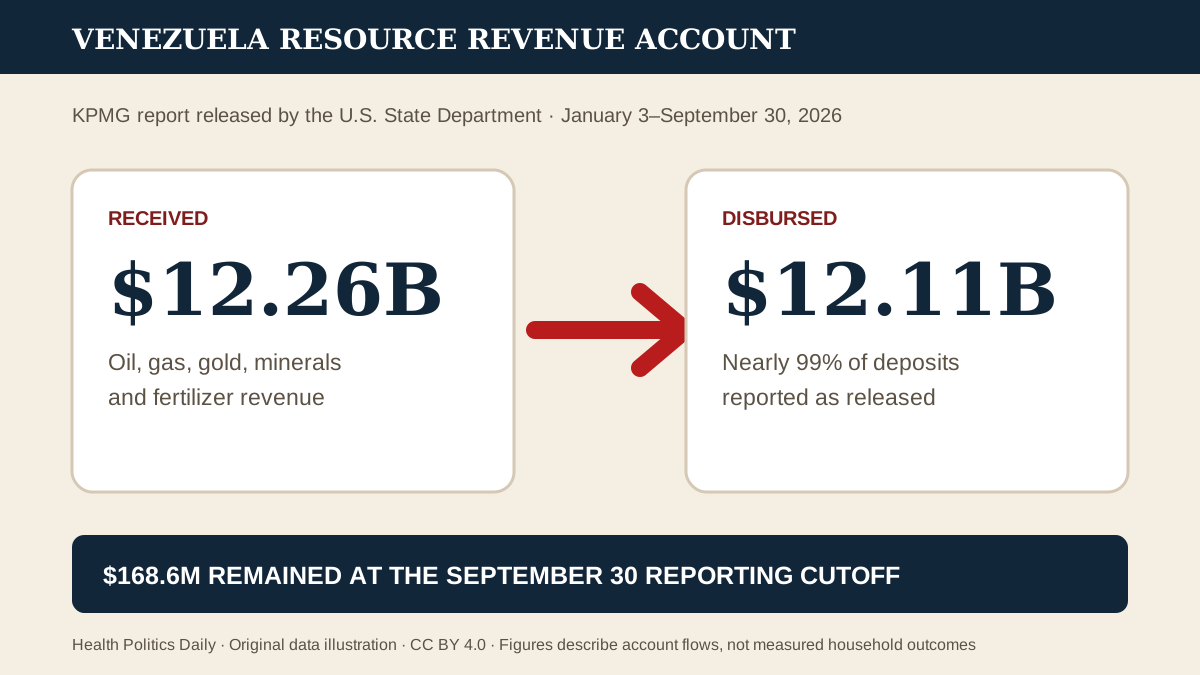
Verified baseline: $12.26 billion received, $12.11 billion disbursed
A 53-page report prepared by KPMG and released by the U.S. State Department says the Venezuela Custody Account received $12.26 billion from January 3 through September 30, 2026. It says $12.11 billion—nearly 99%—was disbursed, leaving about $168.6 million in the account at the reporting cutoff.
More than $12.1 billion of the deposits came from oil, petroleum products and natural gas, according to accounts of the report by The Associated Press and Reuters. Smaller deposits included about $108 million from gold, $22 million from minerals and $24.6 million from fertilizer.
The account was created after the U.S. operation that removed Nicolás Maduro in January. A January 9 executive order says the funds remain Venezuela’s sovereign property, are held by the United States in a custodial capacity and may be released for public, governmental or diplomatic purposes determined by the secretary of state.
“Disbursed” does not mean every dollar went directly to a household or public project. Most funds supported foreign-exchange transactions through Venezuelan commercial banks, while $133 million paid vendors directly for government services and supplies. Public reporting identified payments including nearly $24 million for dialysis and coal-mining equipment and $8.7 million toward vaccine-procurement debt owed to the Pan American Health Organization.
Why the accounting matters
Oil is Venezuela’s main source of export income, and the arrangement gives U.S. officials approval authority over the timing and purpose of releases from the account. That creates two simultaneous realities: nearly all reported revenue had moved back toward Venezuela by September 30, and Washington retained control over the release process.
For Venezuelans, the practical question is whether foreign-exchange auctions and direct purchases translate into more reliable food, medicine, electricity and other services. The report describes money flows; it does not independently measure household outcomes, regional distribution or service quality.
For U.S. taxpayers and lawmakers, the issue is transparency rather than ownership. The executive order says the money is Venezuelan property, not U.S. revenue. But State and Treasury officials approve transactions, and the published version reportedly redacts the 20 buyers of oil and gold. A September Senate Finance Committee letter asked for buyer identities, anti-money-laundering reviews, KPMG’s scope of work and safeguards for competitive procurement.
The account also sits inside a larger debate about post-Maduro authority and Venezuela’s recovery. Our report on the House impeachment resolution explains how the January military operation remains contested in Congress, while our Strategic Petroleum Reserve explainer provides context on U.S. oil inventories and why Venezuelan supply does not automatically determine retail prices.
What the money was reported to support
- Foreign exchange: most disbursements went to Venezuelan central-bank requests and commercial-bank auctions intended to provide dollars to the economy and support the bolívar.
- Direct payments: about $133 million went to vendors for services and supplies, including health-related equipment and vaccine debt.
- Remaining balance: approximately $168.6 million remained as of September 30, a snapshot that may have changed since the report’s cutoff.
- Not U.S. budget revenue: the governing order classifies the deposits as sovereign Venezuelan funds held in custody, not money available for ordinary federal spending.
Practical implications
Businesses dealing in Venezuelan resources still face U.S. licensing, sanctions and anti-money-laundering checks. The report’s large aggregate totals do not establish that any specific company can buy oil, receive payment or invest without separate authorization.
Venezuelan importers and households may benefit when foreign currency reaches banks and vendors, but exchange-rate stability and access to goods depend on how the auctions operate, who receives dollars and whether supplies arrive. The report is not a guarantee of lower prices, improved medical care or a durable economic recovery.
Investors should also avoid treating the accounting as a forecast for oil prices or Venezuelan assets. Production capacity, sanctions, security, contract terms, infrastructure and global demand remain independent variables. This article provides public-policy context, not personalized investment advice.
Fact, analysis, forecast and opinion
Verified fact: the released report records $12.26 billion in deposits, $12.11 billion in disbursements and about $168.6 million remaining through September 30. Analysis: the figures support the administration’s claim that the United States acted largely as custodian, but they also confirm that U.S. officials controlled approvals for Venezuela’s most important revenue stream. Forecast: congressional oversight is likely to focus on buyer identities, vendor selection and measurable outcomes, but the scope and timing of any inquiry are not assured. Opinion: Health Politics Daily takes no position on the oil arrangement; publishing transaction-level safeguards and outcome measures would make competing claims easier to test.
Bias Lens: custody, control or economic management?
Verified baseline: a U.S.-controlled account received $12.26 billion from Venezuelan resources and disbursed $12.11 billion through September 30. The governing order calls the funds Venezuelan sovereign property, while U.S. officials retain approval authority.
Left-leaning — The New York Times report republished by The Philadelphia Inquirer: emphasizes the degree of U.S. financial control and unresolved questions about democratic authority. Center — The Associated Press: leads with the amount returned and details payments for public services, while noting redacted buyers. Right-leaning — The Wall Street Journal: foregrounds that nearly all revenue was released and describes the account as part of an effort to stabilize the currency and restart imports.
The framing difference is about which verified feature receives top billing: U.S. control, the volume returned or the intended economic function. Those emphases are compatible with the same underlying ledger. None by itself establishes that every disbursement was effective, improper or free from risk.
What remains uncertain
The public record does not identify all buyers, recipients or beneficial owners, and it does not provide transaction-level evidence sufficient to evaluate competition, pricing or conflicts of interest. The report’s September 30 cutoff also means it cannot describe the current balance.
It is unclear how much of the foreign exchange ultimately reached priority imports, how the benefits were distributed across Venezuela or how KPMG tested end use after funds left the custody account. The report is an accounting milestone, not a complete audit of the country’s recovery or a legal judgment on the post-Maduro arrangement.
Principal sources
- White House — Executive Order 14373 governing Venezuelan resource funds
- Senate Finance Committee — oversight questions to Treasury and State
- Associated Press — released report totals and examples of direct payments
- Reuters — account structure, source categories and State Department response
- Wall Street Journal — 53-page report and economic-management context
No suitable directly relevant official or publisher-authorized video with clear, persistent embedding permission was available, so no video was embedded.
No comments yet.