U.S. energy · Finance · Supply resilience
U.S. Oil Reserve Near 283 Million Barrels as Emergency Drawdowns Continue
New reporting puts the U.S. oil reserve near 283 million barrels. Dated DOE figures differ; here is what the inventory does—and does not—tell households.
By Health Politics Daily News Desk · October 19, 2026 at 8:07 p.m. ET
The United States’ emergency crude-oil stockpile remains near 283 million barrels as releases continue. Reuters reported October 19 that it held 282.7 million barrels the previous week, citing the Department of Energy, and described that as the lowest since October 1982.
For households, the consequential distinction is between an emergency buffer and everyday fuel supply. The Strategic Petroleum Reserve is not the country’s entire oil inventory, and its level alone does not establish that a local filling station will run short.
The figures need their dates attached
The DOE’s Quick Facts page, inspected for this report, labels its site-by-site table “as of October 16, 2026” and lists a combined 282.2 million barrels. That is 0.5 million barrels below the Reuters figure. This newsroom could not establish why the two published totals differ and is not silently treating them as the same observation.
The department’s current-inventory window is image-based; readers checking it should inspect the date shown rather than assume an older cached image is current. A headline rounded to “near 283 million” conveys the common scale without resolving a discrepancy the available evidence does not explain.
DOE lists authorized storage capacity at 714 million barrels. Capacity is the space the system is authorized to hold, not the amount available today. Its current page also contains an import-protection calculation explicitly dated to the end of 2025; that is not a current estimate of how long today’s inventory would last.
A loan can lower today’s stock while promising a later return
In its September 29 release, DOE described a solicitation for up to 40 million barrels within the previously announced 172-million-barrel U.S. commitment. The department placed that commitment within a coordinated 400-million-barrel international response and scheduled deliveries under awarded exchanges for November and December.
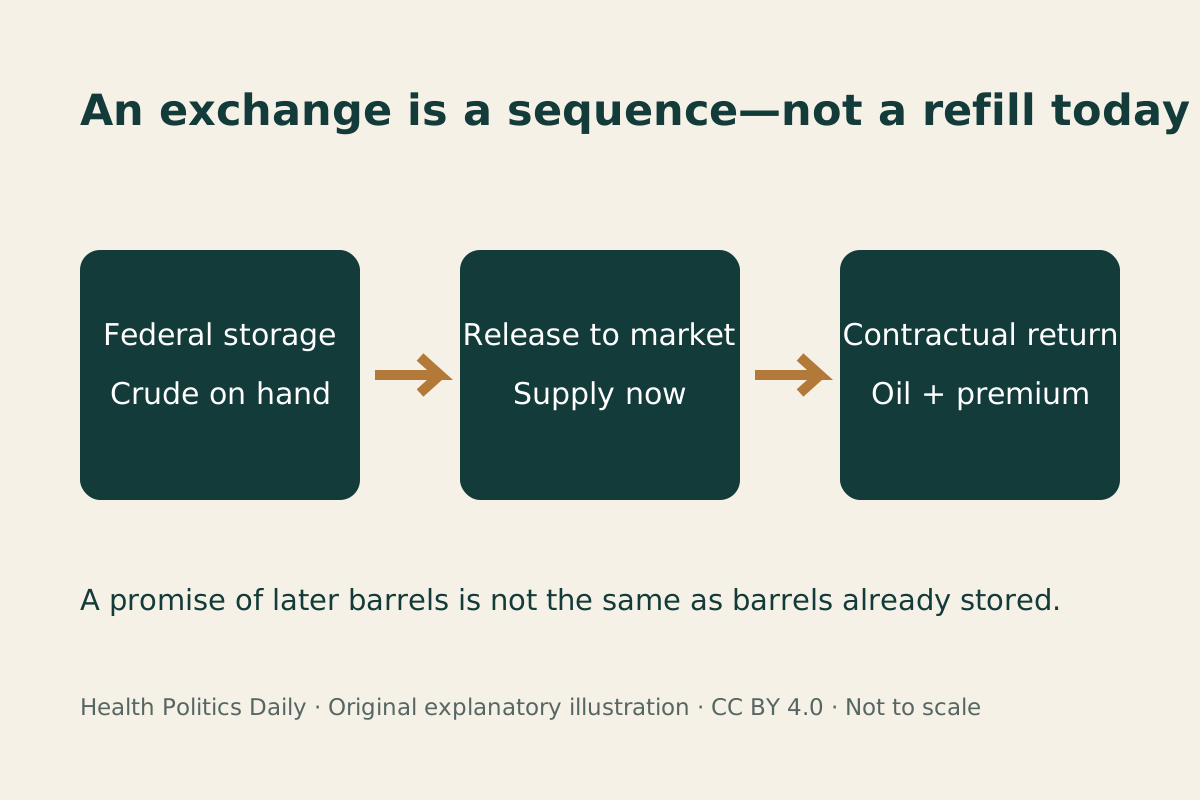
Under an exchange, companies borrow crude and later return oil plus an additional quantity, or premium. DOE says this structure can support immediate supply while adding barrels over time. That is the department’s description of the intended mechanism—not proof that all contracted returns have already arrived or that every promised benefit has been realized.
Our October 16 report on the separate 17-million-barrel solicitation explains why an offer is not itself a completed delivery. The new inventory reporting concerns the stock remaining, rather than merely the size of a proposed transaction.
Why the buffer matters without predicting a pump price
DOE describes the reserve as protection against petroleum-supply disruptions. Its operating explanation distinguishes emergency releases, exchanges and sales, and explains that the stored material is crude oil rather than a ready-to-use nationwide stock of gasoline.
Analysis: Moving oil out makes it available to the market sooner but leaves less in federal storage before replenishment. A future repayment obligation does not provide the same immediate flexibility as oil already underground. Conversely, a lower federal inventory is not equivalent to an equal reduction in every source of market supply.
For drivers and businesses, the useful questions are whether crude can reach operating refineries, whether refined fuel can reach their area, and what local suppliers are charging. This inventory update alone cannot answer those questions or support a personal investment decision. Our coverage of international reserve coordination provides additional context on emergency stocks as one policy tool, not an unlimited substitute for normal supply.
What remains uncertain
The precise reason for the 282.2-versus-282.7-million-barrel difference remains unresolved here. The timing and volume of future returns, subsequent drawdowns and the effect on retail prices also cannot be established from these snapshots. No new nationwide fuel-shortage declaration is established by the sources reviewed for this report.
Bias Lens: inventory, resilience and promised replenishment
Verified baseline: DOE publishes a dated 282.2-million-barrel table; Reuters reports 282.7 million. Exchanges require later returns. These facts do not, by themselves, determine a retail price or resolve the discrepancy.
Center—Reuters, October 19: The short update prioritizes the inventory and historical comparison.
Left-leaning—The Guardian, September 26: Earlier reporting scrutinizes practical and legal obstacles to Venezuela-related replenishment promises.
Right-leaning—Fox Business, June 10: Earlier coverage foregrounds low reserves and potential pump-price consequences.
Comparison limits: The two older pieces are context, not competing accounts of today’s number. Their different questions and publication dates matter more than imposing a three-way partisan dispute. These labels orient readers; they do not establish the accuracy or character of everything either publisher produces. No same-day left/right comparison was verified.
Sources and media
Principal documents: DOE’s dated inventory table, reserve overview and exchange announcement; independently reported inventory update from Reuters. No suitable current, directly relevant authorized video was verified, so none is embedded. The original explanatory illustration is credited and licensed below; it is not a photograph or a measurement of inventory.