U.S. Politics · Federal Courts · Media Law
Judge Allows Trump’s $10 Billion BBC Defamation Claim to Proceed
The court found that President Trump pleaded a legally plausible defamation claim over an edited documentary segment. That is enough to continue the case—not a finding that the BBC defamed him or owes damages.
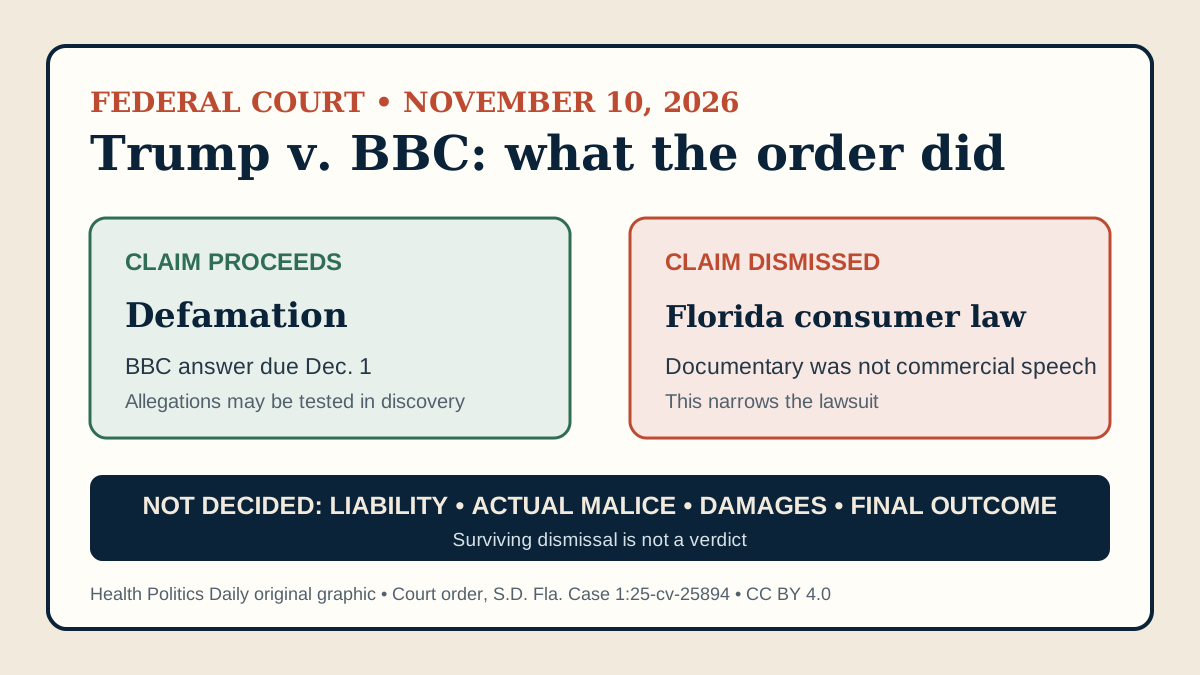
Verified baseline: one claim advances and one was dismissed
U.S. District Judge Jeffrey T. Kuntz on Tuesday granted in part and denied in part the BBC’s motion to dismiss President Donald Trump’s lawsuit. The court allowed Count I, defamation, to proceed and dismissed Count II, brought under the Florida Deceptive and Unfair Trade Practices Act.
The BBC must answer the remaining count by December 1. A separate discovery order requires Trump to sit for a deposition by December 11 unless the schedule changes. Neither deadline predicts the case’s result.
At this stage, a judge tests whether a complaint alleges a legally sufficient claim while generally accepting its well-pleaded factual allegations as true. The court did not conduct a trial, determine witness credibility, calculate damages or rule that the BBC is liable.
What the dispute is about
Trump sued over a 2024 Panorama documentary that combined two portions of his January 6, 2021 speech delivered nearly 55 minutes apart. The resulting sequence placed his instruction to march toward the Capitol next to his later words “fight like hell,” while omitting a passage calling for supporters to act peacefully.
The BBC has acknowledged that the edit was misleading and apologized. It continues to deny that the program legally defamed Trump. An apology for an editing decision and civil liability are separate questions: liability requires proof of all elements of the claim and any applicable defenses.
Why the judge found the defamation allegations plausible
The order said the time separating the two excerpts could support an inference, at the pleading stage, that the BBC knew or should have known the combined segment did not accurately reproduce Trump’s statement. The judge also found that the complaint plausibly alleged distribution connected to Florida and reputational harm.
Because Trump is a public figure, he ultimately must satisfy the demanding “actual malice” standard—proof that the publisher knew a statement was false or acted with reckless disregard for whether it was false. Surviving a motion to dismiss means the allegations may be tested through discovery; it does not mean that standard has been met.
The judge dismissed the Florida consumer-law count because the documentary was not commercial speech covered by that statute. That dismissal narrows the lawsuit even as the principal defamation dispute continues.
What happens next
The BBC’s answer can admit, deny or state that it lacks sufficient information about individual allegations, and may preserve defenses. Discovery can include documents, internal communications and sworn testimony relevant to editing, publication, knowledge, distribution and alleged harm.
The court could later resolve all or part of the case on summary judgment if the evidence does not create a genuine dispute requiring trial. The parties could also settle. If the case reaches trial, Trump would carry the burden of proof; the $10 billion figure in the complaint is a demand, not an award or valuation made by the court.
Why it matters beyond the two parties
The case tests the boundary between protected editorial judgment and a plaintiff’s claim that an edit created a materially different statement. That distinction matters to broadcasters, documentary producers and political figures, but this preliminary ruling does not create a nationwide rule that ordinary condensation is defamatory.
For audiences, the practical lesson is to separate source footage from edited sequences and to distinguish allegations, procedural rulings and final judgments. Health Politics Daily applied the same distinction when covering the temporary order stopping work on the Trump memorial arch and the Justice Department’s move to dismiss its California ballot lawsuit.
Fact, analysis, forecast and opinion
Verified fact: the court permitted the defamation count to continue, dismissed the Florida consumer-law count and ordered the BBC to answer by December 1. Analysis: the ruling gives Trump access to further litigation and discovery while leaving the harder evidentiary questions untouched. Forecast: motions over evidence, depositions or summary judgment are likely, but the timing and outcome cannot be predicted. Opinion: Health Politics Daily takes no position on the merits and treats neither side’s public characterization as a judicial finding.
Bias Lens: court victory, press-freedom test or procedural step?
Verified baseline: the defamation claim survived a motion to dismiss; the Florida consumer-law claim was dismissed. The BBC apologized for the edit but denies defamation, and the judge expressly left proof and damages for a later stage.
Left-leaning — The Guardian: foregrounded the judge’s appointment by Trump, the press-freedom implications and the high actual-malice burden still facing the president. Center — Associated Press: led with the split procedural outcome and repeatedly noted that the merits remain undecided. Right-leaning — Fox News Digital: emphasized Trump’s description of a victory and quoted the order’s criticism of the edit, while also reporting the dismissed count and BBC response.
The meaningful difference is emphasis: institutional stakes, procedural balance or the court’s criticism of the editing. The order itself is the baseline; political framing cannot convert a pleading-stage decision into a final verdict.
What remains uncertain
It remains unknown what discovery will show about editorial decision-making, audience reach and alleged reputational harm. The court has not decided whether the segment was actionable under defamation law, whether the BBC acted with actual malice, whether Trump suffered compensable damages or whether either side will prevail on later motions or at trial.
Principal sources
- U.S. District Court for the Southern District of Florida — November 10 order
- Associated Press — procedural outcome and responses
- Reuters — independent legal reporting
- CBS News — BBC response and deposition context
The Guardian’s publisher-hosted analysis video is linked rather than embedded so the publisher retains playback, rights and accessibility controls.
No comments yet.