U.S. Politics · Federal Courts · Washington
Federal Judge Halts Trump Memorial Arch Construction for 14 Days
The temporary order stops construction and site preparation at Memorial Circle after federal officials approved a 250-foot arch. It preserves the site while the court weighs claims that the project requires congressional authorization.
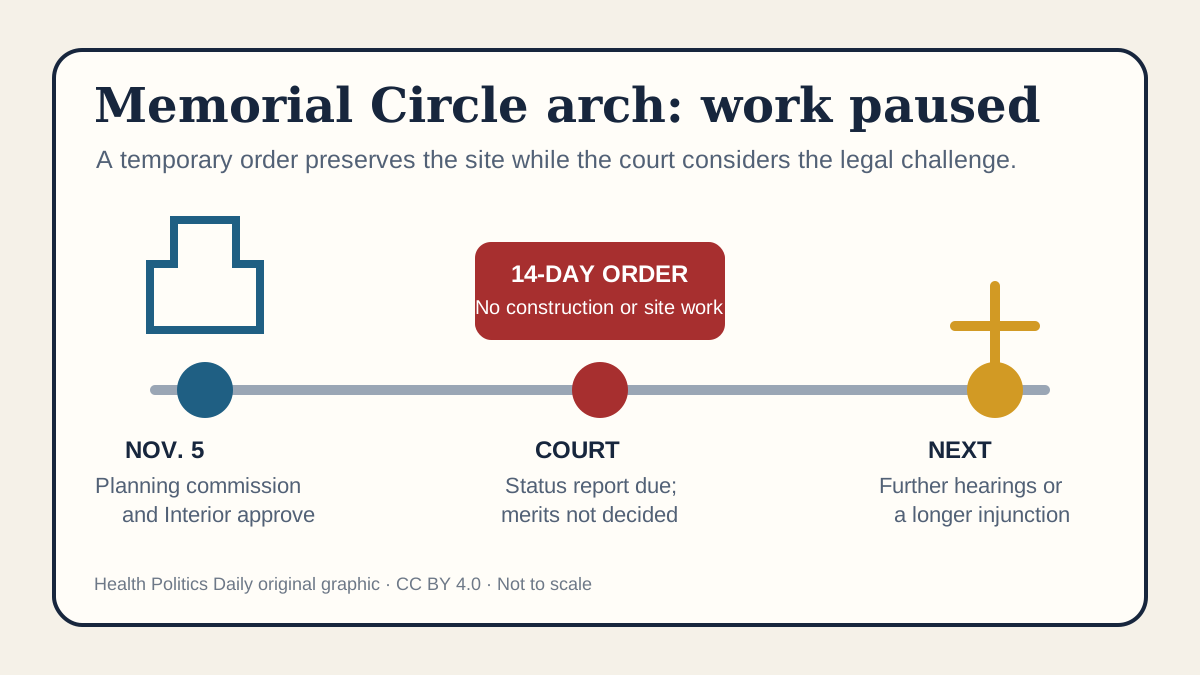
Verified baseline: the court stopped work for 14 days
U.S. District Judge Tanya Chutkan issued a 14-day temporary restraining order late November 5. It bars the National Park Service and other federal defendants from construction, excavation, demolition, land disturbance, utility installation, roadway closures or other construction-related activity for the proposed arch at or near Memorial Circle.
The order came after two approvals on the same day. The National Capital Planning Commission voted 8–4 to approve final site and building plans after a lengthy public hearing, and the Interior Department issued its final decision authorizing construction. The court’s 33-page memorandum opinion says the administration had indicated that work could start as soon as November 5.
The pause does not cancel those approvals. It temporarily prevents the physical work they would allow while the court considers consolidated cases brought by the District of Columbia and Virginia and by three Vietnam War veterans and an architectural historian.
Why the judge found immediate action necessary
Chutkan found that D.C. and Virginia had shown a likelihood of irreparable harm if work began. The opinion points to traffic disruptions around Memorial Circle, costs for detours and incident management, effects on mutual-aid emergency planning and environmental impacts that could begin with construction.
The court also found that the two jurisdictions were likely to succeed at this preliminary stage on a claim under the Commemorative Works Act. That is not a final ruling. A temporary restraining order is designed to preserve the status quo for a short period; the government can continue contesting the plaintiffs’ standing, statutory interpretation and legal claims.
The federal government has argued that a 1925 law authorizing a memorial at the western end of Arlington Memorial Bridge supplies the necessary authority. The plaintiffs say a modern 250-foot commemorative work requires a new act of Congress and additional review. Chutkan wrote that the century-old statute was unlikely to provide the broad authority the government claims, but the merits remain open.
What the project would change
The planned arch would rise at Memorial Circle between the Lincoln Memorial and Arlington National Cemetery. The planning commission staff report describes a granite-clad structure about 250 feet tall, with three sculptural figures at the top. Supporters describe it as a national gateway and tribute to American independence, unity and veterans.
Opponents have raised concerns about the historic view toward Arlington National Cemetery, traffic, environmental review, airspace and whether Congress must approve and fund the project. Those objections are not all legal findings. The court’s temporary order rests on the narrower question of whether immediate construction should proceed while the challenges are heard.
What happens during the pause
The government must ensure that contractors and agents comply and file a status report with the court. D.C. and Virginia must post a $1 bond. The court deferred a request to stay the Interior decision itself and held the veterans’ separate request for a preliminary injunction in abeyance because the short order already preserves the site.
Before the 14 days expire, the court could hold further proceedings, issue a longer preliminary injunction, modify the restrictions or allow them to lapse. The parties could also appeal. None of those outcomes is automatic.
Congress may become relevant independently of the lawsuit. Lawmakers could authorize, restrict or fund the project, but no such new legislation was part of the court record described in the opinion. The election result giving Democrats control of the next Congress may change oversight and appropriations priorities, but it does not itself decide the case.
Practical implications
- For drivers and nearby agencies: arch-related construction and roadway closures cannot begin during the order, so no new detour is authorized by this project during that period.
- For Arlington Cemetery visitors: access rules and ceremonies are not changed by the court order; it concerns work at Memorial Circle.
- For contractors: the federal defendants must communicate the order to people or firms acting on the project, and work covered by the order must stop.
- For taxpayers: the ruling does not establish a final price, funding source or liability. Those questions remain part of the broader public and legal debate.
- For the public: a temporary order is not a finding that either side has won. The docket and future written orders—not political predictions—will determine what can happen next.
Fact, analysis, forecast and opinion
Verified fact: the planning commission and Interior approved the project on November 5, and a federal judge then barred construction-related work for 14 days. Analysis: the sequence created an immediate legal collision between the executive branch’s construction timetable and statutory claims raised by local governments and veterans. Forecast: the short deadline makes further court action likely, but whether the pause becomes longer is uncertain. Opinion: Health Politics Daily takes no position on the arch’s design, symbolism or whether it should be built.
What remains uncertain
The court has not finally decided whether the Commemorative Works Act applies, whether the 1925 law authorizes this structure or whether every plaintiff may sue. It is also unclear how quickly the court will rule on a preliminary injunction or the requested stay of the Interior decision.
The project’s final financing, construction timetable and any security functions remain unsettled in the public record. Estimates or descriptions offered by advocates or opponents should not be treated as completed contracts or operational plans unless federal agencies publish supporting documents.
Bias Lens: setback, legal safeguard or temporary delay?
Verified baseline: the same-day approvals remain in place, but the November 5 court order bars arch-related construction and site work for 14 days. The court has not issued a final judgment on the project’s legality.
Left-leaning — NPR: emphasizes the late-night intervention, local-government harms and questions surrounding the administration’s evolving national-security justification. Center — Associated Press: leads with the 14-day order, then presents the planning vote, arguments over congressional authority and competing views from supporters and opponents. Right-leaning — Fox News: foregrounds the commission’s approval and the arch’s intended commemorative purpose before describing the court challenge and preservation concerns.
The framing differs mainly in which institution and rationale appears first: the judge and alleged harms, the legal sequence, or the approved monument and its supporters. All three report the central fact that construction is temporarily blocked, and none can resolve the pending legal questions.
Principal sources
- U.S. District Court for the District of Columbia — temporary restraining order
- U.S. District Court — memorandum opinion
- National Capital Planning Commission — staff report and project record
- Associated Press — hearing, vote and responses
No directly relevant official or publisher-authorized video with clear embedding permission was available at publication, so no video was embedded.
No comments yet.