Finance · U.S. Markets · Artificial Intelligence
Nasdaq Falls 5.5% Into Correction as AI Stocks Tumble
The technology-heavy index closed 11.9% below its October record as investors reassessed data-center growth, regulation and expensive AI bets. One severe session does not establish a lasting trend.
What happened
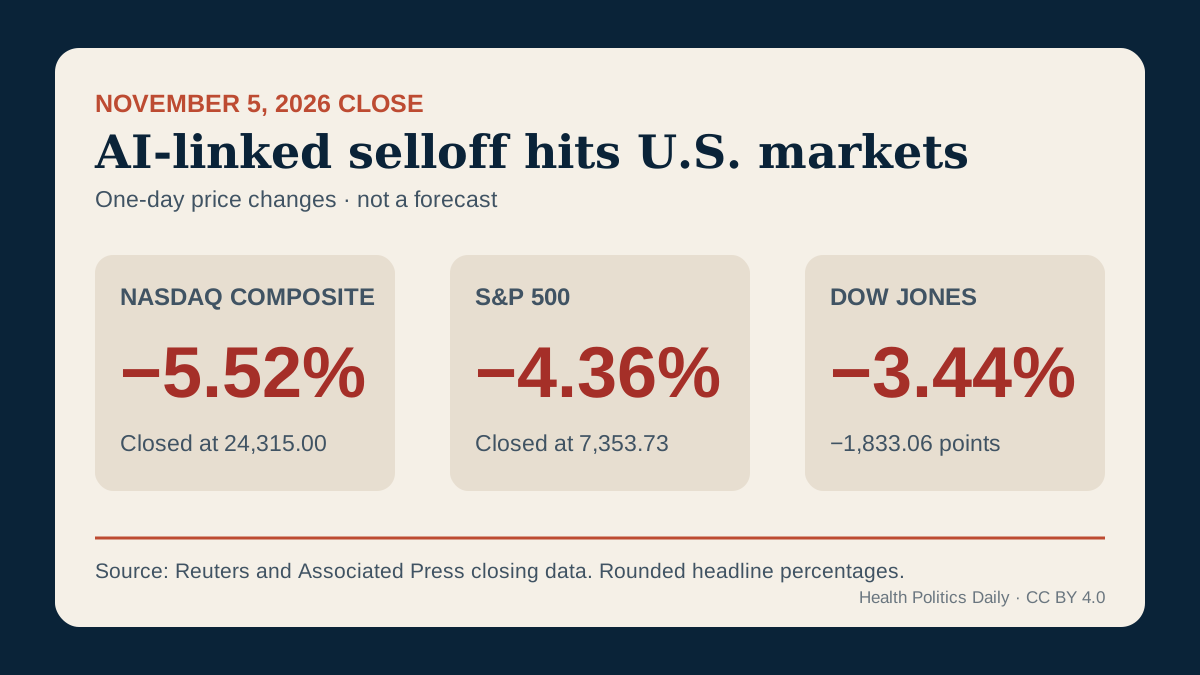
The Nasdaq Composite fell 1,421.52 points, or 5.52%, to 24,315.00 on Thursday. That left it 11.9% below its October record, meeting the widely used—but unofficial—definition of a market correction: a decline of at least 10% from a recent high.
The S&P 500 dropped 334.89 points, or 4.36%, to 7,353.73. The Dow Jones Industrial Average lost 1,833.06 points, or 3.44%, to 51,523.06. Reuters described the Nasdaq’s decline as its largest in 19 months; the S&P 500 and Nasdaq posted their deepest daily losses since April 2025.
The selloff more than erased Wednesday’s broad rally. That reversal matters because it shows how quickly investors changed their assessment of the same election outcome and the risks surrounding AI spending.
Why AI-linked shares led the decline
Chipmakers, data-center operators, power suppliers and other companies tied to AI infrastructure suffered some of the sharpest losses. Investors were weighing several risks at once: very high valuations, heavy borrowing and capital spending, uneven earnings results, and the possibility that newly elected officials or local governments will slow data-center construction.
Reuters reported that the Philadelphia Semiconductor Index fell about 10%. Qualcomm dropped after its quarterly smartphone-chip sales missed estimates, while several data-center and cloud-infrastructure companies posted double-digit declines. Those company-specific results reinforced a broader repricing already under way in the AI trade.
Politics was one part of the market narrative. Democratic victories in Congress, state governments and local data-center votes increased expectations of tougher scrutiny of power use, water use, consumer costs and construction. But it is not possible to assign Thursday’s market loss to a single cause. Prices reflect millions of trades, and the same election result had helped produce a rally one day earlier.
What a correction does—and does not—mean
A correction is a measurement, not a forecast. It says the Nasdaq has fallen at least 10% from a recent high; it does not prove a recession, a permanent AI slowdown or an imminent recovery. Despite Thursday’s fall, Associated Press closing data showed the Nasdaq still up 4.6% in 2026 and the S&P 500 up 7.4%.
For households, the immediate effect depends on exposure. Retirement accounts and index funds may show lower balances, while people who are not selling do not lock in those paper losses. Borrowing costs, employment and business investment would become more consequential if the decline persists and tightens financial conditions. This is general reporting, not personalized investment advice.
Fact, analysis, forecast and opinion
Verified fact: the Nasdaq fell 5.52% and closed 11.9% below its October record; the S&P 500 fell 4.36% and the Dow fell 3.44%. Analysis: the concentration of losses in chips, data centers and related infrastructure shows investors reassessing both AI economics and political constraints. Forecast: whether the correction deepens, stabilizes or reverses is unknown. Opinion: Health Politics Daily takes no position on whether any security is overvalued or whether a reader should buy, hold or sell it.
Bias Lens: regulation shock or AI valuation reset?
Verified baseline: the closing declines are observable market data. Reports can identify comments, votes, earnings and price moves, but they cannot prove that one political development caused the entire selloff.
The left-leaning Guardian foregrounded expectations of stronger AI regulation after the Democratic election gains. Centrist Reuters combined that political explanation with disappointing chip results, elevated valuations and concerns about the cost of data-center expansion. Right-leaning Fox Business emphasized regulatory risk and Democratic control while also noting that lower Treasury yields could cushion markets.
The outlets differ mainly in emphasis, not in the verified direction of prices. A careful reading keeps the election, local permitting, company earnings and pre-existing AI-finance concerns in view instead of treating one explanation as settled fact.
What to watch next
- whether the Nasdaq remains more than 10% below its record after subsequent sessions;
- credit conditions for heavily financed data-center developers and AI infrastructure companies;
- actual legislation, regulation and local permitting decisions rather than campaign expectations;
- earnings guidance and capital-spending plans from chipmakers, cloud providers and utilities; and
- whether weakness spreads beyond technology into hiring, business investment and consumer spending.
For context, see our report on Wednesday’s short-lived post-midterm rally and our coverage of Arm’s record revenue and data-center royalties.
Principal sources
- Nasdaq — Composite index overview
- S&P Dow Jones Indices — S&P 500
- Reuters — U.S. market close
- Associated Press — major index closing figures
Reuters’ publisher-authorized market report is linked rather than embedded so Reuters retains playback, rights and accessibility controls.
No comments yet.