Finance · U.S. Economy · Labor
U.S. Jobless Claims Match 57-Year Low as Hiring Remains Slow
New claims fell to 189,000, signaling unusually few layoffs. But continuing claims increased and monthly hiring remains modest, making this a low-layoff labor market—not proof that job searches are easy.
What the Labor Department reported
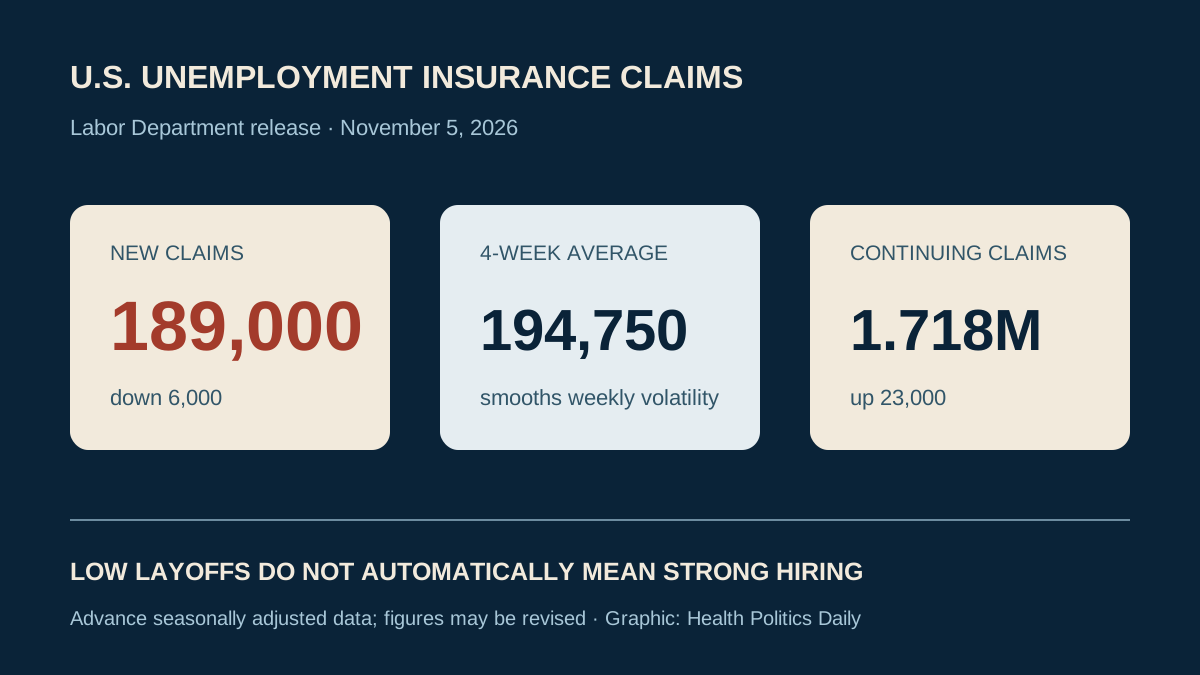
Seasonally adjusted initial claims for state unemployment benefits fell by 6,000 to 189,000 in the week ending October 31, the Labor Department reported Thursday. That matched the level reached in July, the lowest since 1969. The four-week average declined to 194,750.
Continuing claims, reported with a one-week lag, rose by 23,000 to 1.718 million for the week ending October 24. The insured unemployment rate remained 1.1%.
Low layoffs do not equal fast hiring
Initial claims are a timely measure of new benefit applications and a useful proxy for layoffs. They do not count every job loss, measure total employment or show how quickly unemployed people find new work. Continuing claims can offer a different signal because they include eligible people still receiving benefits.
The combination of few new layoffs and modest payroll growth is often described as a low-hire, low-fire market. Employers appear reluctant to dismiss existing workers, while job creation has remained slower than in many earlier expansions.
What it means for workers and policy
For people already employed, low claims suggest broad job stability. For job seekers, the data are less reassuring: fewer layoffs can coexist with fewer openings, longer searches or uneven hiring across industries. Individual benefit eligibility and payment amounts depend on state rules; this report does not determine any person's claim.
Federal Reserve officials monitor claims alongside payrolls, unemployment, wages, job openings, inflation and broader spending. One weekly report is not enough to establish a change in interest-rate policy.
Fact, analysis, forecast and opinion
Verified fact: initial claims fell to 189,000, the four-week average fell to 194,750 and continuing claims rose to 1.718 million. Analysis: the figures show low layoffs but also fit a labor market where hiring is comparatively slow. Forecast: economists expect Friday's October employment report to show further job growth, but that estimate is not measured data and may be wrong. Opinion: Health Politics Daily takes no position on the appropriate path for interest rates.
Bias Lens: resilient labor market or stalled opportunity?
Verified baseline: new claims fell by 6,000 to 189,000; continuing claims rose by 23,000 to 1.718 million. Initial and continuing claims measure different stages of unemployment insurance and can move in opposite directions.
Left-leaning — The Washington Post: emphasizes job security while noting historically modest hiring and policy uncertainty. Center — Associated Press: foregrounds the weekly decline and situates it against payroll growth and Friday's report. Right-leaning/business — The Wall Street Journal: stresses the unexpected decline while describing a low-hire, low-fire pattern.
The difference is emphasis: security for current workers versus limited opportunities for job seekers. The underlying claims figures are not in dispute.
What remains uncertain
Weekly claims are advance estimates and can be revised. Seasonal adjustment is especially important around holidays and unusual events, and benefits data exclude many people who are ineligible, have exhausted benefits or do not apply. Friday's monthly employment report will provide a broader but also revisable view.
Principal sources
- U.S. Department of Labor — Unemployment Insurance Weekly Claims
- Associated Press — claims and labor-market context
- Reuters — historical comparison and economist context
- Bureau of Labor Statistics — monthly employment release
No suitable directly relevant authorized video with clear persistent embedding permission was available at publication.
No comments yet.