Health Policy · Ebola · International Travel
CDC Ebola Rule Requires All U.S.-Bound Flyers to Declare DRC Travel
The temporary rule applies at airports worldwide, including to U.S. citizens, children and aircraft crew. It asks one narrow question; it is not a medical test or a declaration that a traveler has no Ebola exposure.
By Health Politics Daily News Desk · November 4, 2026 at 11:55 p.m. ET

Watch in this article
Pumpjack operating at the Kern River Oil Field
A short CC0 field video provides visual context for reporting on oil production and fuel supply.
Thomas Farley / Wikimedia Commons · CC0 1.0 · License and source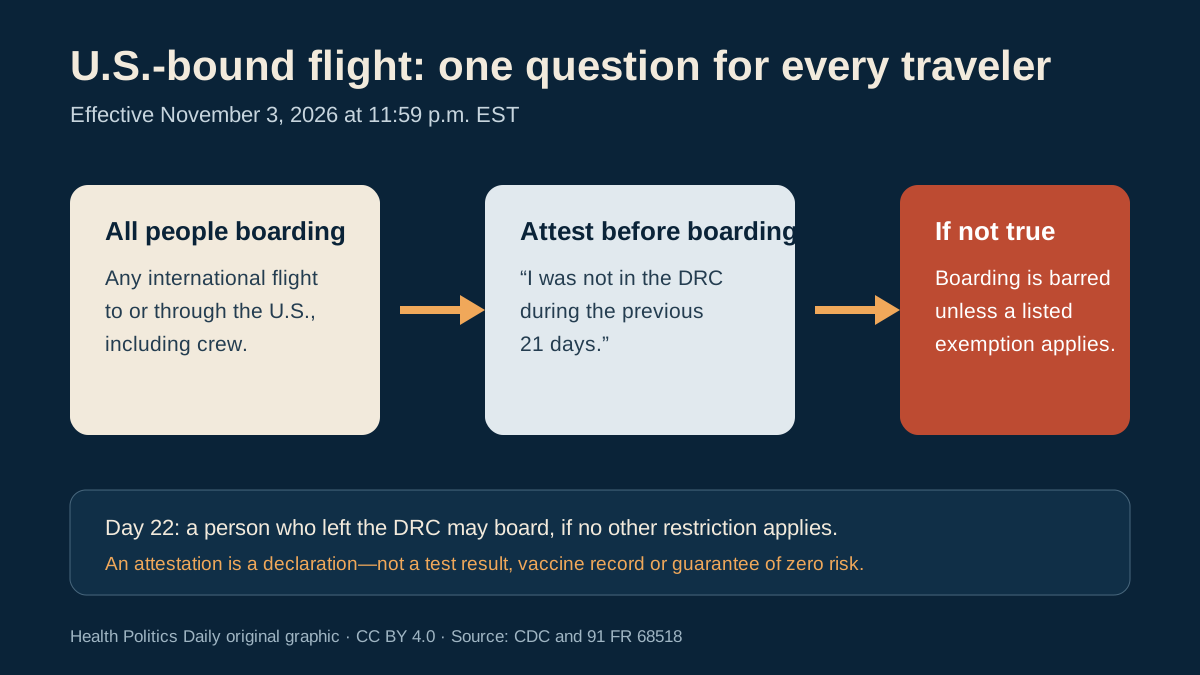
Verified baseline
Since 11:59 p.m. Eastern Standard Time on November 3, every person boarding an international flight to or connecting through the United States must attest—on paper, digitally or through an accepted verbal process—that they have not been in the Democratic Republic of the Congo during the previous 21 days.
The Centers for Disease Control and Prevention amended the order on October 28 to cover all people on passenger and cargo aircraft, including operating crew and crew traveling to another assignment. The Federal Register notice says it remains in effect through 11:59 p.m. EST on December 18 unless amended or rescinded earlier.
Who must complete the declaration
The requirement applies regardless of citizenship, nationality, age or country of departure. A parent, guardian, travel companion or other authorized representative may complete it for someone else. Airlines and other aircraft operators must collect and retain attestations and may accept a verbal response under CDC's specified procedure.
Because the rule applies to flights connecting through the United States, a traveler whose final destination is another country must still comply if the itinerary enters a U.S. airport.
What recent DRC travel means
A person who has been in the DRC during the previous 21 days generally cannot truthfully make the required declaration and therefore may not board a U.S.-bound flight unless a listed exemption applies. The notice says a person who left the DRC may board on day 22, provided no other public-health restriction applies.
The order works alongside earlier entry restrictions. CDC says U.S. citizens and nationals receive different legal treatment from some foreign nationals, but recent DRC presence can still prevent boarding during the 21-day period under this separate attestation rule. Travelers with exceptional circumstances should use official CDC and airline channels rather than relying on informal advice.
Why every international traveler is asked
Many U.S.-bound itineraries from central Africa connect through airports in Europe, the Middle East or elsewhere. A universal question avoids relying only on the airport where the final flight begins. CDC says the 21-day window reflects the maximum recognized incubation period for Ebola disease.
The declaration is not a diagnostic test. Someone can truthfully state that they were not in the DRC and still have unrelated symptoms or another exposure requiring evaluation. Conversely, recent presence in the DRC does not mean a person has Ebola.
What the rule does not require
- It does not require every international traveler to take an Ebola test.
- It does not require proof of Ebola vaccination.
- It does not by itself quarantine everyone arriving from Africa.
- It does not replace airline document rules, visa requirements or separate CDC screening and entry orders.
Practical implications
Airlines must add the declaration to check-in and boarding workflows across their international networks. Travelers should allow time to review the statement and answer accurately. Anyone who has recently been in the DRC should contact the airline and the CDC-designated assistance channel before traveling rather than arriving at the gate expecting an exception.
Knowingly providing false information can carry legal consequences. The order also authorizes airlines to deny boarding when the attestation is missing or cannot truthfully be made. This reporting is general information, not individualized medical or legal advice.
Fact, analysis, forecast and opinion
Verified fact: the worldwide attestation requirement is active and applies to all people boarding international flights to or through the United States. Analysis: universal collection shifts enforcement to airlines and closes gaps created by indirect itineraries. Forecast: the order is scheduled to expire December 18, but CDC may amend or rescind it as outbreak conditions change. Opinion: Health Politics Daily takes no position on the policy; its effectiveness should be evaluated using compliance, travel disruption and importation data.
Bias Lens: precaution or broad travel burden?
Verified baseline: the rule asks every international traveler about DRC presence, while generally preventing recent DRC travelers from boarding. CDC says no U.S. cases tied to the outbreak had been reported when the order was announced.
Center — Reuters: emphasizes the public-health rationale and situates the declaration alongside earlier travel restrictions. Right-leaning — New York Post: foregrounds the rule's reach and airlines' request for more implementation time.
No substantial original left-leaning report focused on the operational rule was available at publication. Adding unrelated outbreak commentary would create false symmetry. The policy text establishes who is covered; news framing mainly changes whether readers first encounter prevention benefits or implementation costs.
What remains uncertain
CDC has not established how many travelers will be denied boarding, how often exemptions will be used or whether the rule will end on schedule. Outbreak geography and case counts can change, and separate restrictions for DRC, Uganda or South Sudan may be revised independently. Travelers should check the current CDC page immediately before departure.
Principal sources
- CDC — amended attestation order and implementation guidance
- Federal Register — legal notice, dates, definitions and exemptions
- CDC — traveler guidance and assistance contact
- Reuters — announcement and outbreak context
No suitable directly relevant authorized video with clear persistent embedding permission was available at publication.
No comments yet.