U.S. Policy · Iran · Maritime Sanctions
U.S. Sanctions Network Accused of False-Flagging Iran-Linked Ships
Treasury says an India-based operation posed as national registries and issued documents to vessels moving Iranian petroleum. The designation blocks covered property and transactions; it does not by itself prove criminal guilt or seize a ship.
By Health Politics Daily News Desk · November 4, 2026 at 8:00 p.m. ET

Watch in this article
Pumpjack operating at the Kern River Oil Field
A short CC0 field video provides visual context for reporting on oil production and fuel supply.
Thomas Farley / Wikimedia Commons · CC0 1.0 · License and source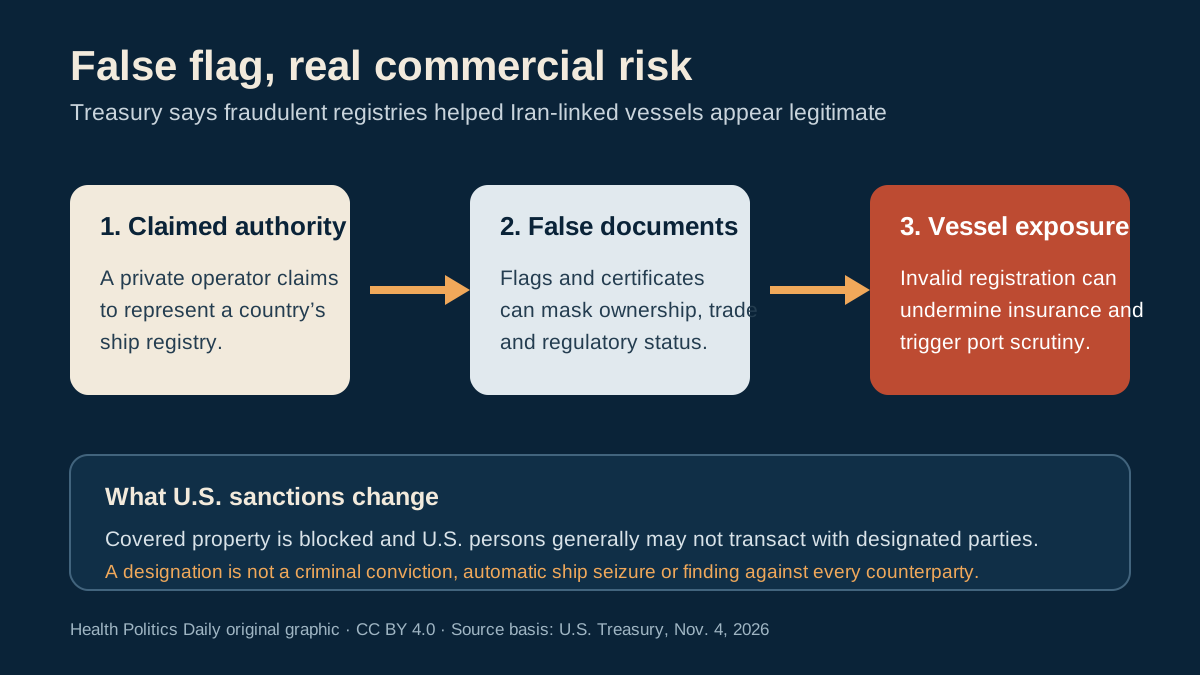
Verified baseline
The U.S. Treasury Department on November 4 sanctioned India-based Suniel Kumar Sharma, his spouse Jaspreet Preeti Shahid, two associates and nine connected entities. Treasury alleges the network created fraudulent maritime flagging authorities and classification societies that purported to represent countries including Guyana, Eswatini and Laos, then supplied documents to vessels transporting Iranian petroleum.
Treasury separately designated Türkiye-based Fugo Ground Services Inc., alleging it provided services to several already-sanctioned Iranian airlines. Reuters independently reported the scope of both actions. The people and companies were placed under economic restrictions; the public releases do not describe a U.S. criminal judgment against them.
What a ship's flag is—and why it matters
Commercial ships are registered to a flag state, whose administration is responsible for applying international standards on safety, pollution prevention and crew conditions. A valid registry record helps ports, banks, cargo owners and insurers identify which government has accepted that oversight role.
A classification society performs a different job: it inspects a vessel against technical rules and issues certificates used in commercial and regulatory decisions. A flag does not guarantee that a ship is seaworthy, and a classification certificate does not establish ownership. Fraud in either layer can make routine screening unreliable.
What Treasury says the network did
Treasury says Sharma and Shahid's activities began as early as 2014 with an attempt to impersonate Dominica's flagging authority. It says the network later established an entity called Eswatini Maritime Affairs and International Ship Registry, even after Eswatini authorities publicly disavowed the operation.
One example in Treasury's release is the sanctioned vessel Ping Shun, International Maritime Organization number 9231901. Treasury says the vessel used the purported Eswatini registry while transporting Iranian oil. These are government allegations stated in a sanctions record, not findings after an adversarial trial.
What the sanctions legally change
The designations were made under Executive Order 13902. Property and interests in property of designated parties that are in the United States or controlled by U.S. persons are generally blocked and must be reported to the Office of Foreign Assets Control. U.S. persons generally may not transact with them without authorization.
Entities owned 50% or more, directly or indirectly, by one or more blocked persons are also blocked even if not named separately. Non-U.S. companies can face exposure when a transaction touches U.S. banks, U.S. persons, blocked property or other sanctions rules. The designation does not automatically confiscate every associated vessel or replace case-specific legal review.
Insurance and safety are the pressure points
Protection-and-indemnity insurance commonly covers third-party liabilities such as pollution, collision damage and crew injury. Treasury warned that falsely flagged vessels may lack valid coverage. That can shift risk to coastal governments, ports, cargo interests and other shipowners after an accident.
Invalid documents can also lead a port state to detain a vessel or demand proof from the claimed flag administration. Banks and insurers may pause transactions while they check ownership, IMO numbers, voyage history and registry authenticity. A name or flag alone is not enough because vessels can change both.
The aviation designation
Treasury says Fugo supported Iran Air, Mahan Air, Qeshm Fars Air and Meraj Air through passenger, cargo, ramp and representation services. Each airline has a different sanctions history; listing Fugo does not establish that every passenger, employee or customer violated U.S. law.
Practical implications
- Shipowners and charterers: verify registry authority directly with the claimed flag state and screen by IMO number, ownership and control.
- Insurers and lenders: confirm that certificates and coverage come from recognized issuers and evaluate sanctions clauses.
- Ports and coastal authorities: may intensify document checks and contingency planning for pollution or casualty costs.
- Workers and cargo owners: can face delay or contract disputes even when they are not sanctions targets.
This is general reporting, not legal, shipping or investment advice. Compliance depends on jurisdiction, ownership, transaction structure and current licenses.
Fact, analysis, forecast and opinion
Verified fact: Treasury designated the named people and entities and published specific allegations and identifiers. Analysis: targeting documentation aims to make shadow-fleet operations harder even when cargo and ownership are obscured. Forecast: ports, banks and insurers are likely to increase registry verification, but the response cannot yet be measured. Opinion: Health Politics Daily takes no position on U.S. Iran policy; enforcement claims should distinguish designation, evidence, prosecution and adjudication.
Bias Lens: enforcement, escalation or maritime safety?
Verified baseline: Treasury imposed economic sanctions and alleged a network supplied fraudulent flags and certificates to Iran-linked vessels. Reuters corroborated who was listed and the administration's rationale. No court verdict is identified in the public designation.
Center — Reuters: leads with the people and firms sanctioned, then places the action inside the administration's broader Iran campaign and post-election politics. Official source — U.S. Treasury: emphasizes alleged criminality, deterrence and safety and environmental risks.
No substantial, original left-leaning and right-leaning reports focused on this specific designation were available at publication. Adding older Iran commentary or a fringe source would create false symmetry. The useful framing contrast is between an enforcement agency advocating its action and a wire service adding political and economic context.
What remains uncertain
The public record does not show how the named parties will respond, how many current voyages rely on documents from the listed entities, or how quickly foreign registries and ports will act. Treasury's insurance warning is a risk assessment, not proof that every affected vessel is uninsured. Future licenses, delistings, litigation or additional designations could change the picture.
Principal sources
- U.S. Treasury — designation and allegations
- OFAC — November 4 action and identifiers
- Reuters — scope and context
- International Maritime Organization — flag-state framework
No suitable directly relevant authorized video with clear persistent embedding permission was available at publication.
No comments yet.