International · Maritime Security · Energy
Hormuz Tanker Hit by Limpet Mines in First Successful Attack of War
A small boat attached two explosives to the Panama-flagged Louise 1, causing an engine-room fire and temporarily disabling the ship. The crew was safe, but the method creates a difficult new security problem.
By Health Politics Daily News Desk · October 30, 2026 at 11:59 a.m. ET
Verified baseline
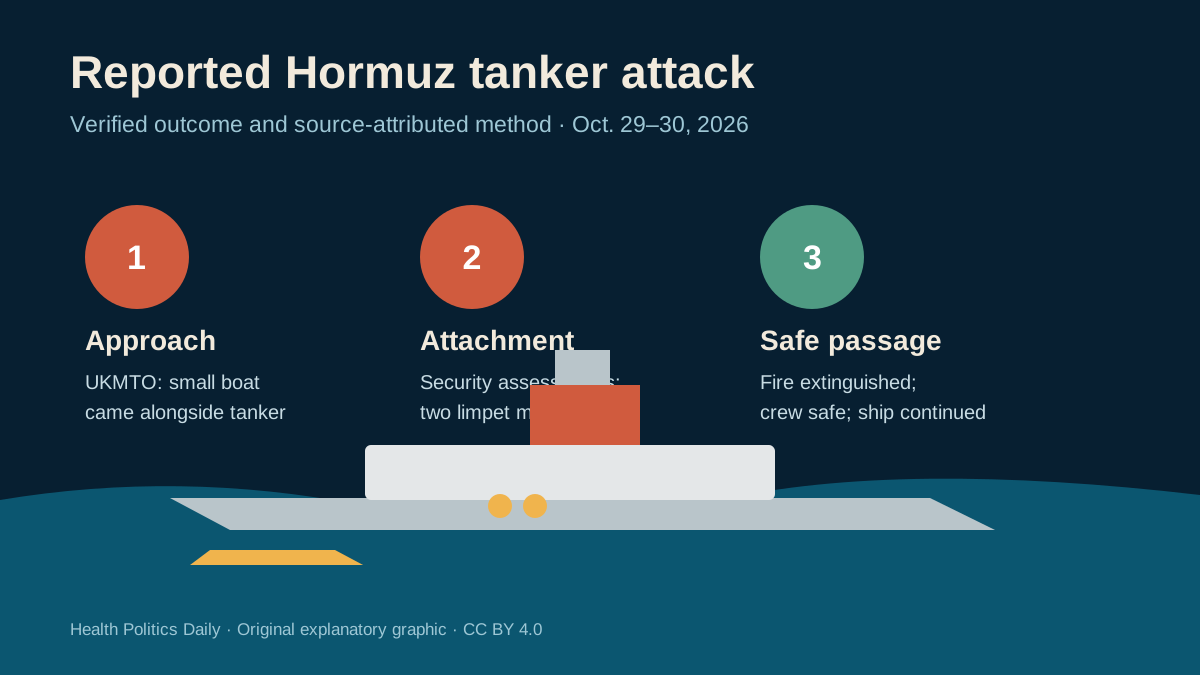
The United Kingdom Maritime Trade Operations agency said a small boat came alongside a tanker in the Strait of Hormuz and attached explosive devices to its hull on Thursday, October 29. The blasts caused an engine-room fire and briefly disabled the ship about 25 nautical miles northeast of Khasab, Oman.
UKMTO said the fire was extinguished, the crew was safe, there was no environmental impact and the vessel continued to its next port. Maritime-security assessments reviewed by Reuters identified the tanker as the Panama-flagged Louise 1 and the devices as two limpet mines. Those identification details come from three security sources, not from the public UKMTO notice.
What is known—and what is not
No government or group had publicly claimed responsibility at publication. Iran has attacked or detained vessels it says violated its transit restrictions, but that established pattern does not prove who placed these devices. The ship’s listed operator did not immediately comment.
Two security sources told Reuters this was the first known successful limpet-mine strike in the area since the U.S.–Iran war began in February, following an unsuccessful attempt in September. The same tanker was struck by Ukrainian naval drones in the Black Sea in July over its alleged role in Russia’s oil trade; that earlier incident does not establish who carried out Thursday’s attack.
Why the method changes the risk
Limpet mines are compact explosives designed to attach directly to a ship’s hull. A small craft can appear amid ordinary traffic, approach at close range and withdraw before detonation. That makes the threat harder to detect than a missile or drone launch and gives commercial crews little time to distinguish hostile activity from routine navigation.
The method is neither new nor technologically sophisticated. Maritime analysts cited prior regional use beginning in 2017 and later attacks on tankers. What is new in the current conflict is the reported successful attachment to a moving commercial vessel in the congested strait.
Practical implications
- For crews and operators: current UKMTO notices, flag-state instructions and company security plans should take priority over unverified social-media reports. Unusual small-boat approaches require prompt reporting, but crews should not improvise military responses.
- For cargo owners and insurers: close-range attack risk may increase security costs, waiting times and premiums even when a ship remains operational.
- For households and businesses: one safely resolved incident does not determine fuel prices. Insurance, inventories, production, rerouting and further attacks all influence the cost of energy and transport.
Fact, analysis, forecast and opinion
Verified fact: explosives attached from a small boat caused a fire; the crew was safe, no pollution was reported and the tanker continued. Analysis: direct hull attachment creates a low-cost, close-range threat that naval escorts and long-range sensors may not fully solve. Forecast: operators are likely to tighten approach procedures and review transit windows, but the size and duration of any market effect cannot yet be known. Opinion: Health Politics Daily takes no position on military escalation; authorities should publish vessel-level facts quickly and distinguish confirmed outcomes from anonymous-source attribution.
Earlier coverage explains Iran’s reported shift toward small-boat surveillance, the partly unverified seven-tanker claim and wider effect of Gulf attacks on oil prices.
Bias Lens: incident facts, attribution and strategic meaning
Verified baseline: UKMTO confirmed the small-boat approach, attached explosives, fire, safe crew, absence of reported pollution and onward voyage. The tanker name, mine type and “first successful use” characterization come from maritime-security sources; responsibility remains unclaimed.
Center wire — Reuters: separates UKMTO’s confirmed outcome from security-source assessments and emphasizes that attribution is unresolved. Financial press — Financial Times: frames the incident as a tactical shift and a shipping-security risk. Maritime trade press — gCaptain: focuses on the low-cost method, congested lanes and operational implications. No meaningful left–right split appeared in the directly relevant original reporting, so this lens compares evidentiary and industry frames rather than forcing partisan symmetry.
What remains uncertain
Public reporting does not establish who ordered or carried out the attack, how the small boat approached undetected, whether the ship will require repairs or how insurers will classify the loss. It is also unknown whether this becomes a repeatable campaign tactic or remains an isolated event.
Principal sources
- UK Maritime Trade Operations — official incident notices
- Reuters — vessel identification, mine assessment and security-source context
- gCaptain — authorized Reuters report and maritime context
- U.S. Energy Information Administration — Hormuz energy-flow context
No suitable directly relevant official or publisher-authorized video with clear persistent embedding permission was available.
No comments yet.