U.S. Policy · Telecommunications · Cybersecurity
FCC Plans Vote to Restrict Chinese Telecom Access to U.S. Phone Numbers
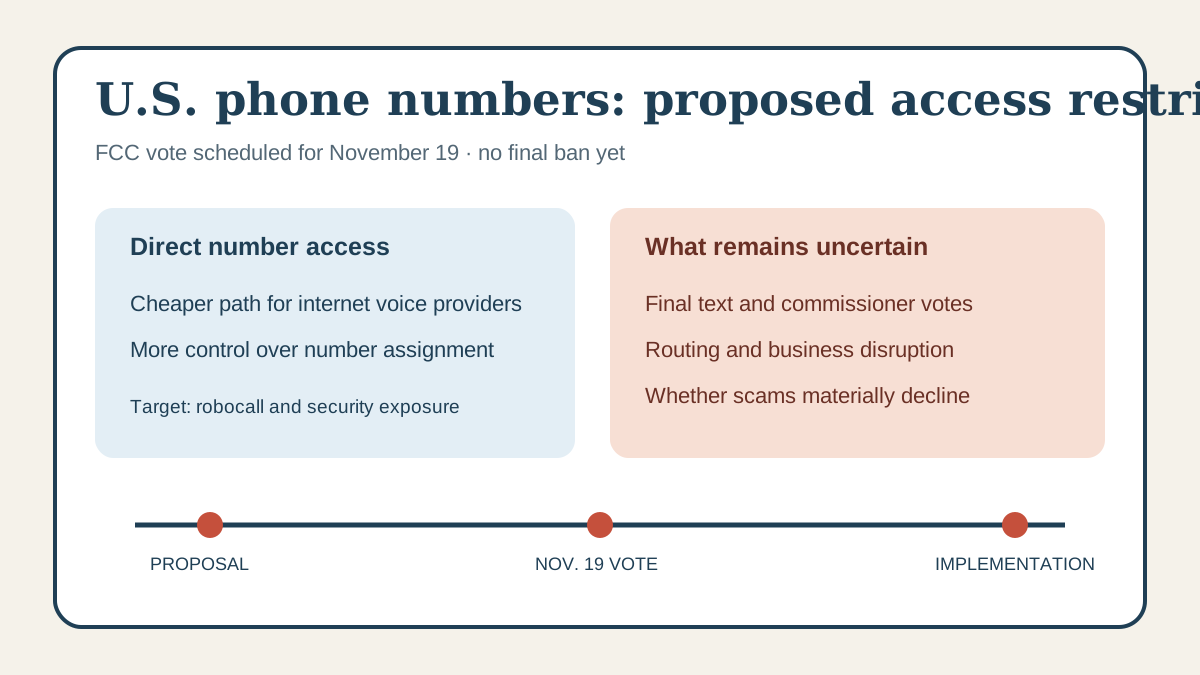
The proposal would limit direct numbering access for named Chinese carriers and providers using equipment on the FCC’s covered list. It is not yet a final ban, and indirect routing and business effects remain unsettled.
By Health Politics Daily News Desk · October 30, 2026 at 9:59 a.m. ET
Verified baseline
The Federal Communications Commission plans to vote November 19 on restrictions that would block China Mobile, China Telecom, China Unicom and certain other internet-based voice providers from obtaining direct access to U.S. telephone numbers.
The agency also plans to consider barring direct numbering access for providers that use equipment or services on its national-security covered list, including Huawei and ZTE equipment. The text has not yet received a commission vote, so reports that the ban is already in effect are premature.
What direct access means
Interconnected Voice over Internet Protocol providers can receive telephone numbers directly from numbering administrators instead of obtaining them through another carrier. Direct access can lower costs, speed service deployment and give a provider more control over advanced calling features.
Those same efficiencies can complicate enforcement when ownership, routing or robocall practices are opaque. FCC rules already require certifications, foreign-ownership disclosures and compliance information; authorizations can be suspended, terminated or revoked for failures.
Why the FCC says restrictions are needed
FCC Chair Brendan Carr describes numbering controls as a first line of defense against illegal robocalls and security threats. The proceeding grew from earlier work on providers whose authorization was revoked and on entities using covered equipment.
U.S. concern also reflects the Salt Typhoon cyber-espionage campaign. American officials say China-linked actors infiltrated telecommunications infrastructure and obtained call-record data; China has denied responsibility. The proposed numbering rule would reduce one category of access but would not by itself repair compromised networks or stop every spoofed call.
What could change for consumers and businesses
Most consumers would not need to change a phone number or device because of the vote alone. The proposal concerns how providers obtain and manage number resources, not a blanket cancellation of calls between the United States and China.
Companies using affected providers could face higher costs, new intermediaries or migration work. Carriers opposing broader interconnection restrictions have warned that traffic may move through less transparent routes and that international communications could be disrupted. The FCC has not published a final implementation schedule for this specific proposal.
A wider package of telecom restrictions
Reuters reports that the FCC also intends to bar Chinese laboratories from testing U.S.-bound electronics beginning in December 2028 and is considering further restrictions on connections to U.S. networks and U.S. data-center operations. Those are related but legally distinct actions with separate records and timelines.
The agency previously revoked or denied U.S. operating authority for major Chinese carriers after national-security reviews. Courts upheld several of those decisions. Prior actions do not predetermine the November vote or every legal challenge that may follow.
Fact, analysis, forecast and opinion
Verified fact: the FCC has scheduled a vote on direct numbering restrictions and has not yet adopted the proposal. Analysis: direct-access controls can raise the cost of abuse, but traffic can migrate to intermediary networks, making enforcement quality as important as the formal ban. Forecast: the commission may approve the item, amend it or set phased compliance; legal and diplomatic challenges are possible. Opinion: Health Politics Daily takes no position on U.S.–China rivalry; security restrictions should identify evidence, scope, due process and measurable consumer benefits.
Our report on the FBI’s ShinyHunters breach investigation covers another communications-security threat. Our coverage of F-35 parts routed through Hong Kong explains a separate supply-chain risk, while our report on the Chinese connected-vehicle bill addresses another proposed technology restriction.
Bias Lens: security control or costly network fragmentation?
Verified baseline: the FCC will vote November 19 on direct-number access restrictions; the proposal is not yet effective and its full implementation effects are unknown.
Agency framing: the FCC’s proceeding emphasizes robocall prevention, national security and the integrity of scarce numbering resources. Center wire framing: Reuters reports the planned vote alongside Salt Typhoon, prior carrier bans and China’s denial. Industry and Chinese framing: China Unicom and USTelecom have warned that broader restrictions may disrupt global traffic or reduce visibility, while China’s government calls the policy an abuse of national-security claims. A left–right U.S. media split was not meaningful in the available original coverage, so this lens compares the directly relevant institutional frames instead of forcing partisan symmetry.
What remains uncertain
The final order, commissioner votes, covered provider list, transition rules and treatment of existing numbers were not fully available at publication. It is also unknown how much illegal robocall volume would fall, how much traffic would move through intermediaries or whether affected companies would prevail in court.
Principal sources
- FCC — numbering-policy proceeding and comment record
- Federal Register — existing direct-access rules and authority
- Reuters — planned vote and affected companies
- Reuters — carrier and industry objections
The FCC streams open meetings on its official live page, but no enduring item-specific authorized video was available at publication, so none was embedded.
No comments yet.