Finance · Europe · Central Banks
ECB Holds Deposit Rate at 2.5% as Lagarde Sets February Exit
The European Central Bank paused after two earlier increases, balancing rising energy-driven inflation risks against tighter financing and weaker growth. The same day, President Christine Lagarde said she will leave before her term ends.
By Health Politics Daily News Desk · October 29, 2026 at 9:57 a.m. ET
Verified baseline
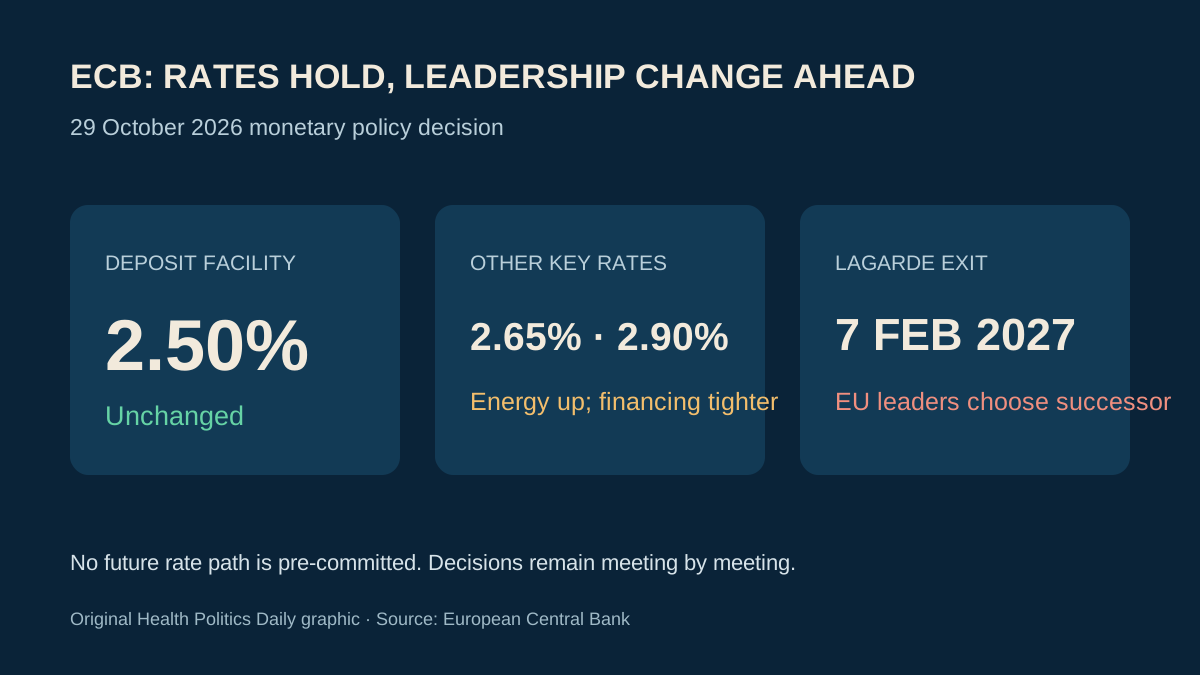
The ECB kept the deposit facility at 2.50%, the main refinancing rate at 2.65% and the marginal lending facility at 2.90%. Its statement said rising energy prices create upside risks to inflation and downside risks to growth, while underlying inflation has remained broadly stable and wages have not yet shown a material response.
The bank also said financing conditions have tightened since September and could restrain both inflation and growth. It repeated that decisions will be based on incoming data meeting by meeting and that it is not pre-committing to a particular rate path.
Separately, Lagarde informed the Governing Council and European Council President António Costa that she will step down on February 7, 2027. Under the EU treaty process, the European Council appoints the next ECB president. The ECB did not say that her departure caused the rate decision.
Why the hold matters
The decision leaves the benchmark cost of money unchanged for now. That does not freeze every mortgage, business-loan or savings rate: retail rates also depend on contract terms, bank funding costs, credit risk and national markets. The euro and short-term bond yields fell after the announcement, Reuters reported, showing that investors interpreted the statement as somewhat less aggressive than feared.
The policy dilemma is unusually sharp. A prolonged energy shock can raise consumer prices and production costs, but higher market borrowing costs can also slow investment, housing and consumption. Tightening too little risks persistent inflation; tightening too much risks compounding the growth slowdown and financial stress.
Practical implications
- Variable-rate borrowers: there is no ECB increase today, but payments may still reset according to contract benchmarks and lender timing.
- Fixed-rate borrowers: existing payments generally do not change because of one meeting; refinancing offers reflect longer-term market rates.
- Savers: deposit returns need not move in lockstep with the ECB and vary widely by bank and country.
- Businesses: the bank’s own lending survey already shows tighter credit standards and weaker loan demand, so access to credit may remain constrained even without a new policy-rate increase.
Fact, analysis, forecast and opinion
Verified fact: all three key rates were held and Lagarde will leave on February 7. Analysis: the ECB is weighing an energy-driven inflation risk against an independent tightening in market financing conditions. Forecast: a December increase remains possible, but the ECB has made no commitment and new data could change the balance. Opinion: Health Politics Daily takes no position on the appropriate rate; clear communication should separate current decisions, conditional risks and succession politics.
Our coverage of the Federal Reserve’s divided rate hold shows a similar meeting-by-meeting approach under different U.S. conditions. The Bank of Canada’s quarter-point increase provides a contrast in how another central bank responded to energy-linked inflation risks.
Bias Lens: inflation vigilance, growth risk and succession
Verified baseline: the ECB held rates, warned about both inflation and growth, made no December commitment and announced a separate February leadership transition.
A left-center-right political comparison is not especially meaningful for a technical central-bank decision. Instead, compare emphasis: the ECB centers its dual risk assessment and data dependence; Reuters foregrounds the market reaction and divided economist views; The Wall Street Journal emphasizes French bond stress and the leadership search. These frames can all be true; they answer different questions.
What remains uncertain
The duration of the energy shock, second-round effects on wages and prices, the pace of growth and the December decision are unknown. The European Council has not named a successor, and the identity or policy views of the next president cannot be inferred from today’s announcement.
Principal sources
- European Central Bank — October monetary policy decisions
- European Central Bank — Lagarde departure announcement
- European Central Bank — official press conference and statement
- Reuters — market reaction and economist assessments
- The Wall Street Journal — succession and bond-market context
The ECB’s official, publisher-authorized press-conference webcast is linked above. It is not embedded so viewers can use the central bank’s own accessibility and playback controls.
No comments yet.