Health Policy · Rare Disease · Gene Therapy
FDA Proposes Individualized Gene-Editing Pathway as CMS Plans Medicaid Expansion
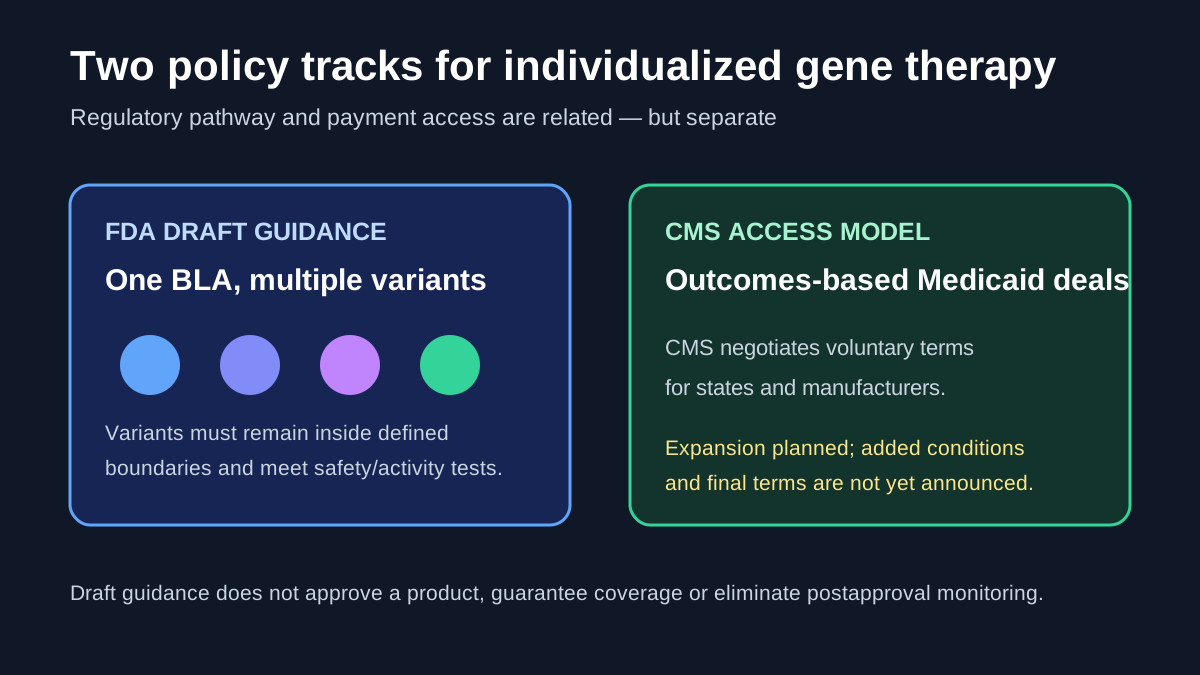
FDA’s draft would let sponsors manage multiple patient-specific variants within one biologics application when they fit defined scientific boundaries. CMS separately plans to expand a voluntary outcomes-based purchasing model beyond sickle cell disease.
By Health Politics Daily News Desk · October 28, 2026 at 7:58 a.m. ET
Verified baseline
The Food and Drug Administration issued draft guidance explaining how an individualized human genome-editing product with multiple patient-specific variants could be submitted within one Biologics License Application. The document is open for comment through November 27 and contains nonbinding recommendations; it is not a product approval or final rule.
In the same Health and Human Services announcement, the Centers for Medicare & Medicaid Services said it will invite manufacturers of therapies for additional conditions into its Cell and Gene Therapy Access Model. CMS has not yet released the new request for applications or named the added conditions.
How the FDA proposal would work
Individualized therapies may use a common platform while changing the genetic target for each patient’s mutation. FDA proposes an “Individualized Feature Space”: predefined boundaries describing how the gene-editing component may vary while remaining part of the same licensed product.
If a new variant stays within those boundaries and laboratory testing supports adequate safety and activity, a sponsor could add it after approval without running a new clinical trial for that exact variant. The original application would still need evidence supporting the platform, manufacturing controls and the proposed boundaries. FDA also addresses unintended genetic changes, potency testing, validation, labeling and product identification.
The proposal does not mean every customized edit can bypass clinical evidence. Variants outside the approved feature space could require additional development, and FDA retains authority over licensure, inspections, postapproval changes and safety monitoring.
What CMS is proposing
The CMS access model currently coordinates voluntary outcomes-based agreements between manufacturers and state Medicaid programs for sickle cell gene therapies. Participating programs cover about 84% of Medicaid beneficiaries with sickle cell disease, according to CMS.
Under outcomes-based arrangements, payment terms can depend partly on whether a therapy achieves agreed results. CMS says pooled negotiation can reduce administrative burden and improve state leverage. The planned expansion could bring other high-cost cell and gene therapies into the model, but prices, outcomes, participating states and manufacturers will depend on the forthcoming application process and negotiations.
Why the two tracks matter together
FDA answers whether a therapy can be developed, reviewed and licensed; CMS addresses how participating Medicaid programs may pay for and administer access. Faster regulatory adaptation does not guarantee insurance coverage, and a payment model cannot substitute for FDA evidence requirements.
For families with ultra-rare disorders, the proposed framework could make it more feasible to develop treatments for mutations affecting very few people. The central challenge is generating enough reliable evidence for safety and benefit when each variant may be used in only one or a handful of patients.
Practical implications
- Patients and families: no new therapy became available solely because of this announcement; clinical eligibility and coverage remain product-specific.
- Researchers and manufacturers: early discussion with FDA may be important for defining feature-space boundaries and evidence plans.
- State Medicaid programs: participation is voluntary, and expanded terms have not yet been issued.
- Clinicians: the framework does not replace informed consent, treatment-center requirements or long-term monitoring.
This is general policy reporting, not medical advice or a recommendation to pursue a particular therapy.
Fact, analysis, forecast and opinion
Verified fact: FDA issued draft guidance and CMS announced a future expansion process. Analysis: pairing a reusable regulatory structure with pooled payment negotiations addresses two different bottlenecks for individualized therapies. Forecast: the approach could widen development and access, but its impact depends on final guidance, manufacturer participation, evidence quality and negotiated terms. Opinion: Health Politics Daily supports transparent evidence standards, meaningful consent and public reporting of outcomes and costs.
Related context includes our coverage of FDA’s earlier rare-disease review framework, technology and clinical-trial access and HHS’s kidney-care roadmap.
Bias Lens: breakthrough pathway or evidence shortcut?
Verified baseline: the FDA document is draft, nonbinding guidance; CMS’s expansion details are not final; no therapy gained approval or guaranteed coverage from the announcement.
A responsible ideological comparison is limited because early coverage is mostly technical. Official — HHS: emphasizes faster access and innovation. Independent regulatory coverage — Regulatory Affairs Professionals Society: focuses on the feature-space mechanics and evidence boundaries. Program documentation — CMS FAQs: emphasizes voluntary participation, outcomes-based payment and the long evaluation period. The main framing difference is promise versus implementation detail, not a settled left-right dispute.
What remains uncertain
FDA may revise the guidance after public comment. CMS has not identified the conditions, manufacturers, prices, outcomes measures or timetable for the expanded model. It is also unknown how many individualized products will fit the proposed framework, how long reviews will take or whether state Medicaid programs will adopt the added agreements.
Principal sources
- FDA draft guidance page
- FDA draft guidance document
- HHS announcement
- CMS Cell and Gene Therapy Access Model
FDA provides a publisher-authorized recorded webinar from its guidance page; because its downstream embedding terms were not independently verified, the article links to the official page rather than embedding the video.
No comments yet.