Health · Clinical research · Artificial intelligence
AstraZeneca and Oracle Plan AI Trial-Matching Projects Under Non-Binding Agreement
The October 20 collaboration starts with hypertension research in Abu Dhabi. Patient matching, privacy commitments and measured clinical benefits are separate questions.
By Health Politics Daily News Desk · October 20, 2026 at 6:08 a.m. ET
AstraZeneca and Oracle announced an October 20 collaboration to test how artificial intelligence and health data could connect people with clinical trials and improve research workflows. Both companies describe a non-binding agreement—not a completed deployment or a demonstration of better medical outcomes.
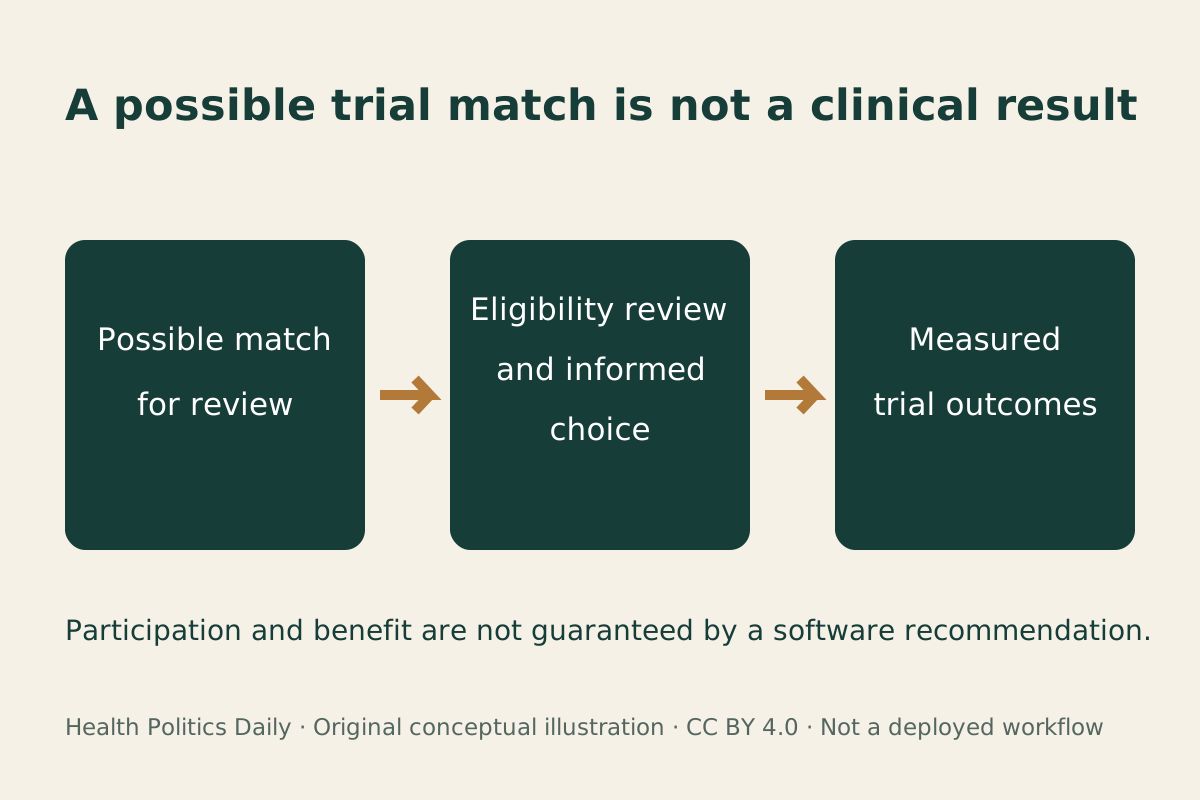
For patients, the potential value is practical: helping a clinical team recognize a possible trial candidate earlier. But being flagged by software, being eligible for a study, choosing to participate and benefiting from an experimental intervention are different steps. The announcement does not erase any of those distinctions.
What the companies plan to test
Oracle’s release says the partners will explore trial recruitment, evidence generation and bringing research insights into care. It identifies potential work across cancer, cardiovascular, kidney and metabolic conditions, respiratory and immunology conditions, and rare diseases.
Oracle says the partners intend to develop shared governance, reusable technical components and agreed measures of results before deciding whether successful approaches can extend to other diseases and locations. These are intended activities and assessment plans, not reported performance results.
AstraZeneca’s separate announcement specifies an initial hypertension-care and research program in Abu Dhabi with healthcare company M42. It describes helping clinical teams identify uncontrolled hypertension, support guideline-directed care and recruit trial participants. No financial terms were disclosed.
Reuters corroborated the partnership and its initial project. Independent reporting confirms that the announcement was made; it does not independently establish that the proposed systems have delivered the advertised benefits.
What the privacy promises do—and do not—establish
AstraZeneca says the collaboration will use deidentified real-world data and that it will not receive patient-identifiable information. It says each proposed project will be reviewed individually and proceed only after the relevant legal, privacy, regulatory, ethical and institutional safeguards are in place.
Analysis: Those are important design commitments, but a press release is not a published security audit. Questions for implementation include which organizations can access which data, what permissions govern its use, how errors are corrected and how compliance is independently checked. This report does not allege a breach or verify protections that have not been demonstrated publicly.
A possible match is not informed consent
The FDA’s patient guidance explains that trials are research involving human volunteers, that participation is voluntary and that the study is explained through informed consent before a person agrees to join. Participants may leave a study. These protections are not replaced by a company’s announcement about recruitment software.
FDA also stresses that participants should represent the populations that may use a medical product. Analysis: An evaluation of an AI matching system should therefore look beyond the number of candidate records it flags. Relevant questions include whether matches are accurate, whether suitable people are missed, whether different groups are reached fairly and whether clinicians and patients can understand the next step.
People interested in research can use the FDA’s guidance and discuss a specific study with their healthcare team. This announcement is not an invitation to a named open trial, confirmation of personal eligibility or a recommendation to change treatment.
The evidence still needed
The reviewed announcements do not report a comparative clinical study demonstrating faster diagnosis, safer treatment or improved survival from this collaboration. Useful future evidence would identify the settings and patients studied, define success in advance, report errors and exclusions, and compare outcomes with an appropriate alternative—not merely count how often a tool was used.
Our coverage of Roche’s trial-data preview similarly distinguishes a promising announcement from the evidence needed to evaluate it. Our report on Merck KGaA’s Silence acquisition explains why corporate activity does not itself establish that an experimental treatment works.
Uncertainty: Project scope, implementation timing, published outcome measures and independent validation remain to be established. The stated aim of broader access is not yet a measured finding that a particular patient has gained access.
Bias Lens: an AI partnership is not a proven clinical result
Verified baseline: This is an announced non-binding collaboration, with an initial Abu Dhabi project and company-stated safeguards. No demonstrated clinical benefit from the collaboration is established in the releases.
Center—Reuters: Its account foregrounds patient matching and safety monitoring within drug development. The Wall Street Journal’s accessible headline and summary emphasize testing connections between research and clinical workflows; its news coverage is not equated here with its opinion pages.
Industry lens—Fierce Biotech: It concentrates on recruitment as a drug-development bottleneck and the non-binding agreement. That is a business-process emphasis, not independent proof of patient benefit.
Comparison limit: No directly relevant left-leaning and right-leaning pair was verified for this announcement. Unrelated AI controversies would not be a fair substitute. The useful distinction here is between company expectations, reporting about the agreement and independently measured outcomes—not an invented partisan dispute.
Sources and media
Primary sources are the two October 20 company releases and FDA’s clinical-trial participation guidance. Reuters and Fierce Biotech provide corroboration and industry context. The original diagram is explanatory, not a depiction of deployed software. No suitable directly relevant authorized video was verified, so none is embedded.